El Rito Studio Tour and learning to let go a little bit...

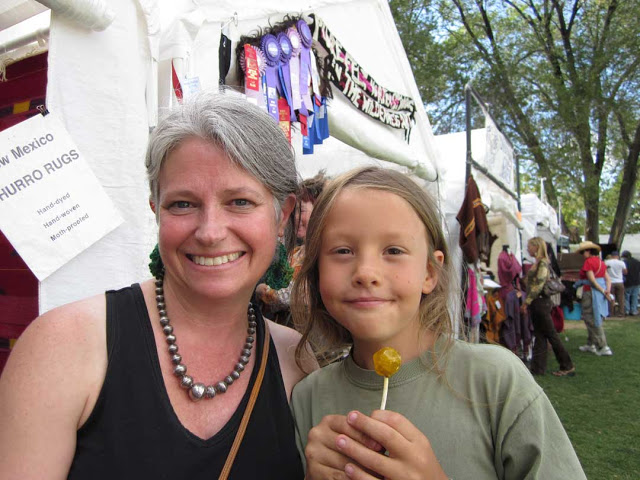
Saturday morning Emily and I headed over to El Rito, NM, a small town 15 miles north of Abiquiu and about the same distance west of Ojo Caliente.  I lived in this little town for about 3 years and was excited to return and see some of the old friends there.  Sara and Sierra were happy to tour us around El Rito for their annual studio tour.

My best buds Sierra and Sara outside Julie Wagner's studio

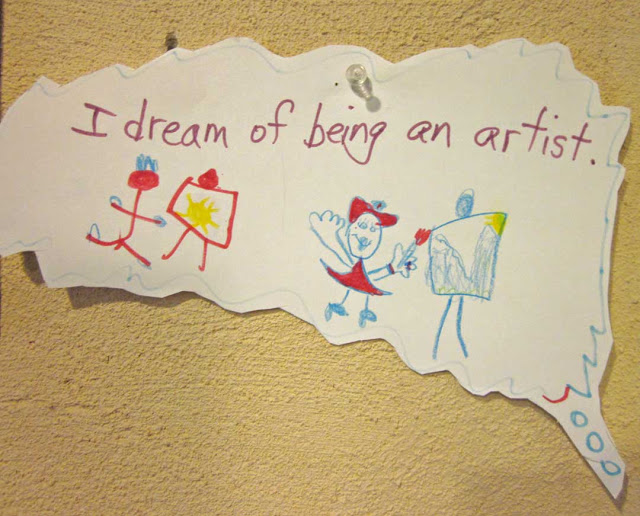
A young artist's work at the El Rito Public Library where they also have an event called "Death by Chocolate".  I think it speaks for itself. (Thank you to the person who made a batch of gluten free brownies!  I increased my donation at that point!)

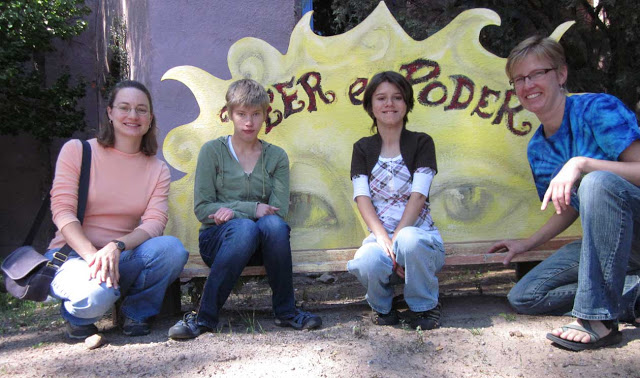
The gang with the Leer es Poder sign outside the library.

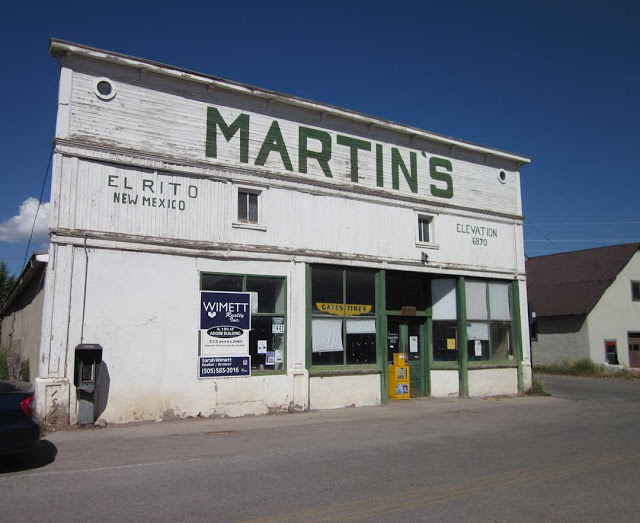
I used to live virtually next door to Martins grocery.  It closed its doors a few years ago and I miss walking through the dusty aisles marveling that you can get potted meat ALL over northern New Mexico.

We visited a friend and artist from my days of living in El Rito, Julie Claire.  Julie and I talked a little about her intuitive painting workshops which she does through her coaching business, Full Bloom Coaching in both Santa Fe and El Rito.  I have been intrigued by her process for years and hope to take one of her classes one day soon.  I think Julie can teach me to loosen up and let go of some of the things that inhibit my design process.  Tapestry is such a rigid medium in so many ways.  Once the design is finished, I pretty much don't deviate from the cartoon after I start weaving.  Yes, there are occasionally small changes I make as I go along--shifting a color or changing some highlights.  But the process to that point which includes a trip to Santa Fe to have a cartoon enlarged by a blueprint shop not to mention the days of dyeing to come up with the exact colors for the piece mean that I am unlikely to deviate from the design once it goes to the loom.  And weaving a tapestry can take months... following your pattern.  This process seems to lend itself to rigidity of the mind... and I would like to loosen things up a little bit.

In Julie's workshops as I understand it, you start with one large surface and start painting--and you keep painting on that surface.  Layers of pictures happen and you have to be willing to let the one you were working on go and let it change into something else.  And isn't that how life works anyway?


Woven Stories: Weaving Traditions of Northern New Mexico

Saturday after spending time at the Taos Wool Festival, I went to see the new film by Andrea Heckman, Woven Stories: Weaving Traditions of Northern New Mexico.  This was the U.S. premier of the movie and was screened at the Taos Center for the Arts.

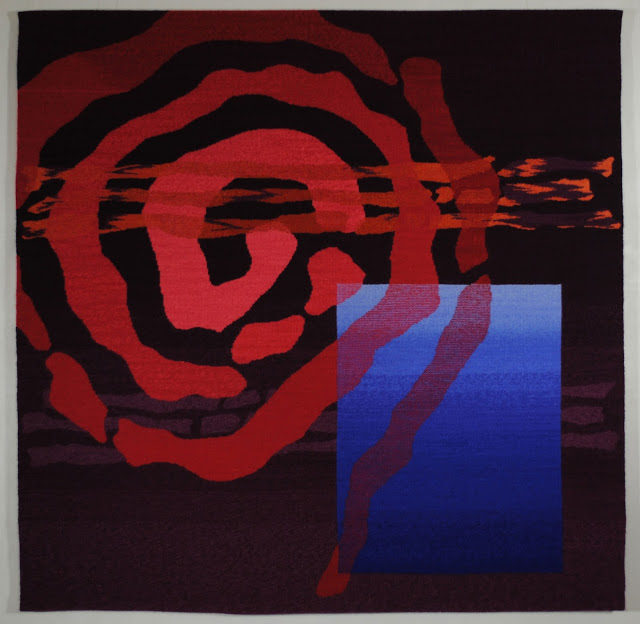
First I want to admit to the 100+ people in the audience that yes, it was me who shouted out, "Hey! That's my piece!" at the beginning of the movie.  I know that is probably not cool.  But I was excited to see my piece, Emergence II featured twice in the film. (I also admit that the ONE margarita I had had an hour earlier at the Adobe Bar might have influenced the outburst just a tad.)

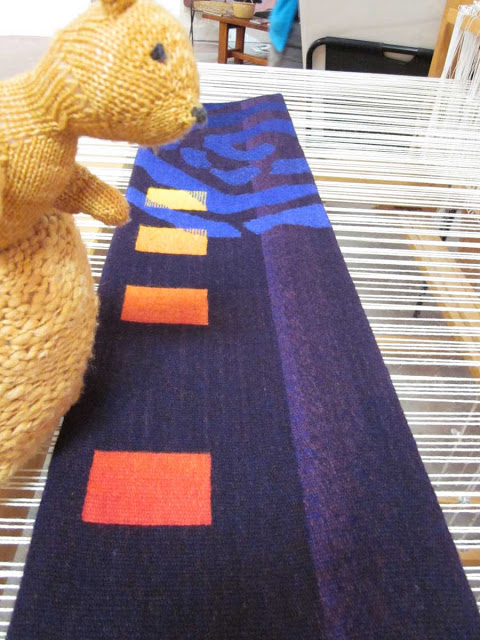
Rebecca Mezoff, Emergence II
45 x 45 inches, hand-dyed wool tapestry
This film is full of wonderful voices.  Rachel Brown herself makes an appearance.  Her granddaughter and owner of Rachel's contemporary tapestry gallery Weaving Southwest, Teresa Loveless, gives a lot of information about Rachel's contribution to fiber art in northern NM.  Teresa is also featured dyeing yarn for the gallery's yarn store.  There is a Lisa Trujillo Chimayo weaving class filmed in the gallery with some thoughts by Lisa and the participants.  There are stories from Kristina Wilson and many other long-time tapestry and fiber artists in New Mexico including Tierra Wools, Espanola Valley Fiber Arts Center, the Mora mill, some sheep breeders, and a little bit about puebloan weaving at Taos Pueblo.  My first tapestry teacher, Karen Martinez, talks about teaching tapestry at Northern NM College.

Fred Black talks about tapestry being like "frozen music" with its melodies and movement which I thought was a lovely metaphor.


Andrea also has a book called Woven Stories: Andean Textiles and Rituals.  The film can be ordered from www.stonecorralmedia.com.  The direct link to the page with the DVD is HERE.

Taos Wool Festival 2011

Every year (if I possibly can), I go to the Taos Wool Festival.  Emily says this is because "that is where my peeps are."  I'm not sure if she is talking about the alpaca, the churro sheep, or the people (or maybe just the cinnamon almond vendor), but I do enjoy spending some time there every first weekend in October.

The Taos Wool Festival is run by the Mountain and Valley Wool Association and this was their 25th year.  Their mission is to promote Colorado, New Mexico, and Texas wool, animal fiber, and their products.  For more information, their website is HERE.

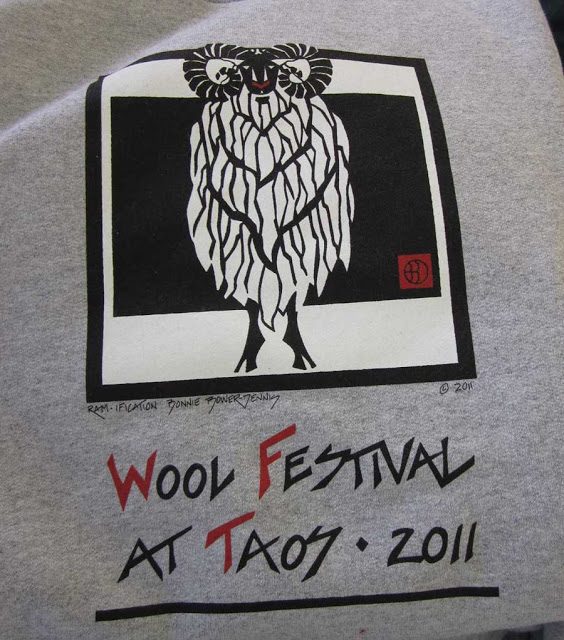
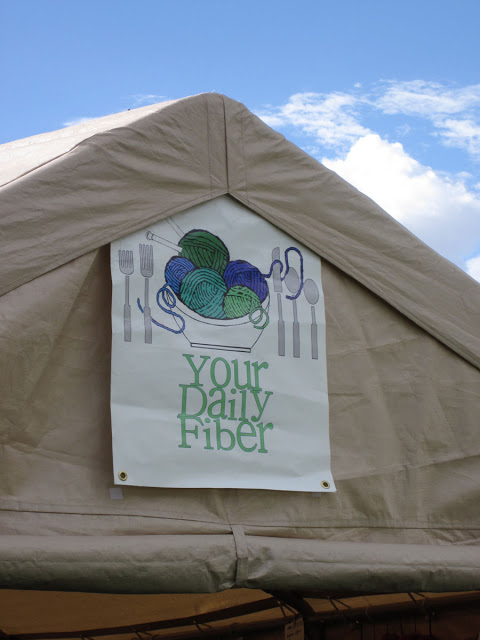
I usually buy a t-shirt... and I liked the logo a lot this year... but even though it was only Saturday afternoon, they were out of any shirts in my size in a color I liked, so I settled for this photograph.

Disclaimer: no animals were harmed in the making of this blog post... and there are some shots of a naked churro sheep so if that sort of thing makes you woozy, you might want to skip the rest.

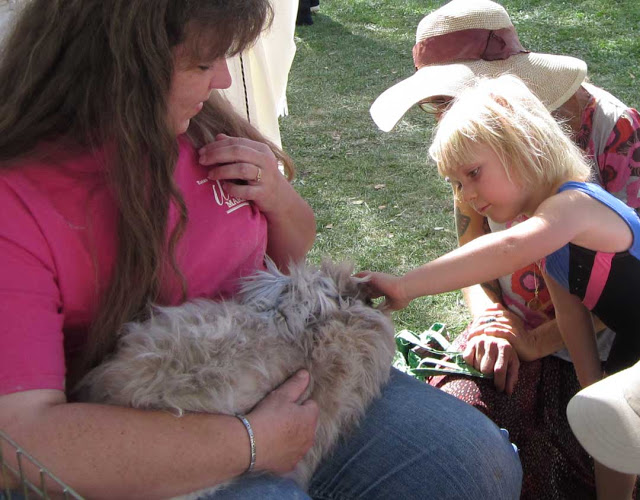
There are lots of animals every year and I love seeing the angora bunnies.  This little girl settled in to get acquainted with this rabbit.

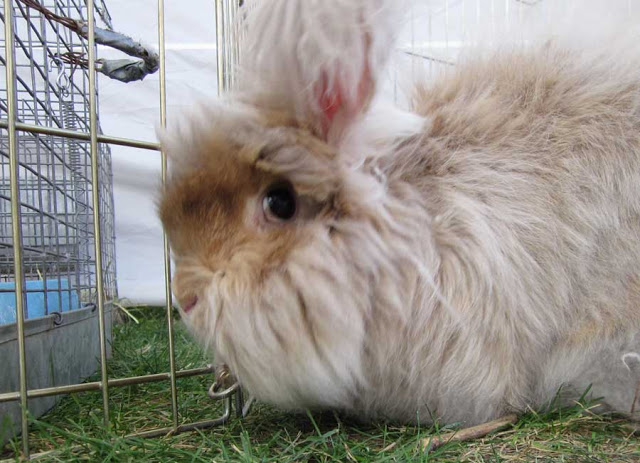
I think this one is giving me the bunny evil-eye.  Admittedly I was stalking him with my camera and I couldn't get him to hold still enough to get a clear shot that included his long shaggy ears which stood straight up.  The woman minding the bunny cages said he was an English angora (I could have that wrong, things were a little confusing at that point)... and his ears were a hoot!  He wasn't amenable to a photograph though.

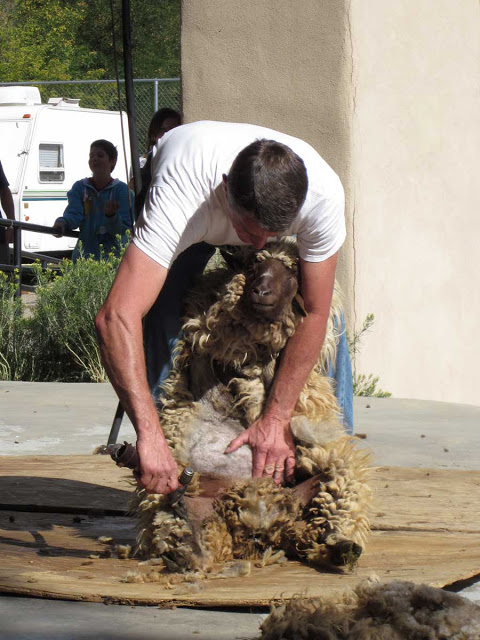
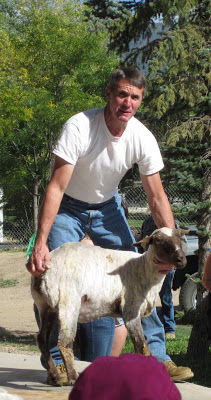
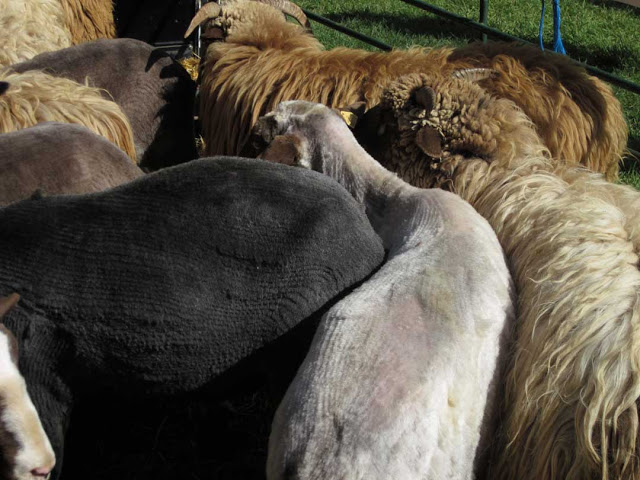
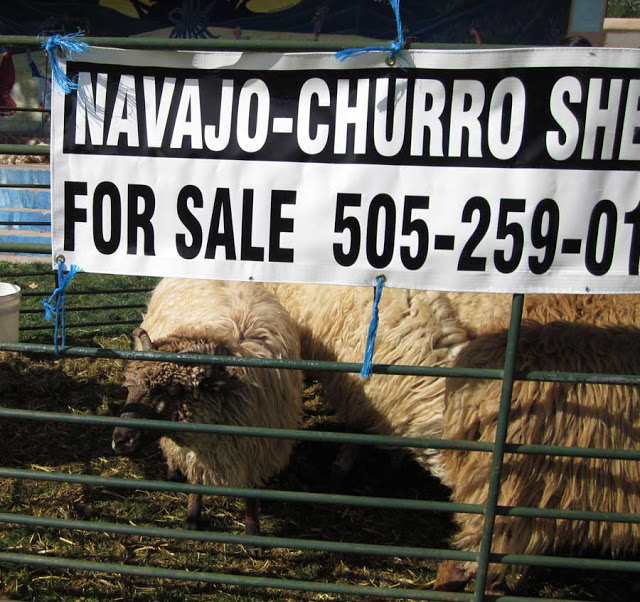
There was a pen of Navajo Churro sheep and we did get to see one shorn (turn back now if you don't want to see the naked sheep!).  Churro are the prize sheep of the Navajo.  I recently watched the movie "A Gift from Talking God: The Story of the Navajo-Churro" which you can find out more about HERE.  It is a wonderful documentary about how the churro sheep were almost wiped out and brought back to use in this region of the United States. They are highly prized for their double coat and their low-lanalin fleece as well as for their meat.
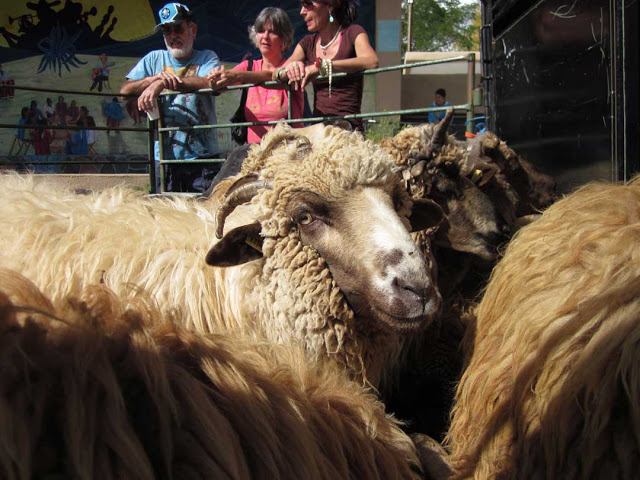
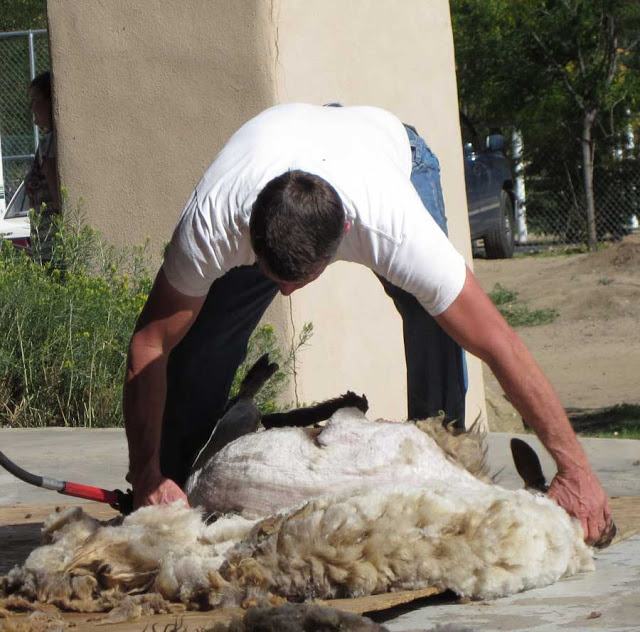
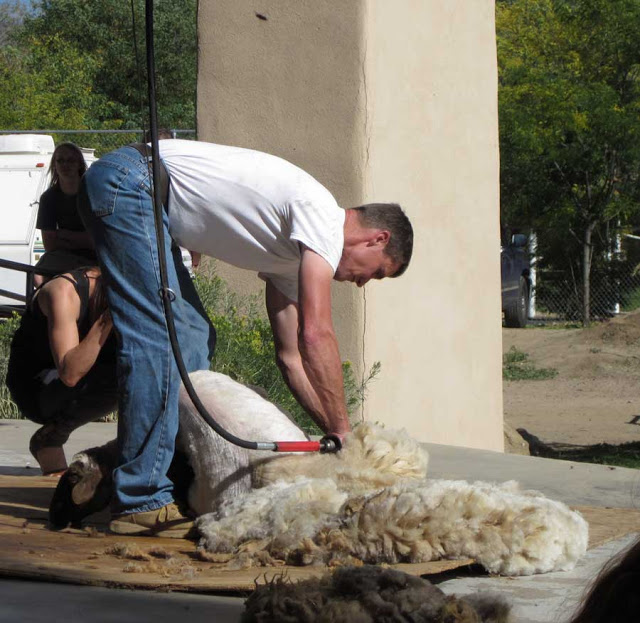
I don't know the name of this sheep shearer, but he was fast and I didn't see any sheep blood flying either.  It amazes me how the sheep just lay there.  About 6 years ago I saw a traditional shearer in El Rito using clippers shear a sheep almost as fast as this man did with his electric set-up.  When the sheep is turned upside down, they just go limp.  Robert, the El Rito shearer, told me that it was hard-wired into their brain because they are prey animals and when they are flipped over they are most likely going to be killed, so their brains just shut off. 
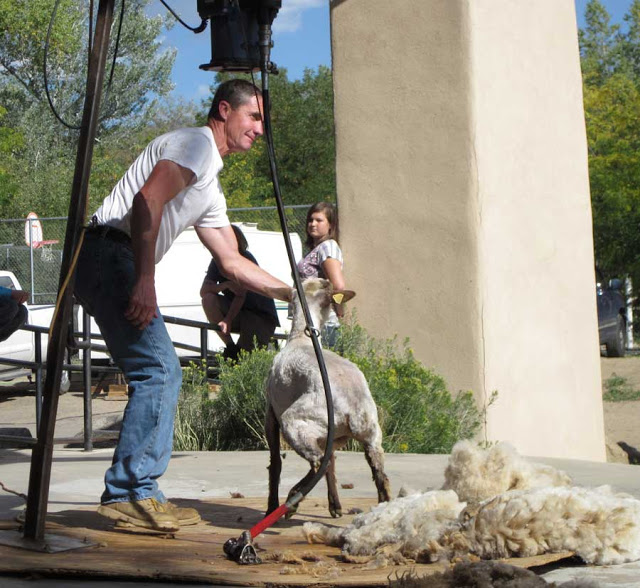
The whole thing only took a couple minutes.

Here he is after being let back into the churro pen.  I'm pretty sure at this point he was thinking, "Whoa, something is radically different..."

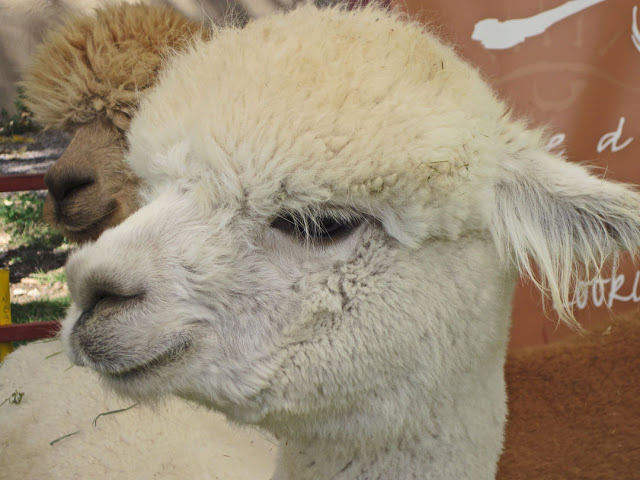
There were alpaca, which are my favorite.  This one was crying and the handler said they make the whimpering noise when they are distressed.  By Saturday afternoon he had probably had too many people taking photos of him.  Sorry dude.

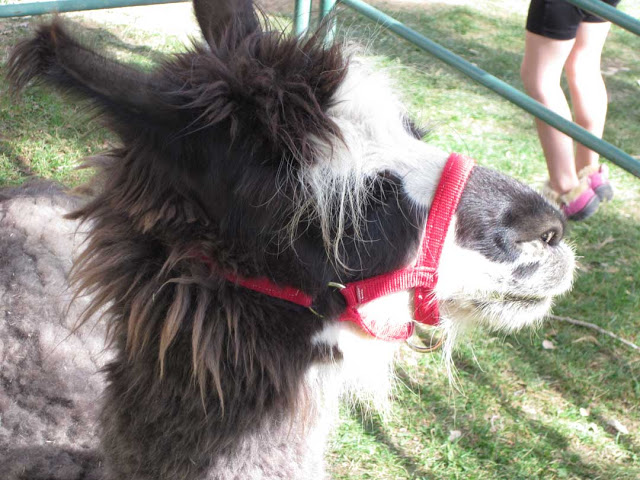
Llamas

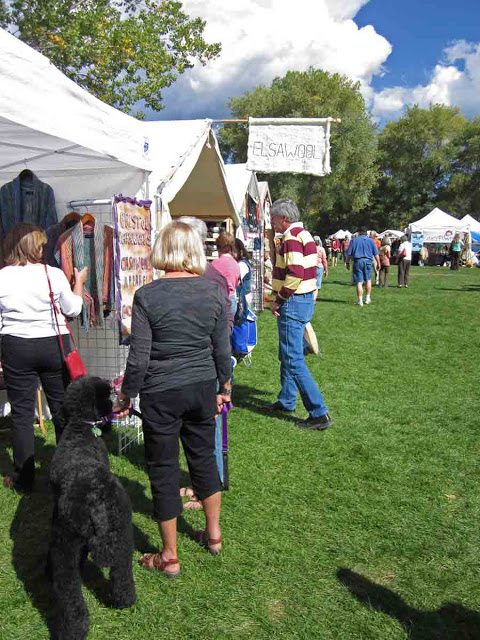
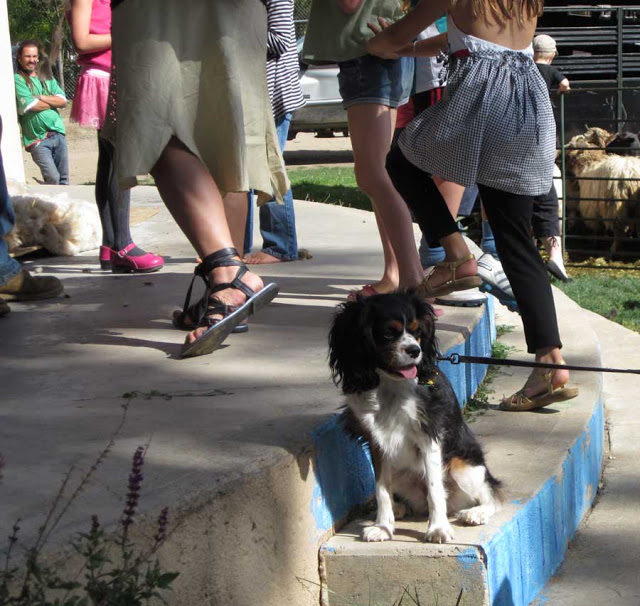
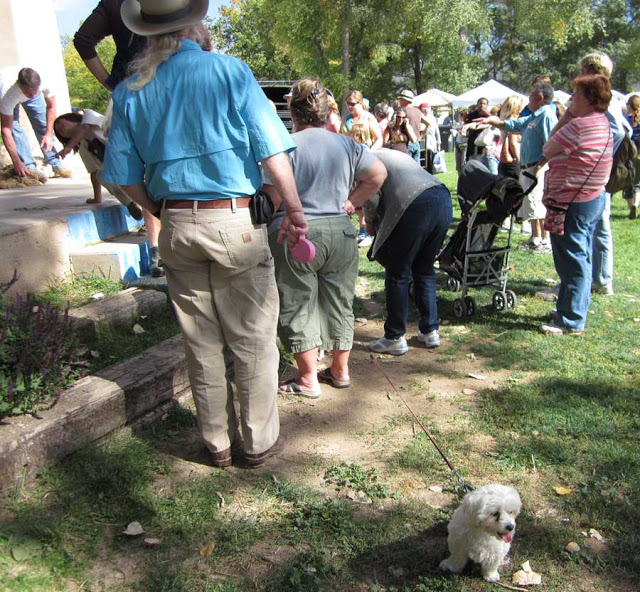
And there were dogs everywhere.


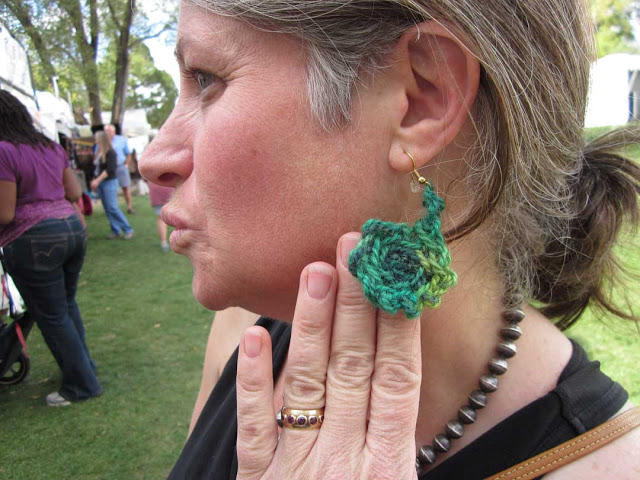
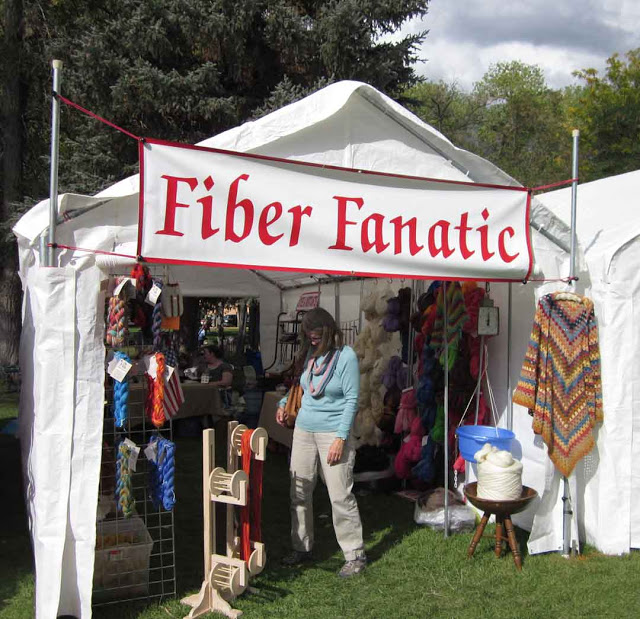
And of course we can't forget the actual fiber booths.  There were marvelous tapestries and rugs by Fred BlackBettye Sullivan, and Alex George Sullivan.  When I got to the Sullivan's booth, the person wearing Bettye Sullivan's name tag was definitely not Bettye (and I had NOT had a margarita yet).  It was Julie Cloutman of Taos Fiber Arts who was running the booth for the Sullivans that day.  Julie was sporting a fantastic pair of knitted (or they could have been crocheted, the artist is multi-talented) earrings.  The artist was the offspring of the people running the felting booth next door.  Here are the earrings and Julie with the artist himself.  I regret that I do not know his name, so if anyone does, please comment and I'll credit him!  He did win a ribbon in the youth competition for a rather conceptual piece of crocheting which was a long chain with loops--aptly titled "Scarf".

10/9/11: And Martie of Taos Sunflower  just told me that the young artist is Chakotay Mitchell, son of Merce Mitchell of Pure Felt.  Thanks for the information Martie (your yarn shop was my very very favorite for so long, but I sure understand the need to do other things!) and to Chakotay for his great fiber art!


There were marvelous signs, and of course fantastic amounts of fiber.


I'm kind of sorry it is over for the year.  I didn't buy any yarn.
Hannah Haworth and the roving prairie dog at Weaving Southwest

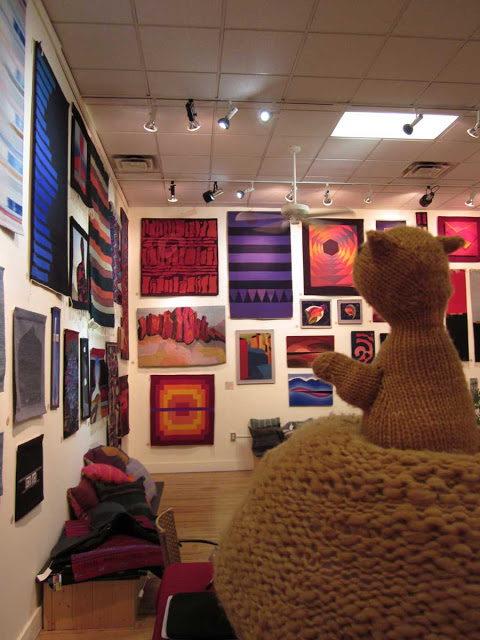
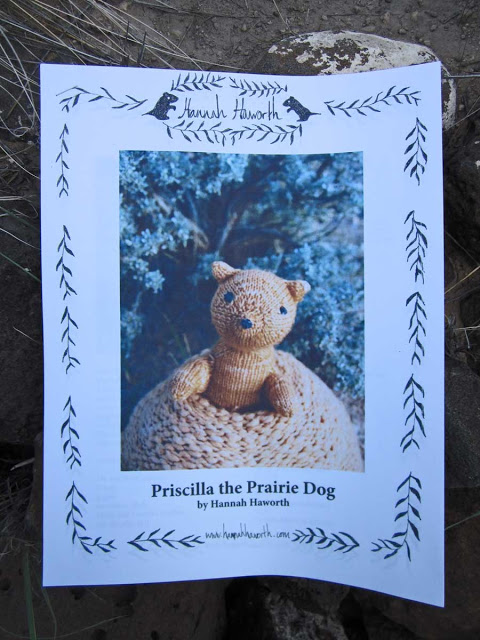
I visit Weaving Southwest fairly frequently.  I like to visit my tapestries and see which ones have gone home with someone.  Plus the people there are just so fantastically friendly!  Hannah Haworth is a fairly new addition to the staff there and she is a knitting goddess and wonderful artist.  This past weekend on one of my trips through the gallery (of which there were at least three), I spotted this little guy on the counter. Priscilla the Prairie Dog.  And she comes right out of her little prairie dog hole and roams around the gallery.


She seemed awfully interested in looking at my tapestries actually! (Admittedly I might have encouraged that a little.)

Priscilla looking at Emergence III

Priscilla checking out Emergence I and the other beautiful tapestries.

Fortunately for us, Hannah has written a pattern for Priscilla and you can get it at Weaving Southwest and on Ravelry HERE.  I definitely went home with a copy.  She is writing new patterns as we speak, so keep an eye on her!


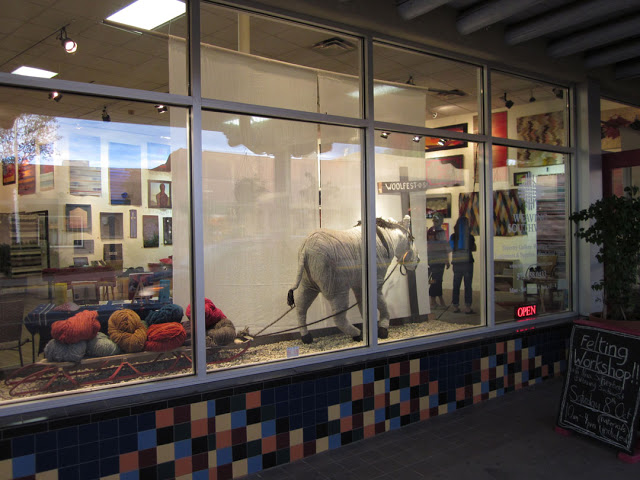
Hannah is also the one responsible for the new window displays at Weaving Southwest.  This one is in the front window.

And this very cool tree with autumn leaves made from Weaving Southwest tapestry yarn is in the back window.

If you do nothing else, go to Hannah's website HERE and look at her amazing work.  Also look through her blog.  It is wonderful to see my New Mexico homeland through the eyes of someone from over the pond (Scotland, right Hannah?). New Mexico shimmers through her eyes.  She is a wonderful addition to Weaving Southwest and I'm so glad she is there.  Thanks Hannah.

Cochineal: there is bug blood in your cherry coke!


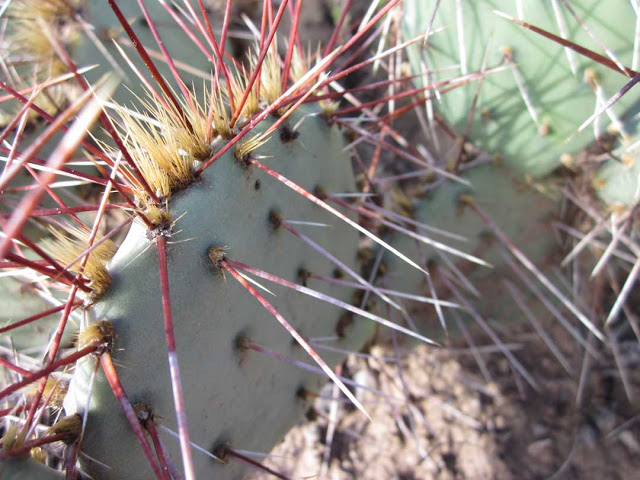
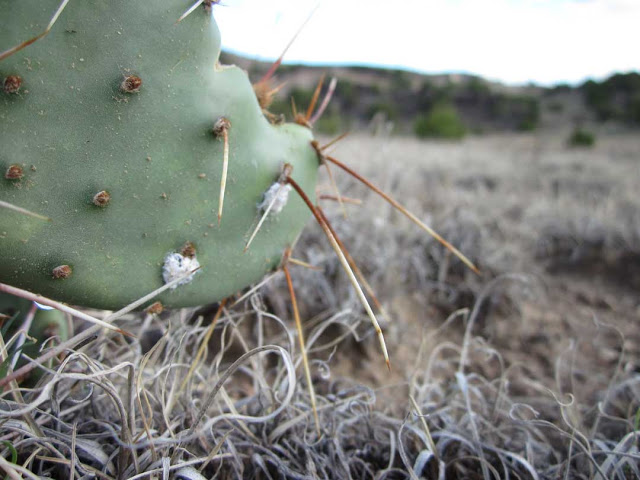
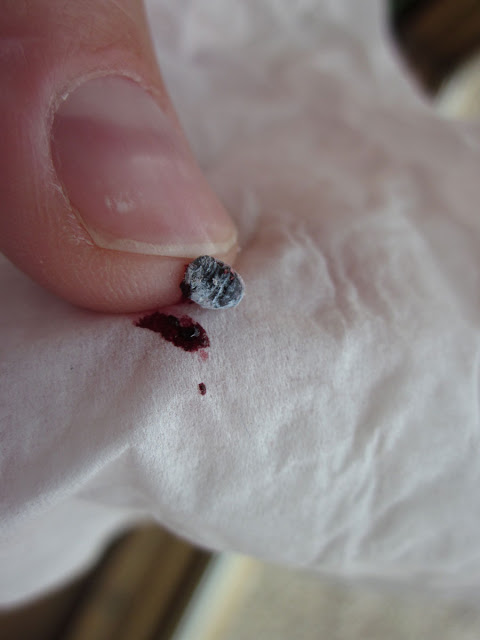
My landlady wrote a book (Life on the Rocks by Katherine Wells) which mentions cochineal on the mesa and I remembered a couple years ago seeing some white fuzz on some prickly pear cactus a mile or so from the house.  This morning in the rain I went back to check, and sure enough, it was cochineal!
After some online research and a return to the Colorways Summer 2011 online magazine (there are some fascinating photos in the article in this emag of the bugs on the cactus: "Sell me your gold, silver, cochineal..." by Linda Ligon) I learned a few more things about cochineal:

  • There are about 70,000 bugs in a pound of cochineal.  I won't be using the ones on my mesa any time soon for dyeing.
  • The insect produces carminic acid (17-24% of the weight of the dried insect per Wikipedia--which we all know is ALWAYS correct) which is used to make cochineal dye.
  • It used to be used extensively for dyeing fabric, but now is used largely in the cosmetics and food industries as a red dye.  At least it isn't carcinogenic!
  • The insects create the powdery/webby patches for protection, camouflage and to prevent dessication.  My cochineal bugs were very well protected as the bugs were deep inside their webs.
  • They like prickly pear cactus the best.
  • They do range into NM but are generally at lower elevations than this mesa (about 5,600 feet)


  • When their eggs hatch, the nymphs crawl to new areas on the cactus or using the waxy substance they are surrounded with, "balloon" to a new host cactus.  Then--get this--they start feeding on the cactus, molt and lose their legs. (!)  That would seem to make further transportation a bit difficult.
  • It looks like cochineal currently sells for twice the price of silver by weight.
  • I found this interesting cochineal farm in Oaxaca that gives tours.  And they have a workshop you can take about cultivating cochineal.  This sounds like my kind of vacation!  Unfortunately I'd probably have to move south to grow them in the US.  It'll be hard to dye much yarn with 10 bugs... and I don't want to kill the entire crop either.  Unfortunately dyeing with them seems to involve death on the part of the bug (when they are pregnant!).


  • And after all this fascinating information, I had to pull out my color books.  From Colors: What they mean and how to make them by Anne Varichon, I found out that there are actually three primary kinds of cochineal.  Besides the Mexican kind that live largely on nopal (prickly pear) cactus, there is the Armenian cochineal which lives on reeds and grasses in Armenia and Turkey and the Polish cochineal which feeds on German knotgrass and lives near the Baltic Sea and in the Ukraine (p 124).
  • Some history from the same book (p 124): dyeing with cochineal seems to have been done since about 700 BCE in Peru and large fields were cultivated long before the arrival of the Spanish.  The Conquistadors realized that this insect represented enormous wealth and escalated production.  Starting in 1520, they exported hundreds of tons of cochineals to Europe and around the world.
  • The annual yield of the nopales fields in southern Mexico can be 264 pounds of insects per acre.


"Spanish Red, I noted in my diary that night, is usually born between the fog and the frost in places where land is cheap and the prickly pear, on which it is a parasite, grows in abundance on the desert sands. It is a holy blight, a noble rot where the treasure is rubies rather than the gold of dessert wine. It is a deep, intensely colored organic red, but it will never be used for Buddhist robes because there is too much death in it. In the twenty-first century women around the world coat their lips with insect blood, we apparently dab our cheeks with it, and in the United States it is one of few permitted red constituents of eye shadow. 'And finally,' I wrote with a happy frisson, 'Cherry Coke is full of it; it is color additive E120.'" [Finlay, V. (2002). Color: A natural history of the palette. New York: Random House. p 137-8.]

Weave well friends! (and when you dye with cochineal, remember all the little bug souls)


Of bumblebees and Taos Fiber Arts

I went to a needle felting class yesterday at Taos Fiber Arts.  Julie and Ashley Cloutman (a mother-daughter team) are a great combination--and they are a lot of fun.  I know Julie because she has sold a whole whack of my tapestries at Weaving Southwest... and anyone who has that much good to say about me must be one fantastic lady. 

Ashley spent a couple hours teaching me the fine art of 3D needle felting--and repeatedly reminding me how not to stab myself.  She was really good at this.  I think she has been stabbed a few times (sharp needles with barbs!).  I only caused myself to bleed once in two hours which I thought was pretty good considering my unfamiliarity with the techniques and my general clumsiness.  Her set-by-set approach and excellent creativity (not to mention humor) makes her a very fun teacher.  (She also has a great line of zombie attire and felted objects. I suspect with the right marketing these could become a craze which would support Ashley for a very long time.)

Julie and Ashley Cloutman of Taos Fiber Arts.

 SHARP needles!

My project started out looking like this (and though it looks simple, it was not easy to get a head and body to the shape I wanted!):
And within a couple hours, had become this funky sort of bee dude:
Notice his little stinger... and purple shoes... and long purple hair...
Ashley started this great Frankenstein figure.  I love the neck bolts... not really sure how she did that.

Taos Fiber Arts has beautiful fiber like this detail of a felted shawl with yarn trapped between the layers (made by Ashley).  They have hand-dyed yarn, roving, clothing, felted scarves, weaving, and will teach you many fiber techniques (including multiple felting techniques--I'm going back for a nuno class sometime and maybe another needle felting class.  Julie also teaches weaving!).

They also have a great collection of old signs (many from Taos Ski Valley) and other fun elements.


Go visit them. 
(P.S. They are fairly easy to find behind the plaza and... they have parking!)

Oh, by the way, the inspiration for the bee I made was this baby sock I knitted this weekend.  Now I just have to knit the other one!  ...unless someone is having a one-legged baby... which might give me some occupational therapy business, but overall would not be desirable to the parents, I'm sure.

I hesitate to give the pattern (because I don't want my ultra knitting-talented relatives to steal my very cute knitting patterns before my niece or nephew is born), but will do so in the interest of not being accused of copyright infringement... because I am not a talented enough knitter to come up with this by myself.  I leave the creative coming-up-with-it-ism to tapestry design.  It is Bumblebee Socks from Knit Baby Head and Toes (ed Gwen Steege).  The pattern is by Barbara Telford.

LeClerc Dorothy loom for sale

Since this is my blog, I suppose I can use it to advertise a loom I am trying to sell!  Sorry for all of you who read this blog for more interesting content.  I once sold a Gilmore loom through the blog though, so maybe this will work.

The loom belonged to my grandmother.  See THIS post for the story about her.  Grandma hasn't used this loom for a long time.  In fact at least 15 years ago (maybe longer, the years have gone faster since high school ended), she gave it to either me or my sister (can't remember which!  My memory is kind of like a big room full of post it notes with vital information written on them and sometimes someone turns on an oscillating fan--yes, I stole that metaphor from Ellis Delaney).  We have passed it back and forth since and rarely used it.

It is a fantastic loom for weaving workshops.  You know the ones--you warp the loom up with some specified sort of warp and cart it into some conference center (usually 3 miles from the car and you wished you had brought that dolly that is in your garage) and all wide-eyed and eager, you are ready for your round-robin class... and everyone hates the colors your chose.  Or maybe they don't and you warped the loom beautifully and everyone else wants to weave on it and you never get the chance...  Anyway, it is a great workshop loom.  It doesn't work worth a toot for tapestry though.  Don't say I didn't warn you.

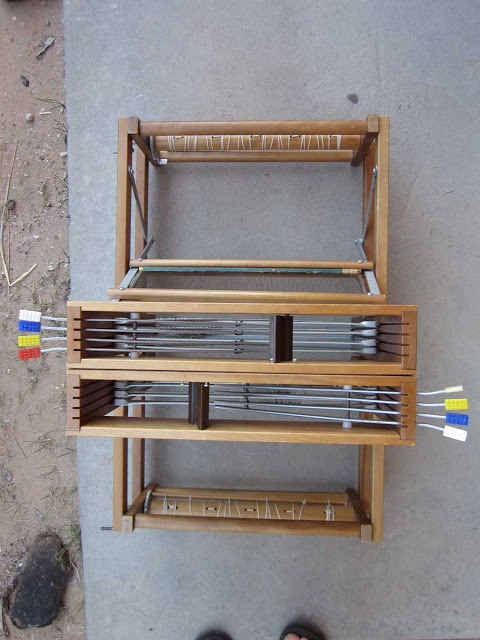
It is a great little loom.  15 3/4 inches weaving width, 8 harness with the ability to add 8 more.  It comes with a 12 and a 10 dent reed and the heddles that are on it (unless I can locate more in the depths of my studio--and believe me, there are depths!).


Side view
LeClerc Dorothy
View from the top.  Yes, one of the little plastic pieces is missing.  It may have been chewed by a dog or swallowed by a child (perhaps me!), or it might have just fallen into the junk heap of time.  It works fine without the plastic piece, though one could probably be fashioned out of sculpey clay if it really bugs you. The red one is missing.  Kids like red.  Maybe that explains all the gut troubles over the years.  Sigh.
Removing one of the castles.  Note the four sets of holes--two more castles could be added to make this a 16 harness loom.
These braces hold the loom rigid and can be lifted if you want to fold it.
Loom with one castle removed and folded. It will not fold unless you remove one castle (it is a physics thing--believe me, it won't)

If you look at this link to the LeClerc website, this loom is the one pictured in the box that says 8 and 12 shaft loom.  You might also note that the price for a new loom like this is $1172.

I'm asking $350 plus shipping to wherever you live.

If you, or someone you love would like to own this loom preferably sometime before October 1st, 2011, let me know!

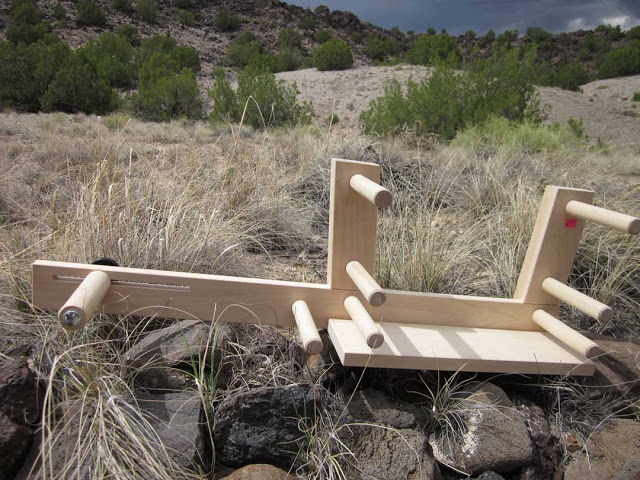
As an almost complete aside,  I also have another loom for sale.  It is a brand new inkle loom made by Schacht.  I know this is kind of cheating, but I received it as a door prize at a conference a few years ago and I already have an identical loom.  I really really don't need two.  So this one needs a new home.  They are about $75 new.  I'll send this one (in the box it came in no less!) to you for $45 plus shipping (and I'll only charge you exactly what the shipping actually is--I promise.  You can check the label when you get the thing).

Isn't this a nice product shot?  That is the price tag still on it.
I have a real fondness for Schacht.  Maybe it is the sheep in their logo.
You have to make your own heddles.  Sorry, that is how it is with inkle looms.
Those are all the looms I can bear to part with right now.