Tales of a Traveling Weaver, Chapter 2: Ancestral Puebloan Weaving

I woke up this morning, still in Cortez, CO (at the start of week number 10 of at least 16). I asked Emily what I could do for her today and she said, "I want you to get medieval on that tapestry." This is not only a testament to her dedication to me having weaving time, but a statement of how much more media-saavy she is than me.  Apparently that is a reference to the 1994 Quentin Tarantino film with John Travolta, Samuel L. Jackson, Uma Thurman blockbuster Pulp Fiction--which of course, being a bit media-challenged, I never saw. It is also a reference to the medieval tapestry tradition. I may have to add this phrase to my lexicon, though perhaps I should watch Pulp Fiction first.

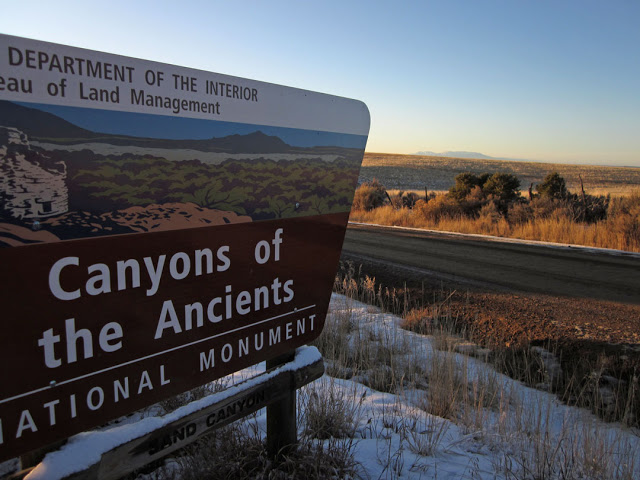
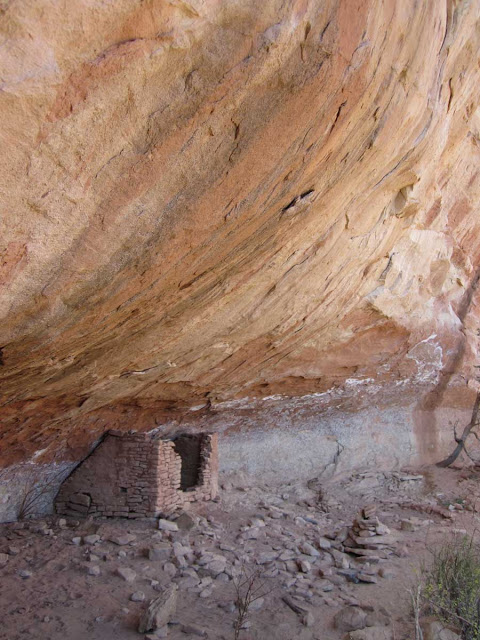
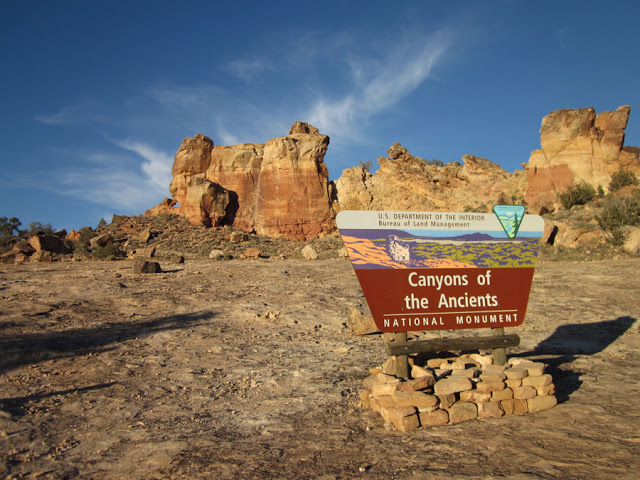
One thing I have greatly enjoyed about Cortez is that it is right in the middle of a huge archeological area.  It is estimated that this area around Cortez probably had a higher population in the ancestral puebloan times than it does today. There are literally archeological sites everywhere. The Canyon of the Ancients National Monument is a place with sites scattered all over this area, but they do have a visitor's center near the newly-created (at least relative to 1200 AD) McPhee Reservoir.

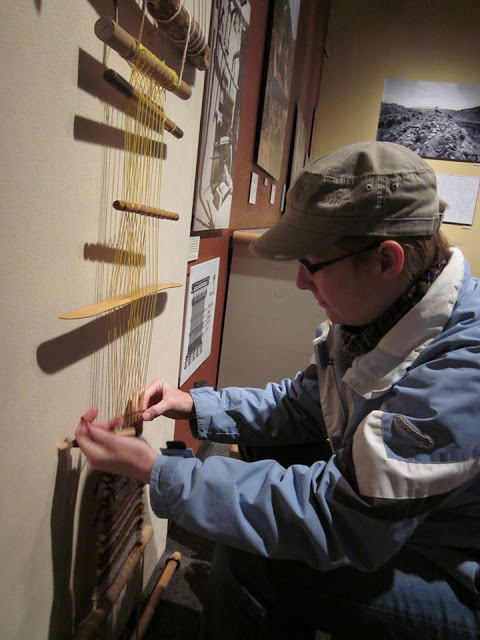
In the visitors center they talk a little bit about weaving and they have this practice loom set up with fairly good instructions on how to weave plain weave.
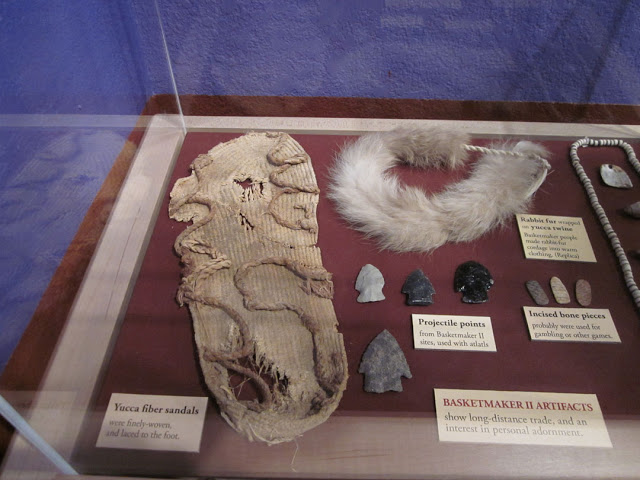
Before the Ancestral Puebloans had cotton, they wove sandals and bags out of yucca.

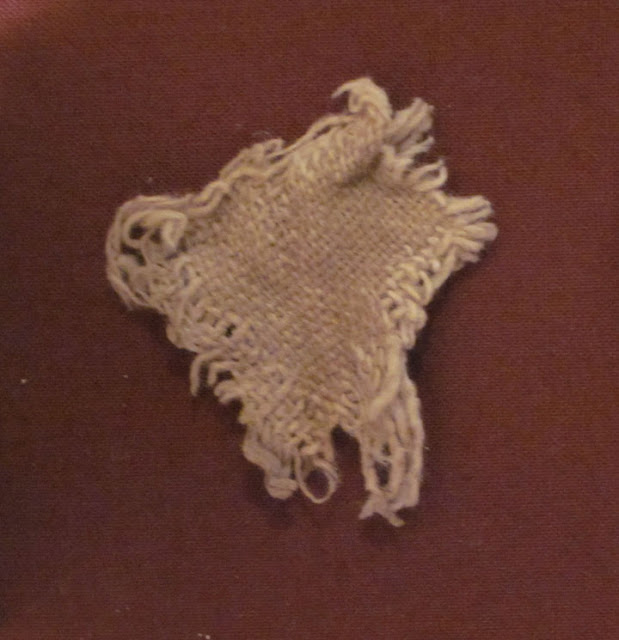
Fragments of woven cotton have been found--they were growing cotton.
Cotton woven fiber fragment

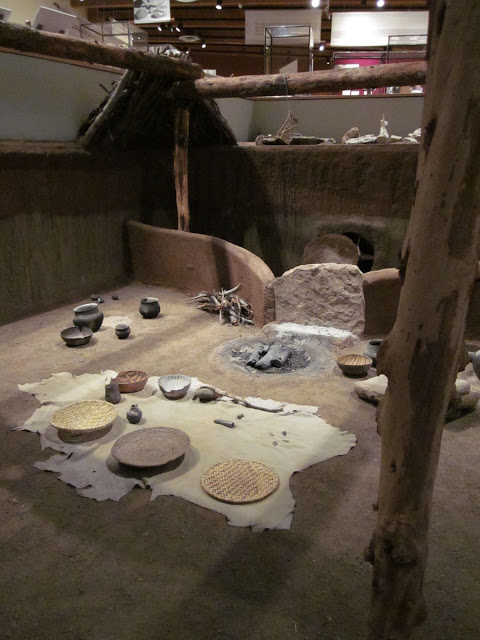
They also have a fascinating replica of a pit house which depicts dwellings from one of the Basketmaker eras.
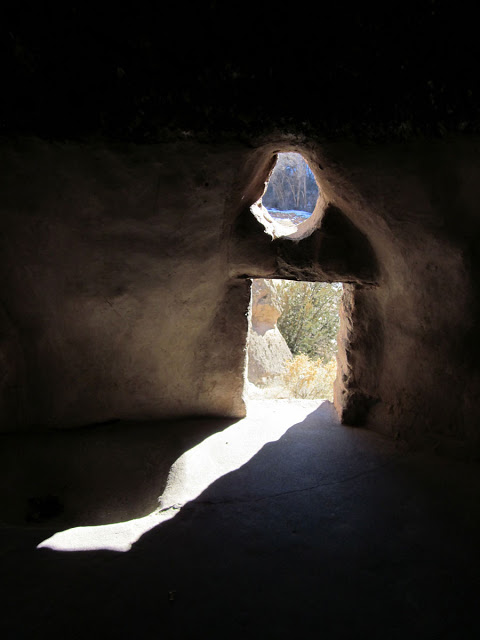
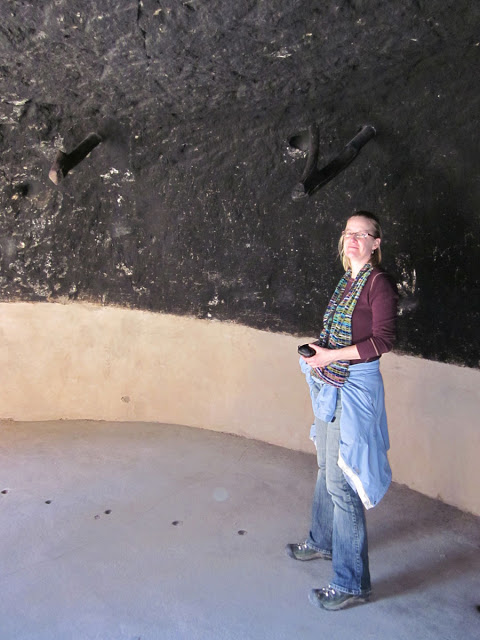
In further recent ancestral puebloan weaving explorations, you can see holes from looms in the tufa caves at Bandalier (see holes on floor and beams from ceiling)...


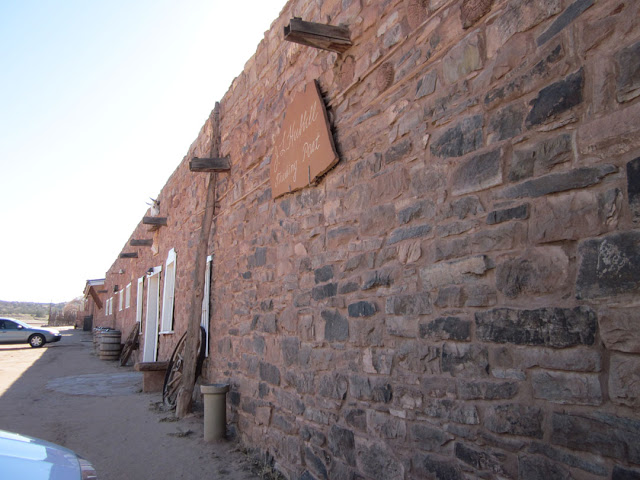
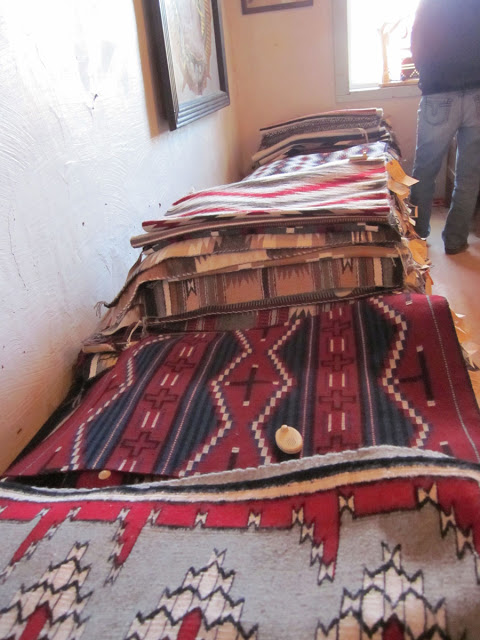
And over Thanksgiving I took a trip to Hubbell Trading Post National Monument in Ganadao, Arizona and Canyon de Chelly National Monument near Chinle, AZ. Hubbell's has a visitor's center which employs Navajo weavers and you can go there and watch them weaving intricate rugs. It is also still an operating trading post. You can pick up a coke, some feed for your chickens, a skein or two of local churro yarn, or in their rug room, a beautiful Navajo rug.


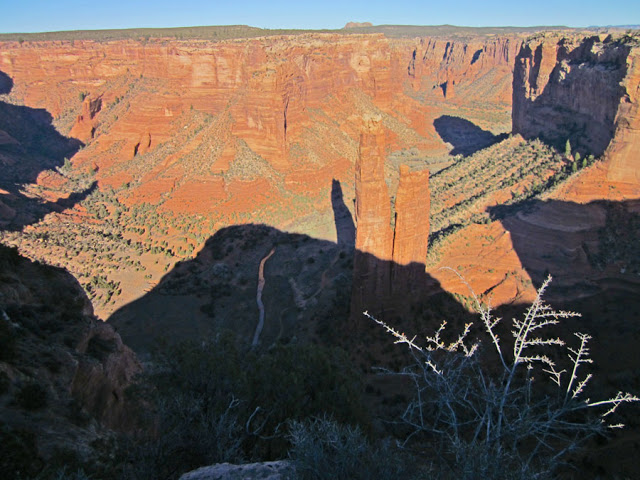
We also stopped for the traditional Thanksgiving tour of Canyon de Chelly. This is a rather poor photo of Spider Rock. My understanding of the Navajo creation stories is shaky at best, but one rendition is that Spider Woman made her home on top of Spider Rock. Spider Woman taught the Dine ancestors to weave on a loom. There are references to either Spider Woman or her husband Spider Man weaving the universe on a large loom.  I love this image--the world starting with a weaving... or the act of weaving.
And finally, I just got the latest Espanola Valley Fiber Arts Center newsletter and want to note that a Tiwa/Piro Pueblo weaver, Louie Garcia is going to be teaching some classes there. Our Southwestern weaving traditions are well saturated with Navajo and Hispanic weaving, but rarely do I see anyone talking about puebloan weaving. Here is a YouTube video where Louie is talking about his work. He talks about breath and spirit in every weaving and the spiritual aspect of pueblo culture.  It looks like he is teaching two classes at EVFAC in January and February.

(Also note that my colleague Cornelia Theimer Gardella is teaching some classes at EVFAC in the spring and I highly recommend her! She is teaching a color theory class with dyeing--so those students of mine who are asking about learning to dye and about color, consider taking this class. Check the EVFAC website for details or Cornelia's website as she is also teaching at Ghost Ranch.)


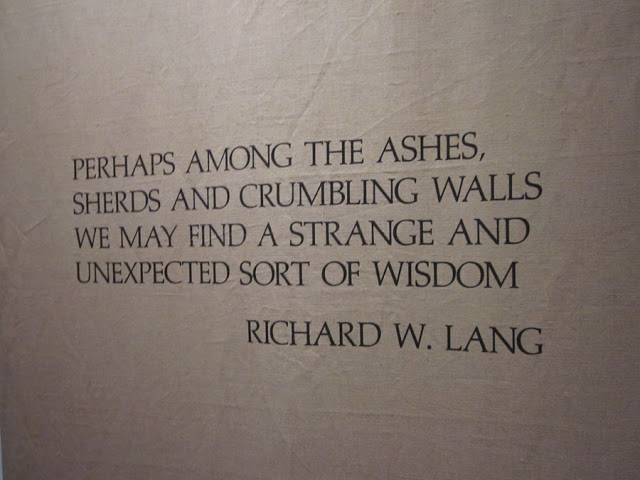
Maybe this is why I keep going back to these ancient sites:
Tales of a Traveling Tapestry Weaver, Chapter 1

So I am currently in roaming mode.  I miss my big loom and my shelves full of yarn, but it is interesting to experience a new place for 3-4 months. I am in Cortez, Colorado at the moment which near Four Corners--southwestern Colorado on the Great Sage Plain. Between hours of working at the hospital here and weaving on a commission, I have been doing a little exploring.


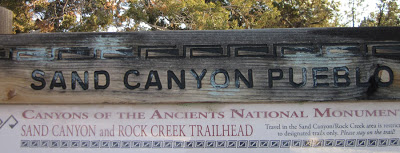
A trip to Sand Canyon Pueblo which is part of Canyons of the Ancients National Monument, revealed a beautiful canyon full of snow on the north-facing slopes and dry and warm on the south-facing slopes. The pueblo was built into the end of a side-canyon with full southern exposure.


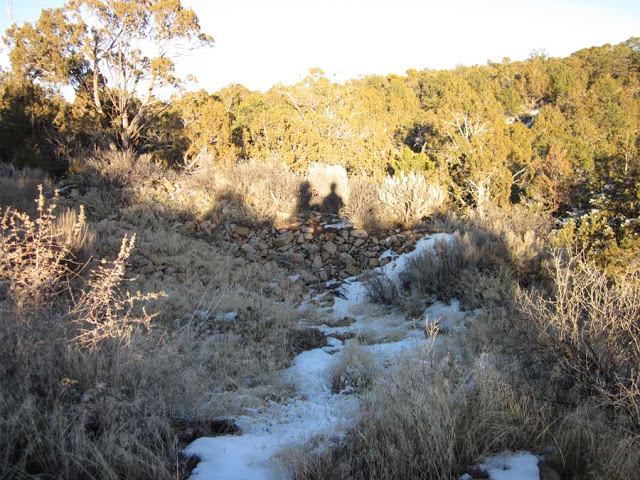
This pueblo has been partially excavated, but then filled back in to preserve the site. You have to use your imagination to see where the multitude of kivas and walls were.

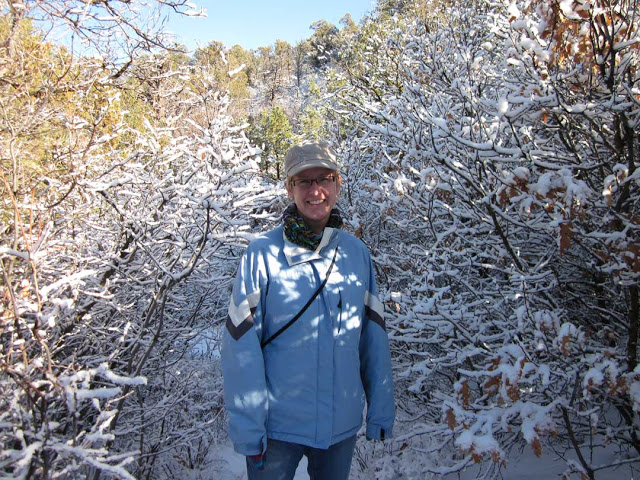
Hiking down the north slope of a beautiful canyon.

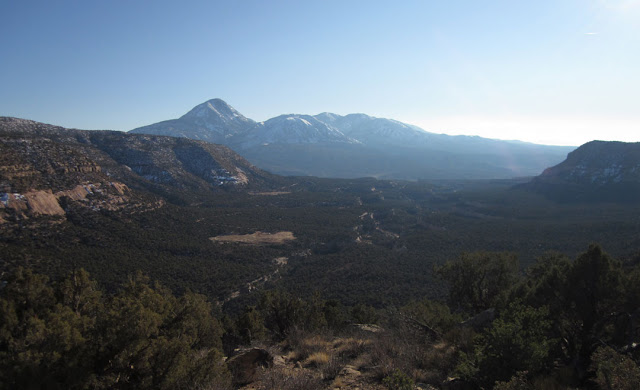
View south from the Sand Canyon Trail to McElmo Canyon and Sleeping Ute Mountain.
These new and wonderful places have become my inspiration. Walking lets me think and imagine and settle into the land.

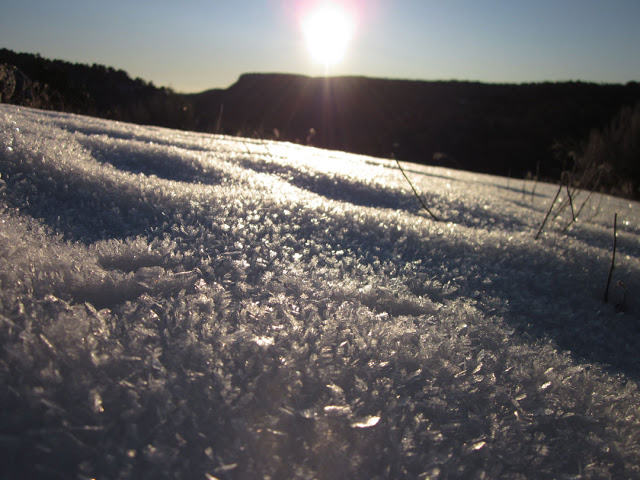
Below photo: sun setting behind the mesa at Sand Canyon Pueblo. The magic of these places is indescribable. Go out and walk, look around you, and listen for the older voices.

Who Does She Think She Is?


The elephant in the room is a big one. Women artists. We still are severely under-represented, underpaid, undersold.

Tapestry and fiber art in general is regarded by our culture as "women's work" (whatever that means!), and "women's work" is still, in 2011, not valued. How, in this climate, can tapestry be understood as a valuable, researched, academically supported, and economically viable art form if it is considered "women's work"?

These questions come from a film I watched recently called Who does she think she is? It is a documentary about successful women artists and their struggle to have their art recognized in the midst of the rest of their lives which include children and family and a lot of "women's work".  If you are a woman artist, please watch this movie (and thanks to Lyn Hart, tapestry artist extraordinaire, for telling me about it). It was released in 2009 by Mystic Artists Film Productions. Go to the website at www.whodoesshethinksheis.net to see a trailer.


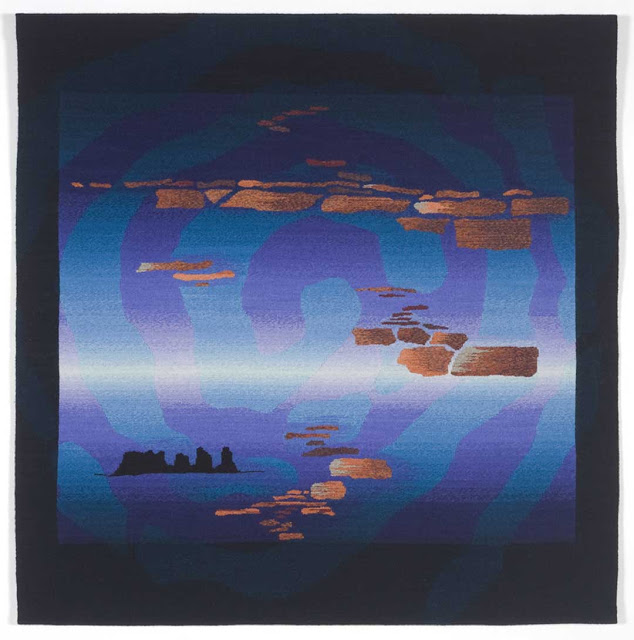
Emergence V: The Center Place

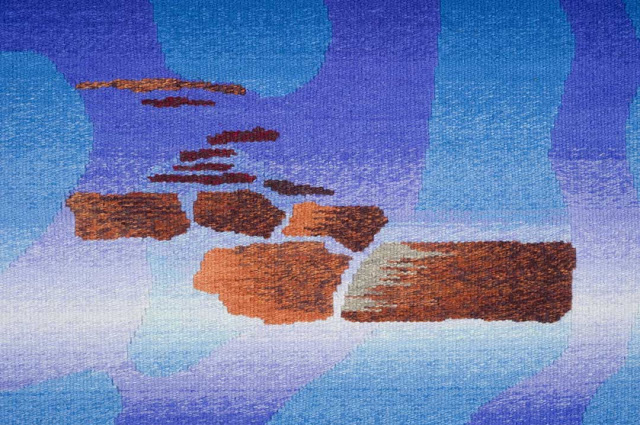
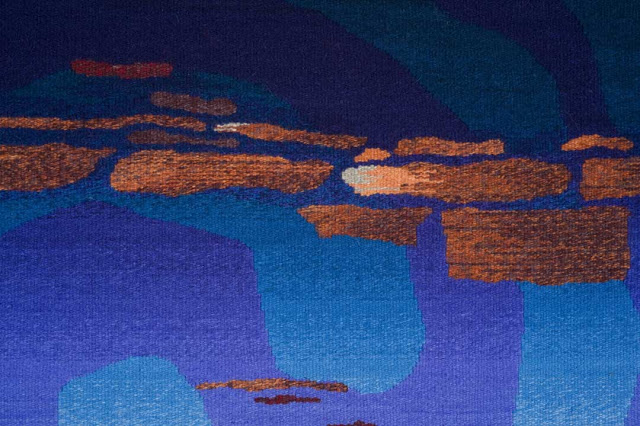
Emergence V: The Center Place, 44 x 44 inches, hand-dyed wool tapestry
photo: James Hart

This is the fifth piece in my Emergence series.
Here are links to the others (or you could just look at my website HERE to see them all):

Emergence I --the first of the series, helped along by some good solid design advice from James Koehler and woven while apprenticing with him in 2008-2009. It was in American Tapestry Biennial 8 as well as the Bauhaus show in Albuquerque in 2010. This tapestry is now at Weaving Southwest in Taos, NM

Emergence II --This piece was in the Bauhaus project (Interwoven Traditions: New Mexico and Bauhaus) show at Michaeliskirche in Erfurt, Germany. From there it went to Weaving Southwest in Taos where it was bought by a college in Colorado for their permanent collection.

Emergence III --This piece was in Fiber Celebrated 2011 at the Intermountain Weaver's Conference in Durango, CO in July 2011 and is now hanging at Weaving Southwest in Taos waiting for someone to take it home.

Emergence IV --This piece is at Weaving Southwest also.

This piece started coalescing in my mind when I was at Chaco Canyon the day James Koehler died. You can see what I wrote about that time HERE.
The feeling of expanding horizon in the desert southwest is important to me. Chaco Canyon is a place where the sky is huge and I am but a small observer of the shifting universe.
The questions about ancient people and the artifacts and unanswered stories they left behind are also endlessly intriguing to me. This piece is full of questions.


Tapestry weaving and the nature of an art form

I picked up Joan Potter Loveless's book, Three Weavers again this morning (of all things, I had to buy another copy of it because mine is buried in a storage locker, but I needed this particular book and bookfinder.com almost always pulls through). I had forgotten that she studied with Anni Albers at Black Mountain College (and took color classes with Josef Albers).  Perhaps this book should have been on the Interwoven Traditions: New Mexico and Bauhaus reading list.

Here is a quote from page 17 that got me thinking of other aspects of tapestry weaving and more questions about why contemporary tapestry is most often not considered an art form by the larger art world (though historical and traditional tapestry often are--why is this?).

Even though, in one sense, the "evolution" of handweaving can be seen as a progression toward more ease, more efficiency, with the development of equipment and tools that accomplish these things, this is not a true picture of what weaving is all about. Weaving in the present is also, and most importantly, all of the minute, separate, weaving occurrences that have gone on in the past, all of the particular, individual, bits and pieces that have been woven in the the past by people sitting at looms or simply twining fibers into some form.  The satisfaction that we derive from being involved in a piece of weaving is exactly the same satisfaction that weavers always have derived from their work. Our work is no better; often it is not nearly as good. Weaving is not involved with the concept of progress; it is much more concerned with holding still the moment, with savoring and with marking it, with this still very simple participation with the fibers that we find around us.

Is this a common perspective among tapestry weavers? (and keep in mind that this book was published in 1992). I feel that meditative aspect of weaving almost every time I sit at the loom and I believe other weavers do also. Is there a fundamental rift between the glittery, monied art world and the slower universe of the tapestry weaver that we just can't overcome? Probably this is just one very small part of the problem of tapestry's place in the larger art world. After all, I imagine all artists have to find that meditative place when they are creating and thus experience this glaring difference of realities when faced with marketing and showing their work. But are tapestry weavers particularly inhibited by the slow plodding nature of our work when it comes to marketing and professional issues?


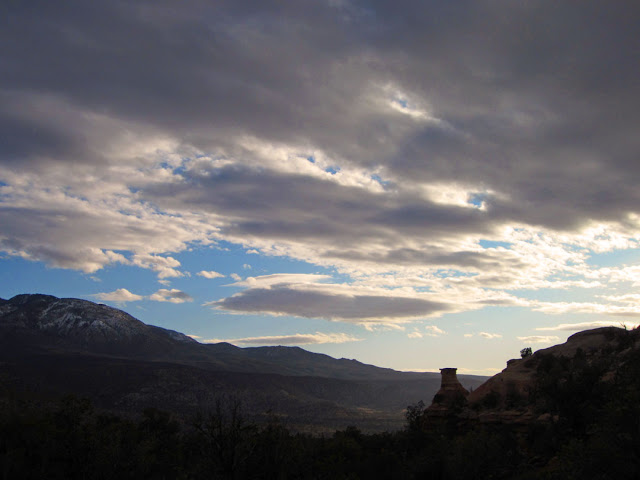
(photos Canyon of the Ancients National Monument, November 12, 2011)

A traveling tapestry studio

I am in a bit of flux.
A state of flux (which reminds me of Back to the Future I'm afraid... which tells you about when I was a teenager) which is unlikely to resolve soon. So for the present moment and until at least January, I am living in Cortez, Colorado. We were hoping for Durango, but it turns out Cortez is okay. It is surrounded by mountains (Sleeping Ute, Mesa Verde, La Platas) and isn't all that different from the small NM towns I'm used to--except there seems to be a lot more white folks here... that kind of throws me off a little some days. I'm working here as a traveling occupational therapist (which just means that the job is temporary and someone else finds me housing).

So my studio has to be a little bit more portable. This is my Macomber workshop loom which found a place in my car (and many things had to be rejected so the looms could fit in--my car is small! But who needs extra shoes anyway?). This loom, or so she says, was my grandmother's first loom. She is a little creaky now and I'm not at all pleased with the lack of very tight tension (okay, it is pretty darn good for a little folding loom, but it isn't the Harrisville!) and the tiny beater, but overall she weaves a straight fell and creates a nice tapestry cloth. What can you expect from a loom that is at least 50 years old? In fact, Grandma insists that this was Mrs. Macomber's own loom which she sold my grandmother upon request.  I never quite bought that story, but have no way to verify it, so perhaps Grandma is correct. My grandmother gave it to me years ago with 4 harnesses in the 8 harness castle.  The last time I worked as a traveling OT (2003-4), I added 4 more harnesses to it, so now it has 8. I just called up the Macombers (they don't have a website, don't even look), gave them the serial number of the loom conveniently etched on a metal plate attached to the loom, and they undoubtedly sifted through some dust-covered index card records, found the needed parts (which they still make--can you believe it?) and shipped me off 4 more harnesses and the necessary treadles. Amazing.  What will happen when those guys bite it? Macomber lovers everywhere will cry long and hard, that's what.


Nothing can replace my Harrisville rug loom.  But for now I am weaving on the little looms.  I've just put the warp on the Macomber for a commission in the Emergence series, and my trusty Mirrix is waiting in the wings in case I get desperate for something somewhat less wonky. Cassy was trying to help me warp, but I ended up with a big threading error, so perhaps she wasn't as helpful as she could have been... you know, if she had gone out for pizza for us instead or something.


Drawing the cartoon on mylar for the next piece on the coffee table in the little rental house. Turns out coffee tables of this shape are great for a 16 X 48 inch piece.

That is the whole studio at the moment... guess I'm lucky to have some smaller looms to cart around... and a job too.

And here is the studio I left behind, empty (well, except for the yellow lab--but I didn't leave her there).


Being a traveling weaver isn't all bad... Being in the heart of historical, ancestral puebloan country, a few days while the weather is nice here and there isn't something I can complain about!  This is Hovenweep National Monument.

And just because I mentioned it earlier, this is the Cortez cow.
(I'm hoping for some better sights than the cow this weekend.)

The question of validation revisited...

Last week I posted the text from a small article I wrote for the latest edition of the American Tapestry Alliance's newsletter, Tapestry Topics. You can read that HERE.

I am interested in furthering discussion in the tapestry artist community about professionalism and how we can increase our presence in the art world as artists. (And though I mention the art vs. craft debate in the article, in the many months since I wrote it, I have come to strongly suspect that that particular discussion is mostly just a waste of time and we should be talking about why tapestry and fiber art in general is not frequently recognized as an art form in the art world today.) So perhaps the real problem for me is not so much that I don't have a degree in art, but that my chosen artistic field is not one that is regularly recognized AS art. We as tapestry artists are good at recognizing each other and showing tapestry work, but how many  shows or galleries do you go to where you see tapestry showcased along with other mediums?

I believe there are many people involved in ATA who are interested in these questions and would love to see tapestry perceived by the art public as an art form. There are a few people who have worked lately on getting the ATA forums going again and perhaps that can be one means of communication among tapestry artists.

So if you are a fiber artist, what is your experience in the art world? And if it hasn't been a positive experience, what can be done to change it?

And if these questions are intriguing to you, consider a book I just finished reading called The $12 Million Stuffed Shark: the Curious Economics of Contemporary Art by Don Thompson. The book starts with the example of a Damien Hirst piece titled The Physical Impossibility of Death in the Mind of Someone Living which, according to Thompson, is a contemporary work of art consisting of a shark caught in 1991 in Australia, prepared and mounted in England by technicians under Hirst's direction, presented in a giant glass vitrine which weighed two tons (not easy to get home).  The selling price was twelve million dollars. From there the book explores the world of art auction houses (primarily Christies and Sothebys), dealers, and art fairs. This is a world in which tapestry plays very little part.  The question is, why?