My first loom

The "how I came to be a tapestry artist" story starts with watching my grandfather weave when I was a child. He was a fabric weaver and he wove yardage on a 60 inch Macomber in Bismarck, ND. When he moved to New Mexico around 1990 he bought a Harrisville rug loom and started using the shaft switching device to make patterned rugs.

I lived in Reno, NV after finishing graduate school and had the opportunity to get my first loom. The pile of sticks which was this loom was found in the corner of a barn on the east coast of the United States. My partner's uncle shipped it to us and with some work, I had a loom I could weave 4 harness balanced weaves on. I was going through some files recently and found photos of the old girl.
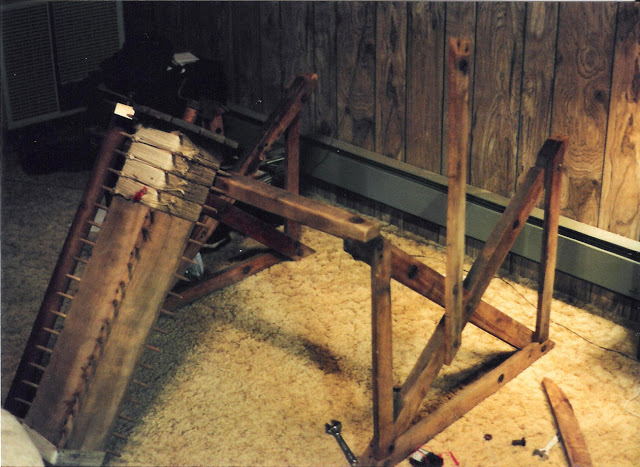


The loom was a two harness counterbalance and was in pretty bad shape. I'm not even sure the whole castle was there and the shafts were unusable.  It was a Union loom.
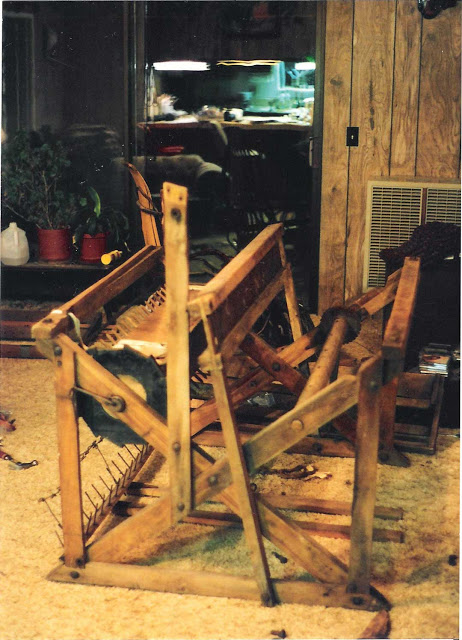


My partner at the time made a new castle and added four counterbalance shafts.
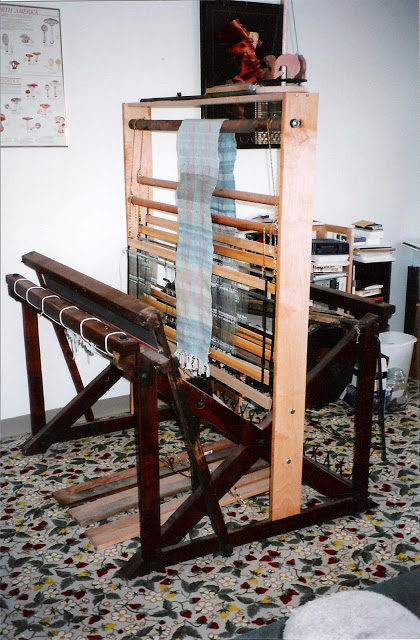
Get a load of that carpet! We called it the strawberry room.

I basically knew nothing about weaving and certainly had no idea there were different mechanisms for running a loom such as counterbalance, jack, or countermarche. I did weave on this loom (with the help of the Reno Fiber Guild!), though I was a long way from doing tapestry. A few years later I sold this loom for $200 to a woman who seemed grateful to have it. I hope it is still weaving.


That probably all happened in 1997 or 1998 which I suppose isn't all that long ago in loom years. Since then I have bought, used, and sold a beautiful 8 harness Gilmore which wouldn't weave tapestry no matter how much I begged it, and now am weaving on my grandfather's Harrisville rug loom.

James Koehler's weft interlock join...

Some of you have asked me recently about James Koehler's weft interlock join. He talks about it in his autobiography but doesn't really describe how to do it. He used this join for all the straight verticals in his tapestries which were primarily the darker frames he wove around his images. It is difficult to describe how to do techniques in words, so I am supplying some video below to make it clearer.

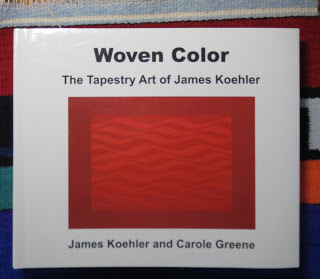
James finished his autobiography, Woven Color: The Tapestry Art of James Koehler less than a year before he died. It is a beautiful book that tells the story of his life and journey as an artist.


 In chapter 10 of the book he discusses his interlock technique which he started using early in his tapestry career while weaving a piece inspired by Rothko. Here is how James describes it:
I noticed that when I was weaving the interlock and moving over by one warp end, it affected the ridge that formed on the surface of the weaving as a result of that particular join. Sometimes, the ridge was on the front of the weaving. Other times it moved to the back--depending on the position of the warp end that I was wrapping around.
If the weft moved through a color block toward a lowered warp end, the ridge was forced to the side of the tapestry facing the weaver when the warp end was raised in the next shed. If the weft moved toward a raised warp end, then the ridge appeared on the opposite side of the tapestry facing away from the weaver. By weaving 11 feet with that in mind, I saw the subtle difference that took place depending upon whether or not the interlock was made around a lowered or a raised warp end.
 In the video I show you how to weave this interlock join from the back side of the tapestry. If you are weaving from the front, simply change the weft that you are wrapping against from a raised warp to a lowered warp and the ridge will move to the side away from you (watch the video, you'll get it).

 
 And I have been sad that James' website was taken down shortly after his death. But I did run across an older geocities website tonight that seems to be operating. It looks like it was last updated in 2009. So you can see some of his tapestries on that website here as well as in some of my old blog posts such as this one.

Artist Headshots

I'm glad November is over. It wasn't a great month overall. But there were some good things that happened. For example, I had asked my good friend Cornelia Theimer Gardella to do some portraits of me for my website a few months ago before the angst-ridden fog descended. And even though now it was the soul-sucking depths of the eleventh month and I no longer felt like I wanted my picture taken, I packed some of my best clothes (the ones without stains or holes) and went to Abiquiu for a photo shoot. Conni is an amazing tapestry artist. Perhaps that is because she has such a good eye. Her photography is gorgeous and you should keep an eye on her website for the moment she rolls out her photography business. If you're an artist, consider having her do your next headshot (especially if you're still using that blurry photo your daughter took with her cell phone right after you got into that last juried show).

And though I don't like my picture taken all that much and I seem to have an eyelid that refuses to stay open when faced with a camera, the photos turned out marvelously. I give Conni all the credit for this. She is a great artist and I suspect a bit of a magician.

Photo: Cornelia Theimer Gardella

The shadows are sometimes difficult to shake.

I missed November somewhere. Decisions are difficult and life has felt a little like that moment when you lose control of the car on the ice and you're suddenly doing 60 backwards down a highway and there is nothing you can do about it. Just a little bit like that.

But I'm still here, though a little fragile and bruised at the moment. I have never been good at making decisions. I second guess myself, mire myself in angst and woe-laden tears, and generally get myself so worked up that rational thought is impossible. But a few things this week helped me find a little center again. I got to do the chicken dance with a preschool class. I can't tell you how liberating that is. And now I know it and when the chance comes up again, I'll be prepared. I got to squeeze my niece and there is nothing better than the big 4-toothed grin of a 9 month old to make you feel much better even if her diaper just leaked on your pants. And I had the good sense (mostly thanks to my very wise spouse's advice) to turn down a job that would have been my absolute dream job ten years ago because I wouldn't get to play Jenga or color with kids if I took it. Ten years ago I didn't care about the chicken dance or teaching kids how to hold a pencil, but apparently now I do and so I can't go back.

It is hard work to listen to your soul talking. Honestly, I'm completely exhausted. But the holiday break is almost here and decisions are being narrowed and even though my dog is a hundred and four, she still wags her tail and takes me for a walk. What could be better than that?


P.S. And because I know you're going to ask, no, I don't know where we are moving yet. Safe to say it isn't Utah though.

Cherry Lake

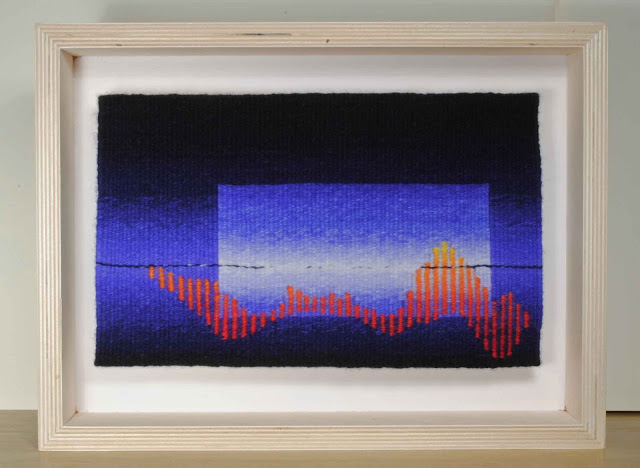
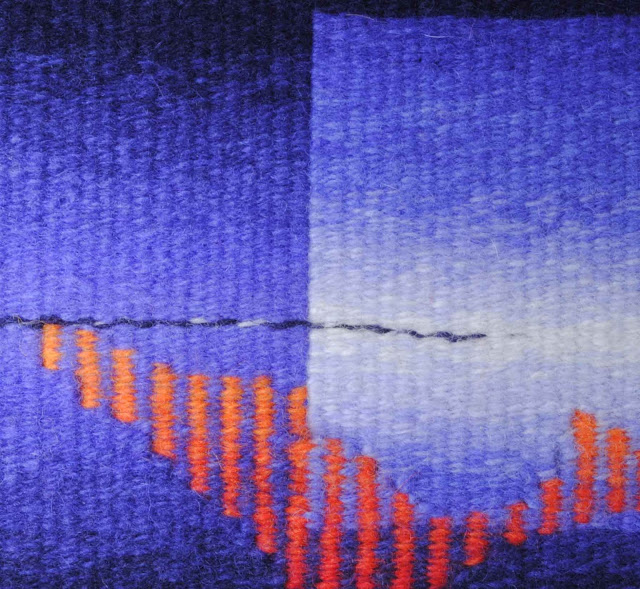
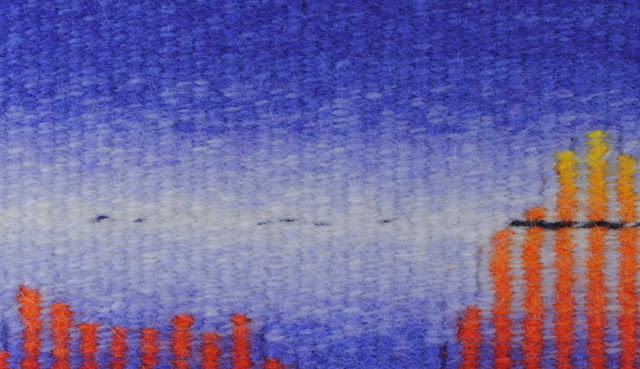
Here is the little tapestry I just finished. I referred to it earlier and showed you a picture of the back while it was still on the loom in this post. I love that these smaller works take me less time to actually weave, but the finishing and mounting seems to take so much longer. Perhaps it was all the complications caused by the pick and pick and the constant color changes... though I ended up liking the effect a great deal and will do something along the same lines again soon!

Here are a couple details.

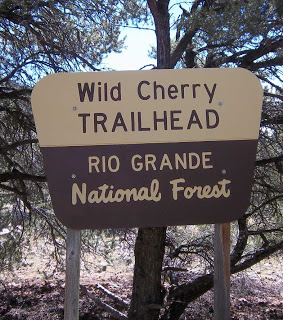
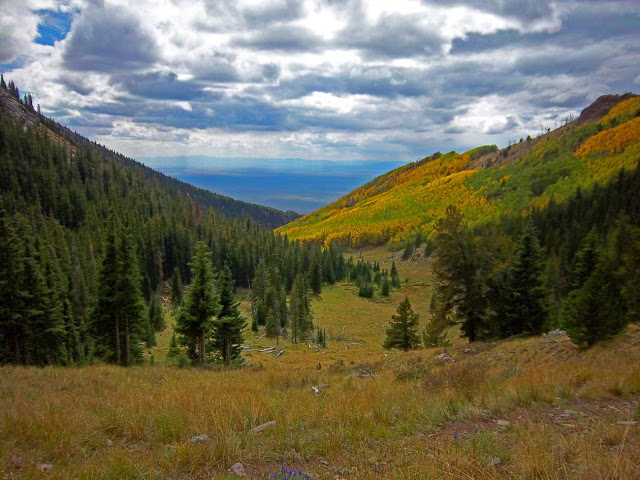
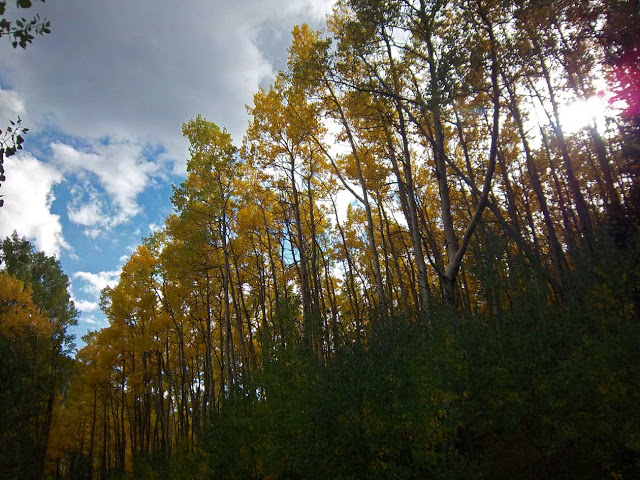
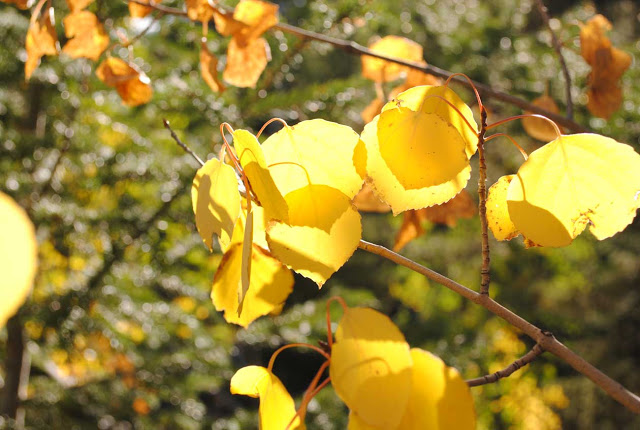
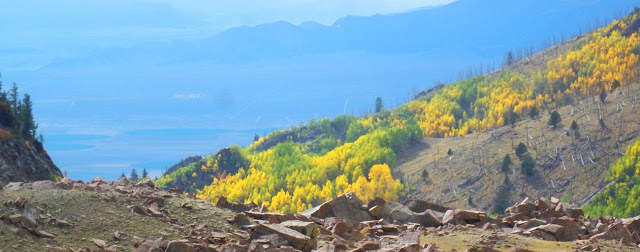
This piece was inspired by a hike Emily and I took to Cherry Lake in the Sangre de Cristo mountains just north of Crestone, CO in early September. The aspens were changing all the way up the mountain and the range of color was phenomenal. I wanted the shape of the pick-and-pick form to mirror the beauty of the mountains as well as the beautiful colors of the trees.


And here is the actual Cherry Lake.

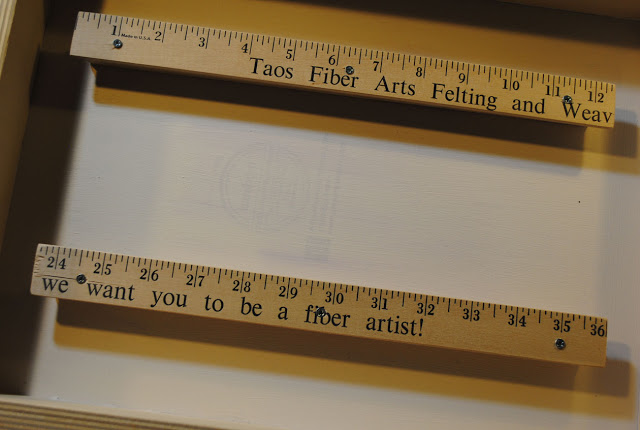
I just had to show you what I used to mount this piece. I had a disappointing trip to the hardware store on Sunday to get parts for this project. I needed some thin, uniform wood to mount the tapestry to and our small hardware store just didn't have anything I thought I could use. I went to MalWart WalMart and ended up getting two school rulers, but they were about half an inch shorter than I wanted them to be. As I was rummaging through my pile of weaving "sticks" at home hoping that I would find something I could use, I spotted the yardstick that my friends at Taos Fiber Arts gave me recently. I was sorry to cut it up, but it was perfect!

The aspen leaves have all fallen now. I am still hiking as the snow has only flown in small amounts up high thus far. But the end of my high altitude hiking season is fast approaching. I might be able to squeeze another month with my snowshoes if I'm lucky.
San Luis Valley far below. Look carefully to see the center pivot farms on the valley floor 4,000 feet below and the San Juans in the distance.

Rainshadow and crane feathers

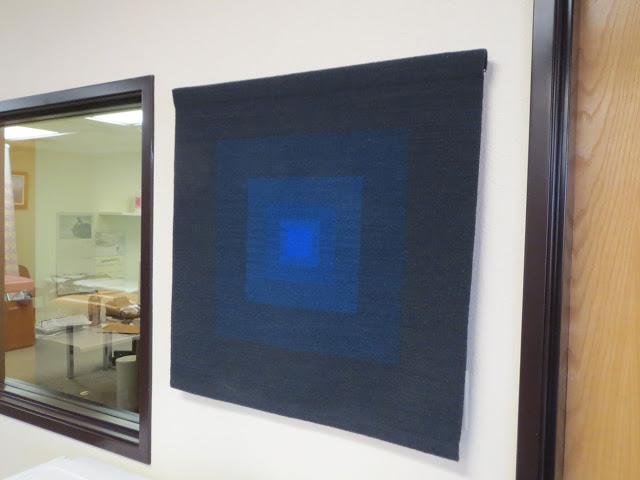
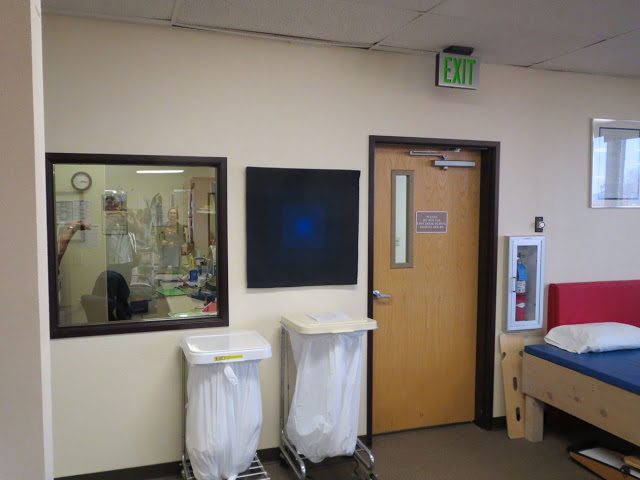
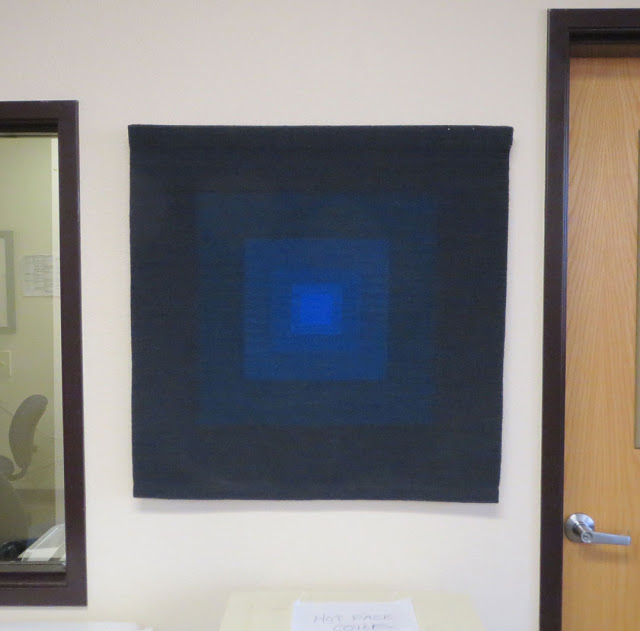
I had the opportunity to visit this old tapestry of mine. It was bought by San Luis Valley Regional Medical Center in 2007 or 2008 and is hanging in their outpatient clinic. The piece is called Rainshadow and honestly, it is one of my favorites. I'm not sure why I like it so much. I did a companion piece with the exact same design but different colors which I did not like as much. There was something about the color of Rainshadow and the way the center square glows that I really liked.


So this piece has been hanging between a door to a medical hallway full of doctor's offices and the therapy office. I thought it might need a cleanup after 5 years, but it seems to be in good shape.
Current linen storage beneath it aside, it was fun to see it again.

And on my evening walk I found a crane feather. The cranes have been feeding in the barley field behind our house the last few days and they have clearly been walking along the acequia which my neighbor recently burned. I suppose the bugs are easier to find when the grass is gone.

These photos are for Tommye Scanlin who is working on some beautiful feathers lately. I especially enjoyed this post about her process working with feather images and how she manipulated the images to create a tapestry design.


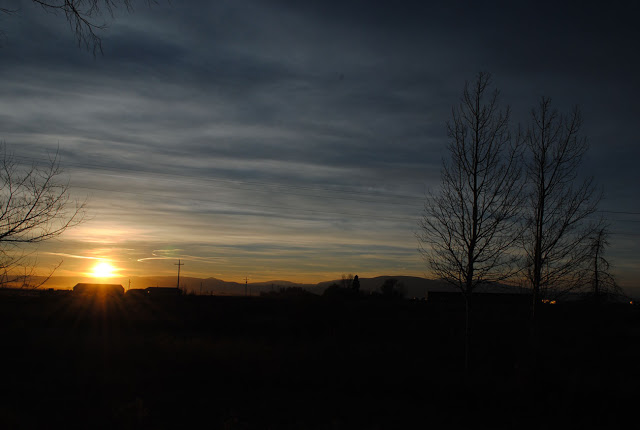
Sunset looking west from my backyard toward the South San Juan mountains

Lessons from Knitting

I have been knitting a little baby blanket--lace, knitted from the center. I like patterns like this that start small and get bigger as you go. I was following the pattern, diligently doing each yarn-over and decrease stitch where the pattern said. And then I hit trouble. This always happens with lace. I follow the pattern and then after a few inches look back at what a pretty thing I am making. But it turns out that it really really helps if you understand the purpose of each stitch so that when things go terribly wrong, and if you're knitting lace they can't help but go wrong at some point (just forgetting one yarn over can cause quite a mess), you can fix them. After tinking* a couple rows, I felt like I was in a place to go forward again. And this time I looked at the pattern, how it repeated, and how each stitch was functioning in the fabric. What do you know. The knitting is going faster and I have lost that little tug of fear that comes when I look up to watch my little niece that the whole thing will have gone completely wrong when I look back down at the knitting. I suppose this is a little life lesson for myself. Look at the pattern, respect the structure, don't sweat the details.

Lace Blanket from 60 More quick Baby Knits

And I just have to mention that Emily said the greatest thing to me last night. We were headed to my sister's house which is about a 30 minute drive away. She said, "And I will drive because that is an hour of knitting." Could you ask for a better spouse?


*"tinking" is knitting backwards. You can't just pull the needles out and rip if you're doing lace because for me, the mess would be unrecoverable. So you have to unknit, one stitch at a time. TINK = KNIT backwards.