2013 or What Tapestry Still Has to Teach Me

New Years Day. After an exhausting few days of marrying Emily and my storage lockers across 1200 miles of the United States, I slept 15 hours last night. When I woke up I didn't know what time it was as Emily consistently unplugs all the appliances when we leave the house for more than a few days. My clock said 3:10. I came downstairs to find that it was closer to 11am. With great hope I tried to find the Rose Parade on TV, but we only get 4 PBS stations, 3 of them in Spanish and though I'd have been happy enough watching the Rose Parade in Spanish, they were more interested in showing soap operas on New Years morning. I did manage to find it streaming live on the internet and caught Dr. Goodall (she is such a bad-ass!) going by before the parade was over. I missed all the bands and everything. (I always hope that one of these days they will show the half time show at a football game and I will see some marching band... but they never do. You'd think I'd give up on this, but I continue to hope in vain that I will see "the band".)

In the spirit of looking forward and hoping for positive changes, I spent today doing what I hope to do much more of in the coming year. Weaving. I happily warped the Mirrix and started a new piece. Yes, I miss my big loom terribly. I patted her beater yesterday in the storage locker and promised to free her sometime this year. In the meantime, the ever-versatile Mirrix will have to do. There is more travel and relocation in our future and no matter how I try, I can't fit the Harrisville rug loom in the back of my VW.


Being an artist and making a living have been the biggest struggle this year. I have learned a great deal about how to be an artist and make a living at it, but have not yet accomplished that while supporting myself or my family. I have learned a lot about balance, and if my not-infrequent tears of frustration are any indication, have a lot more to learn.


I think that tapestry weaving still has a lot to teach me. And when I am not weaving much (like in 2012), I forget the lessons of the slow accumulation of fabric. I forget that if you put a little bit together every day, eventually you have a whole tapestry and something new is born. I forget that the process of each of those weft passes is building something important even if I just can't see it minute to minute. And I think that steady activity of weaving builds something in me too.


So for 2013, I am returning to the loom. I have many other goals, but this is the most important one. Whatever loom I am able to use, I will weave on it. I will make things which may or may not become public pieces, but I will weave nonetheless.
2013 has begun.

The forecast for Alamosa tonight is minus 27 degrees.
27 degrees below zero.
Twenty-Seven.
Degrees (F).
Below.
Zero.

Makes your snot freeze when you breathe.

Happy Happy

Happy Holidays, whatever they may be.


As seen in Salida, CO. There was a large pile of sticks in the back.

Cassy at 13 and a half years.
Another minus 20 degree night

The San Luis Valley is full of bald eagles.

So cold, all the windows are iced on the inside.


And the neighbor's sheep are snowy.


I wish you all some holiday magic, rest, and joy... many messes, kids, dogs, smiles, cookies, and love.

Contemporary tapestry studio newsletter

I have finally launched my studio newsletter. You can sign up for my mailing list HERE! I will be sending infrequent updates on my studio events, workshops, online teaching, and my whereabouts. And you can unsubscribe at any time. Rest assured, I don't share my mailing list with anyone.

So go to this page and sign up!


Rebecca Mezoff Tapestry Studio Newsletter SignUp 


Making tapestry butterflies

I have been teaching workshops for a couple years now and I have noticed that one thing I am asked to demonstrate in every workshop over and over is making tapestry butterflies. There are many methods for holding the yarn while you are weaving a tapestry, but the cheapest is the butterfly because it requires no extra tools.

People get frustrated when their butterflies end up in knots, so pay attention to my tips in the video to avoid this.


And if you don't like butterflies, people use other things to hold the yarn. The tool most frequently used for holding yarn while weaving tapestry are tapestry bobbins. Kathe Todd-Hooker is an expert in different kinds of tapestry bobbins. This page on her store website shows clearly the different kinds of bobbins used. Kathe knows a lot about bobbins, so ask her which ones you need for the kind of tapestry you do! You can see her blog HERE.
Kathe Todd-Hooker sells these bobbins at Fine Fiber Press

I have also seen people use little plastic clips made to hold yarn colors while doing stranded color knitting or embroidery.  Like these!
One of my students loves these. They are definitely inexpensive, but if you are doing large tapestries, they definitely don't hold enough yarn.

My personal preference?  The butterfly.

My first loom

The "how I came to be a tapestry artist" story starts with watching my grandfather weave when I was a child. He was a fabric weaver and he wove yardage on a 60 inch Macomber in Bismarck, ND. When he moved to New Mexico around 1990 he bought a Harrisville rug loom and started using the shaft switching device to make patterned rugs.

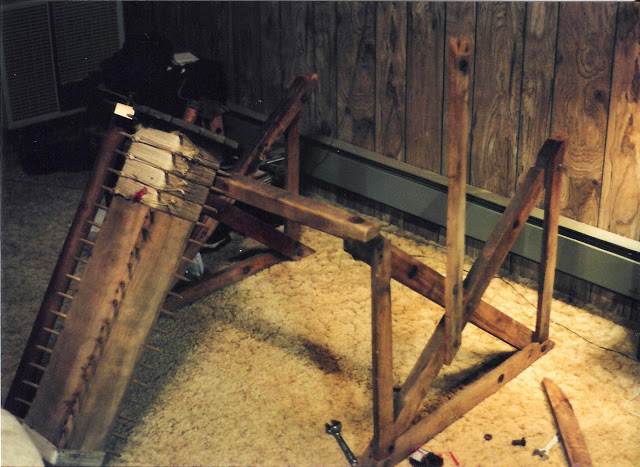
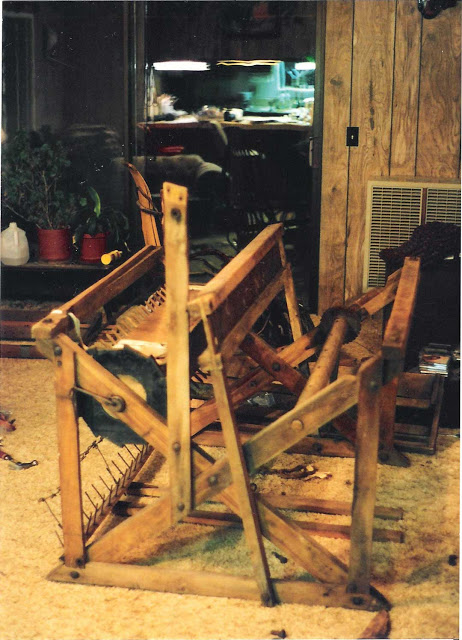
I lived in Reno, NV after finishing graduate school and had the opportunity to get my first loom. The pile of sticks which was this loom was found in the corner of a barn on the east coast of the United States. My partner's uncle shipped it to us and with some work, I had a loom I could weave 4 harness balanced weaves on. I was going through some files recently and found photos of the old girl.


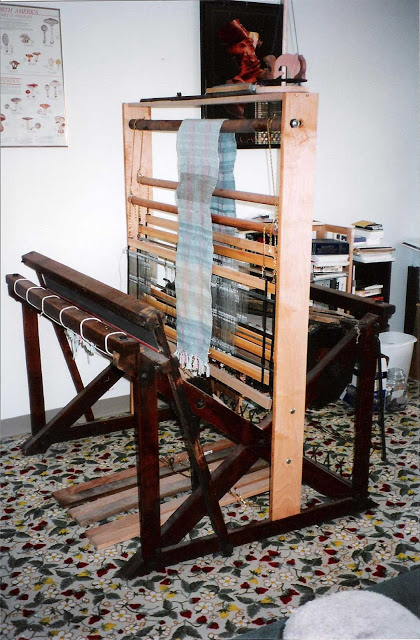
The loom was a two harness counterbalance and was in pretty bad shape. I'm not even sure the whole castle was there and the shafts were unusable.  It was a Union loom.


My partner at the time made a new castle and added four counterbalance shafts.

Get a load of that carpet! We called it the strawberry room.

I basically knew nothing about weaving and certainly had no idea there were different mechanisms for running a loom such as counterbalance, jack, or countermarche. I did weave on this loom (with the help of the Reno Fiber Guild!), though I was a long way from doing tapestry. A few years later I sold this loom for $200 to a woman who seemed grateful to have it. I hope it is still weaving.


That probably all happened in 1997 or 1998 which I suppose isn't all that long ago in loom years. Since then I have bought, used, and sold a beautiful 8 harness Gilmore which wouldn't weave tapestry no matter how much I begged it, and now am weaving on my grandfather's Harrisville rug loom.

James Koehler's weft interlock join...

Some of you have asked me recently about James Koehler's weft interlock join. He talks about it in his autobiography but doesn't really describe how to do it. He used this join for all the straight verticals in his tapestries which were primarily the darker frames he wove around his images. It is difficult to describe how to do techniques in words, so I am supplying some video below to make it clearer.

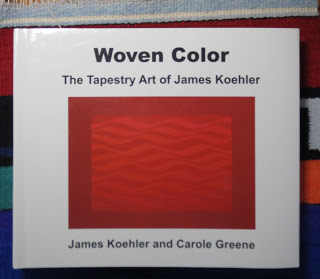
James finished his autobiography, Woven Color: The Tapestry Art of James Koehler less than a year before he died. It is a beautiful book that tells the story of his life and journey as an artist.


 In chapter 10 of the book he discusses his interlock technique which he started using early in his tapestry career while weaving a piece inspired by Rothko. Here is how James describes it:
I noticed that when I was weaving the interlock and moving over by one warp end, it affected the ridge that formed on the surface of the weaving as a result of that particular join. Sometimes, the ridge was on the front of the weaving. Other times it moved to the back--depending on the position of the warp end that I was wrapping around.
If the weft moved through a color block toward a lowered warp end, the ridge was forced to the side of the tapestry facing the weaver when the warp end was raised in the next shed. If the weft moved toward a raised warp end, then the ridge appeared on the opposite side of the tapestry facing away from the weaver. By weaving 11 feet with that in mind, I saw the subtle difference that took place depending upon whether or not the interlock was made around a lowered or a raised warp end.
 In the video I show you how to weave this interlock join from the back side of the tapestry. If you are weaving from the front, simply change the weft that you are wrapping against from a raised warp to a lowered warp and the ridge will move to the side away from you (watch the video, you'll get it).

 
 And I have been sad that James' website was taken down shortly after his death. But I did run across an older geocities website tonight that seems to be operating. It looks like it was last updated in 2009. So you can see some of his tapestries on that website here as well as in some of my old blog posts such as this one.

Artist Headshots

I'm glad November is over. It wasn't a great month overall. But there were some good things that happened. For example, I had asked my good friend Cornelia Theimer Gardella to do some portraits of me for my website a few months ago before the angst-ridden fog descended. And even though now it was the soul-sucking depths of the eleventh month and I no longer felt like I wanted my picture taken, I packed some of my best clothes (the ones without stains or holes) and went to Abiquiu for a photo shoot. Conni is an amazing tapestry artist. Perhaps that is because she has such a good eye. Her photography is gorgeous and you should keep an eye on her website for the moment she rolls out her photography business. If you're an artist, consider having her do your next headshot (especially if you're still using that blurry photo your daughter took with her cell phone right after you got into that last juried show).

And though I don't like my picture taken all that much and I seem to have an eyelid that refuses to stay open when faced with a camera, the photos turned out marvelously. I give Conni all the credit for this. She is a great artist and I suspect a bit of a magician.

Photo: Cornelia Theimer Gardella