Relocation: the final word.

Here is the news a lot of you have been waiting to hear.
Others may be mildly interested.
Some of you won't care one bit.

The long question of where Emily and I are moving has finally been answered. In a stunning series of synchronicities, we have engineered a new life to begin frighteningly soon in Santa Fe, New Mexico.

We were supposed to go to Seattle. For those of you who were (or still are) certain we were moving there, I apologize profusely. My OT license in Washington state was hung up because of a minor paperwork glitch caused by their ridiculous forms my missing a small detail in the application which had us waiting another 6 weeks for the needed license before the move. In that time, three excellent job offers were made to us (only one to me actually, but Emily deserves the bulk of them as she has waited a long time for a good job) and we settled on two of them (one each).

The best news for me is, thanks to my excellent weaving colleague Cornelia Theimer Gardella, I found an amazing studio space in the Second Street area of Santa Fe. It is a place full of artist lofts and Conni and I will be opening our studio there in April.

We will have an official studio opening in September 2013. In the meantime, I look forward to many studio visits from all of you. I'll keep the teapot ready. It is time for me to weave some big tapestries. This transitional period has been long and my big looms being in storage has been difficult. They are soon to be warped again. I already have the ideas piling up. And thanks to a relocation bonus from my new part-time job in health care, I am, for the first time in my life, going to pay someone else to move those big looms into the studio. Whoo Hoo!

I grew up in New Mexico, and for me, this is a return home. Santa Fe was the shining city that we got to visit occasionally as kids when my parents went there for conferences. In fourth grade my class made a trip to visit the capital and we slept on the gym floor of the NM School for the Deaf. Besides having to learn my times tables (which were really hard for me), it is my one memory from that school year. So I'm going back to Santa Fe to make more memories (though hopefully not sleeping on gym floors).

I am grateful for a long list of events which have gone in our favor (which starts with my parents helping me get a masters degree in a popular field), moves through a great adventure as a tapestry weaver, and lands at a beautiful home and studio in Santa Fe, NM with my amazing little family. I am truly blessed.

Cat Mountain Fiber Arts


A few weeks ago I was leaving downtown Alamosa, Colorado and I saw a sign on the sidewalk for The Yarn Gallery. My slipping memory dug deep and remembered that this place was only open on Fridays and I am rarely in downtown Alamosa on Fridays. So I re-parked the car and went up. I was so delighted by what I found that I returned the next Friday to take some photos and talk to Kimberly some more.

Kimberly Perkins runs a small yarn shop and studio on the second floor of an old Masonic building on Main Street. Her main business focus is her hand-dyed yarns which she sells a great deal of at fiber festivals all over the United States. Her online store is HERE. She has some patterns on Ravelry also. Look for Cat Mountain Fiber Arts or kimberlyknitter.
She hand-dyes kits for patterns in Knit, Swirl! by Sandra McIver (as well as many other projects!). There are photos of the patterns in this book on Sandra's website at www.knitswirl.com. The knitting is done with a worsted weight yarn and a lace weight and the effect is of a transparency in the thin yarn. The patterns are knitted largely in one piece and they look like a lot of fun.

Kimberly was knitting one of them up with her beautiful yarn when I was there. It will be stunning once it is finished and blocked.


The yarns needed for these patterns are in various weights and Kimberly dyes them in one hank. The effect is rather magical.

They contain various fibers including merino wool, silk, alpaca, bamboo, and nylon (there are some colorways with metalic thread).
The yarn is dyed one part of the skein at a time. In this photo the yellow is wicking up one of the fibers. She will turn the skein and dye another portion of it another color which results in a beautiful blending where the two colors meet.

White fiber ready for dyeing.
The Yarn Gallery carries other yarn also as well as some knitting supplies so if you're heading through Alamosa on a Friday (or certainly if you live there!), go take a look. Kimberly had some enchanting yarn she spun herself that had beads in it. I am looking for the right project to add some of that to the stash begin knitting that right off!

Look for Kimberly Perkins at Taos Fiber Marketplace in April and at Taos Wool Festival in October. I know I will!

This is exactly how I feel about yarn stores... (and bookstores too if you must know)

Note: 4/20/13
Here is a photo of the finished sweater as seen at Taos Fiber Marketplace.

The great dye experiment of 2013, Part 1

I have been forced to do some experimentation with my dye procedure lately. As I related in THIS POST, I have been having difficulty getting the very light colors to dye evenly. So I was very very careful with the next batch of light colors which was a very light orange and a very light gray. The first go-around with the gray was a disaster. I've never had this much of a disaster actually. I am that kid who got straight A's in high school and when my Spanish teacher gave me an A- one quarter (and it should be noted that that was the quarter I was home sick on the couch for 3 straight months and I was doing the material on my own), I flipped out. I was not the child who got an A-. I suspect that explains a lot about me actually.

I can't even show you a photo of the first gray set. I don't think I could even bear to take one. The second go-around on the light gray was better. It is close enough that the "I'll only accept A's" girl will accept it even though her inner dye critic wouldn't give it an A. (I overdyed the first light gray batch a lovely black. Turned out perfect.) The second color I did that day was light orange. It didn't turn out so hot.
It is not going to pass my critical standards. I can just hear the students complaining now. I have to decide if I will use it in one of my own pieces for a really spotty effect or over-dye it something else lovely. The yarn to the left is the gray. The blue yarn to the right was the teal I messed up and was posted in "A Bad Dye Job" post. Spotty teal yarn becomes a lovely, even blue. I hope I can replicate it!

This is what I did the second time around. I soaked the yarn using some Synthropol to help with penetration of the water. I added the right amount of glauber salt as well as some sodium acetate, I made sure I put the acid in at the beginning so the pot wasn't too hot, and I brought the temperature up to boiling maddeningly slowly. The gray passed (but barely), the orange didn't. Same treatment.

I have never had this much trouble leveling my dye baths. This is supposed to be easy after all! What has changed is that I bought pre-scoured yarn packaged for knitting. It is the same yarn, just scoured by Harrisville and skeined in knitting quantities. I started thinking that perhaps their scouring process was somehow causing the problem. So I ran a little experiment. I do have a masters of science degree and I did take chemistry, so I feel that there is a tiny bit of validity in this study, though the reliability is likely poor partly due to the abysmally small sample size. At any rate, here it is. I may have to get a critical analysis from my number one experiment-designing professor friend, though I don't know if I can take the heat.

Now I know you're going to find the first flaw in the experimental design right away. I didn't use the same dye color I have been having trouble with and certain dyes do take up better than others. You're right. I know. But I needed blue. So blue it was.

The other experimental design dilemma I had was whether to dye them all in the same pot. This should give me a better idea of whether it is the scouring of the yarn that is doing it... theoretically. Plus it is a lot less work to put them all in one pot than to do three separate runs. So, into one pot they went. I did not use any synthropol, Abegal SET, or sodium acetate for this experiment. I only used glauber salt which is my usual procedure.

The three groups are as follows:
 (The plant is Llois. She is clearly in rehab. In fact she was named after the rehab patient of mine who gave her to me. I hope the real Llois is doing better than this Christmas cactus. Incidentally, I call her Yo-is because of the double L.)
So the groups included (B1) the same yarn made by Harrisville but bought on cones unscoured, and subsequently scoured by me; (B2) skeined yarn dyed as sent by Harrisville which is supposedly already scoured; (B3) the same Harrisville pre-scoured yarn but I scoured it again. (Scouring just means you wash the junk that keeps the dye from bonding out of it in really hot water.)

All the blue in one pot. I'm getting a little nervous partway through and here is why:

And the results are in:
The yarn is hanging left to right, two skeins each: B1, B2, B3.
B1 and B3 turned out very similarly--both even and quite pretty. Both of these groups were scoured or re-scoured by me.
B2 flunked. Uneven dyeing, will have to be fixed. Of course I can't really say that there weren't other variables that contributed, but from now on I am going to scour all the yarn regardless.


Tapestry Class at Harrisville Designs

I weave my large tapestries on the Harrisville rug loom that my grandfather gave to me when he could no longer weave. And since I started working with James Koehler, I have used Harrisville yarns for my work. So getting a request to teach at Harrisville Designs this summer was quite exciting to me. I have an aunt who is also a weaver with a Harrisville rug loom (we're a looney loomy family) and she has taken a couple classes at Harrisville with great stories of lakes and old brick buildings and a studio full of sunshine. Now it is my turn to go there. I feel a little like I'm going home even though I've never been to Harrisville at all.


The class I'll be teaching is 5 days and will include the content from my popular Color Gradation for Tapestry class. We will have a couple extra days in this class to explore ways to use technique and color to achieve the visual effects each student is interested in in tapestry. We will explore uses of color on the loom as well as through slide presentations and discussion. We will weave a sampler to practice these techniques and all students will be able to weave a small tapestry or a study for a larger work. I revel in teaching to a wide variety of experience levels at once. As long as you know some very basic things about tapestry weaving, you'll get along fine in this class. And if you're on your 50th tapestry, come and weave with me also. There is always more to learn for both of us. We will use the Knitting and Weaving Center's Harrisville floor looms. Unlike a lot of tapestry weavers, I most enjoy weaving on a floor loom, so this is a chance for me to convert some of my students to this way of doing tapestry. (Grin)

Harrisville Design classes are taught in an old spinning mill which has been beautifully renovated. And of course what could be more gorgeous than New Hampshire in August?

More information is available on the Harrisville Designs website HERE.
The specific class list is HERE.
And the link to my teaching page on my website is HERE with more information about this class and some good words from past students.

The class is August 5-9, 2013.
Mark your calendars!

Yarn waiting for tapestry weavers at the Michigan League of Handweaver's Conference in August 2012

Mary Cost and Architectural Abstractions

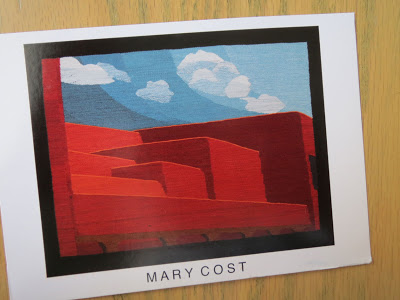
I was able to swing by Mary Cost's new show at Downtown Subscription in Santa Fe, NM on the first day of its run, Tuesday the 5th.
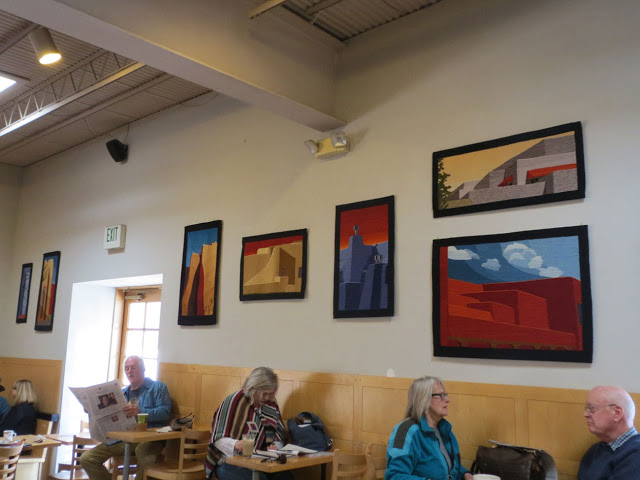
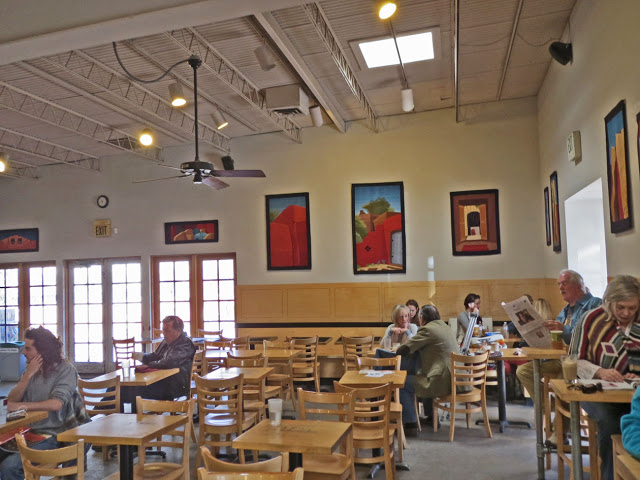
I was sitting at a table, drinking an Izze soda (I had already had a chai tea latte that day at another coffee shop and couldn't go for a second round), and was delighted to watch a woman enthralled by the tapestries. She was holding her coffee (and frankly I was afraid she was going to spill it all over her shoes as she wasn't paying any attention to it), stumbling along between the tables and people looking up at the tapestries. People do find tapestry fascinating if we can just show it to them!
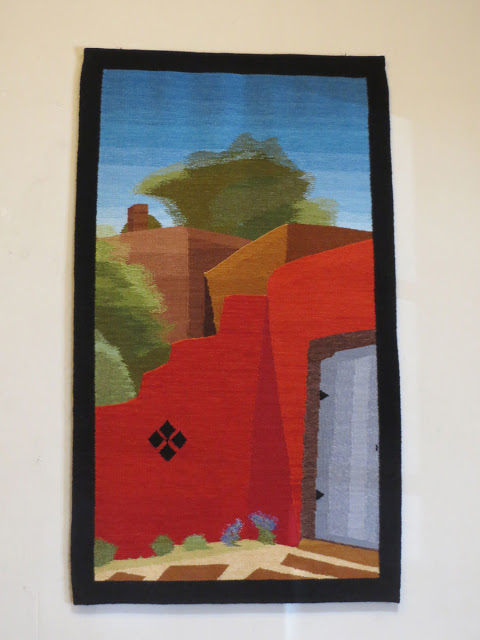
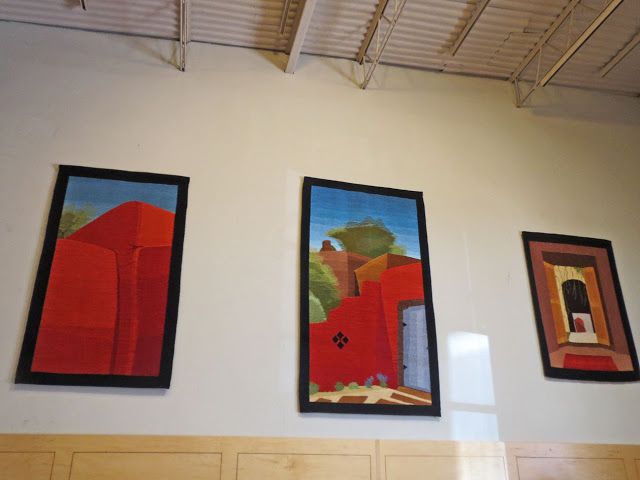
Morning, 55 x 33 inchesNote: This tapestry was hanging high on the wall thus the photograph makes it look narrower at the top. It is actually rectangular.
Mary also used to study with James Koehler. Her work has changed and grown significantly over just the last couple years. I think these recent architectural works are stunning and I hope she considers weaving something really large one of these days. I think it would be gorgeous.
Spring at last, 48.5 x 28.75 inches; Morning, 55 x 33 inches; Inside Looking Out, 38 x 27 inches
So Mary Cost is out there in Santa Fe making sure people see her tapestries. Lets go see them! Her work is beautiful and though the walls are not well-lit, the coffee shop is bright and you can see the work (if you can get by the people--the place was packed by the time I left!). She is represented by La Mesa of Santa Fe.
Mary recently had a piece in the international juried show of the American Tapestry Alliance, American Tapestry Biennial 9. I was able to see it at the Fort Wayne Museum of Art and you can see my blog post and photos about her work HERE and in the video on THIS post.


Look for this postcard on the newspaper rack right as you come in the door. It has all the info on it.


Mary Cost
Architectural Abstractions
March 5 to March 31
Downtown Subscription
376 Garcia Street
Santa Fe, New Mexico

Reception: Friday March 8, 4-6pm

Photographing tapestry

I have my piece for the Small Tapestry International 3: Outside the Line show sitting on the counter in my kitchen. I know this seems odd (after all, I am risking a ketchup malfunction by leaving it there), but I need to remember to rephotograph it and my memory has been failing me on a regular basis the last few weeks. Really I'm just taking things moment by moment at this point. The original photo I took was on the right track, but somehow I didn't get the entire piece in focus.

Cherry Lake is hung inside a larger frame and several times a day I walk by, see it out of the corner of my eye, and think, "who left that television there and what a waste of electricity?!" and then remember that (1) we have a TV but no reception, so it isn't really possible that that could be the blue glow from a TV and (2) that Emily would never have left that tapestry sitting there for a week. Since she is visiting our new niece in a land far away, I am left to fend for myself and for now, the tapestry stays in the kitchen.

I am attempting to learn more about photographing my own work. As a kid I had a Pentax K1000 single lens reflex camera. I got it for my 14th birthday and I loved it. I used it right up until that moment in Seattle in 2004 when I bought my first digital camera. I still keep the Pentax in my closet right next to my softball shoes. You never know when one of those will come in handy after excavation from the layer of dust. I wonder if the shoes still fit.

A couple years ago I bought a Canon digital SLR and have been amazed at what great photos it can take considering the hands of the person operating it. I do understand shutter and aperture and ISO (which used to be ASA in the world of film cameras, didn't it?) and depth of field. But I am no professional.

So today my task is to get a better photo of Cherry Lake. I have left it too late to take it to my professional photographer, so I am screwing up my patience and setting up the light stands and hoping that I can get this one done well myself. Here is the old photo (which was cropped for submission). I'll let you look for the new photo, which I am sure I am going to nail, in the STI3 catalog.


James Koehler, 2 years gone

It has been two years now since I got a phone call on my way to Chaco Canyon that James Koehler had passed away. It seems like a lifetime ago, and like yesterday.

Harmonic Oscillation HOLXIII,

James Koehler

I have been thinking about James and my time studying with him over the last few days. I learned many things from James, both positive and negative. I am sorry he is gone as there are still questions I would ask him. Here is the original post from shortly after his death:

James

The art of tapestry needed people like James.

Stay safe.

Take care of yourselves.

Keep weaving.