Two steps forward, three steps back

Well, I knew that I was going to have to tear apart the studio again to complete some soundproofing in the ceiling that the landlord didn't think really needed to be done before I moved in. Turned out that being able to hear every word of what the business owner upstairs says is not really a great situation. The last straw was being able to hear someone pee in a bathroom somewhere above my head.

So after my studio class the first week of May, I packed everything up again and moved it to the far side of the studio where it would be out of harms way. It sounds like a minor thing when chatting about it, but it has been a large set-back. I had hoped to be dyeing yarn for my new piece right now, but I haven't found a quiet space to concentrate on the design and decide on the colors... and my design and color materials are in boxes under layers of plastic somewhere. So I wait for the work to be done so I can put my new shelves together, get the yarn dyed, and start weaving.

Last Thursday the insulation went up. 


A couple days later, the soundboard was in place. I lost the cool rust-colored beams, but the sound barrier will be worth it.
The looms in their shrouds of plastic. No, I didn't move the Harrisville Rug Loom. That was my stipulation in them doing the work. It is warped and ready to go and I don't want to have to screw with the tension again.


And the furniture was finally delivered two weeks late after four different companies schlepped it who-knows-where... by a very chatty Sikh with a good string of jokes. I wish I could remember jokes because he was really quite funny. I know there was one about the Pope and lawyers in heaven.... I wonder if he knows any about freight companies.

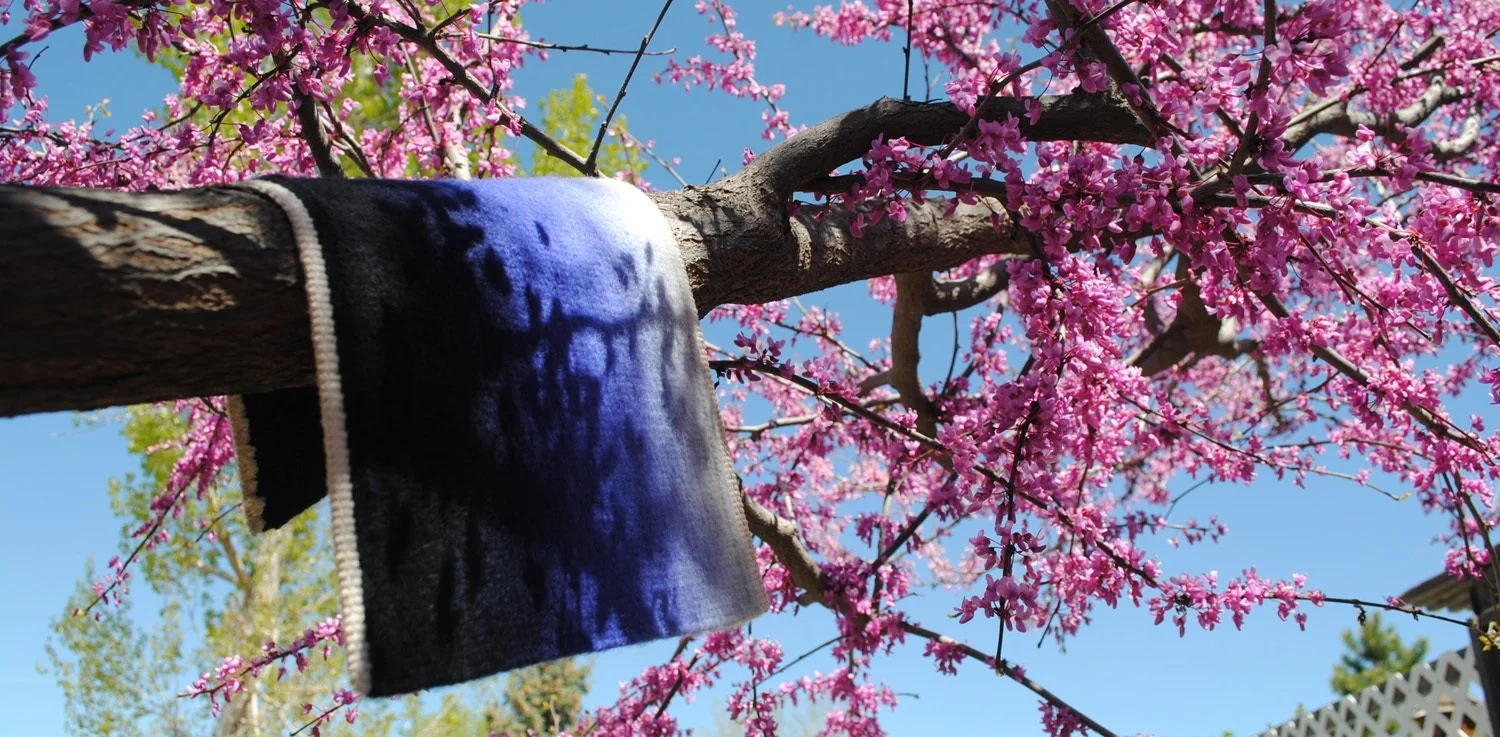
I love spring. One of my studio neighbors had this huge rag rug hanging over his upstairs balcony the other day.

Moths in Tapestry... or Holy Guacamole, HELP!!!

I think I need some moth advice. I have worried little about moths living in a very dry place and having never seen a clothes moth in my tapestry career.

But tonight I unpacked this tapestry.
Rebecca Mezoff, The Goddess's Heart Song, 31 x 34 inches, hand-dyed wool tapestry
The Goddess's Heart Song has been rolled up in storage (in a storage locker) for the past year and a half. It was one of my very first tapestries and resides in my personal collection. I was getting ready to hang the tapestry in my home and looked at the back and saw this.
I looked closer and saw this.


I scraped away the little semi-translucent trails and saw places where it seemed like the nap of the tapestry has been chewed. It is hard to see in the photograph, but here it is. See the little trough in the center of the photo?
So does this evidence suggest moths? (I can't imagine it is anything else.)
And if so, what do I do about it. I think I need some help on this one.
As soon as I post this cry for help, I will vacuum the tapestry. Does anyone know what I should do after that to make sure I save this piece and don't have an infestation? I know that people put yarn in the freezer, take it out and thaw it, and then freeze it again. Is this a good procedure for a tapestry? I certainly don't want any of my other pieces infested. This piece was one of only a few that were in that storage locker. The ones I had with me seem to be fine.

And are there any other thoughts on using cedar? I won't use moth repellant as I don't want that chemical in my environment. I do hang my tapestries 3/4 inch from the wall. The little buggers may have found the tapestry in storage. Probably someone in the next locker was storing thrift store sweaters. Sigh.

Heaven forbid I introduce moths into a new house and they find their way into my extensive yarn stashes. I shudder to think of the potential catastrophe. I don't have any clothes worth two cents, but my yarn... well, they better not mess with the yarn.

My grandmother's writing

My grandmother was a weaver. She wove tapestry. She got a BFA in fiber when she was 60 years old. When she could no longer use her tools, they were passed on to me. Much of my studio has been in storage for a year and a half and I have finally found time to unpack those boxes this week. I found a lot of my grandmother in there.

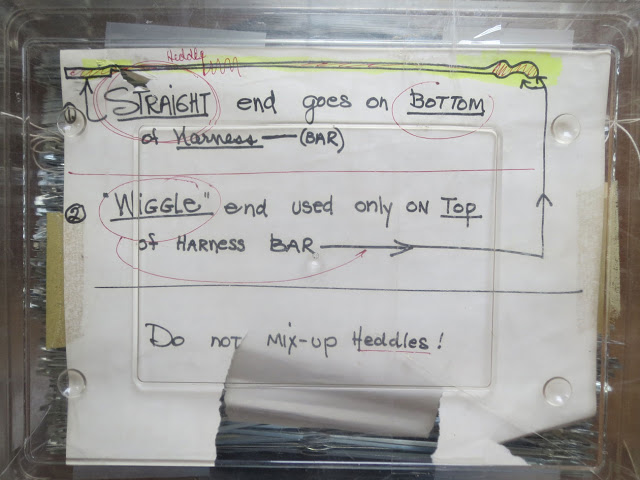
This box contains the heddles that fit on the 48 inch Macomber loom. There are 10 shafts on this loom, each of which has a hefty number of heddles. (Maybe some day I'll get the other 6 shafts just so I can weave some 16 shaft lace. I know a few of you are groaning right now at my tendency to multiply projects.)
But I really have to ask if she ever needed THIS many heddles.
Here is a beautiful hand-carved tapestry fork which has been emblazoned with MEZOFF. I suppose I should be grateful a student won't take it home accidentally (and that my name is also Mezoff), but it sure would be prettier without the label.
I especially love this peanut can which holds the hooks for the tie-up on the Macomber looms. And this may also explain my spelling difficulties. These problems are genetic, right? I am pretty sure the correct word is LOSE... all caps of course.
And a typed label stuck to a small piece of weaving she (or perhaps my grandfather) did. It may have been a gift for me at some point and the label was a courtesy.

And my favorite leash sticks. I am pretty sure anyway that they are called LEASH sticks, not LEASE sticks (the L got cut off in the photo). Although after awhile I'm not so sure about words anymore. Once I've used them wrong enough times, it is pretty hard to rewire my brain to the correct spelling/grammar/useage.
And her books did not escape either. Here is a Harriett Tidball monograph. Most books look something like this. It is of course ironic that she consistently wrote "valuable" or "do not loan" on books that she felt were valuable. But I suppose in some ways that makes them more valuable to me as a remembrance of my grandmother. She is still very much alive and kicking, but no longer weaves. So I weave for her on the days I don't have the mojo to weave for myself.
Thanks for being a weaver Grandma!
And Happy Cinco de Mayo from the sunny southwest. (The tapestry class is going great in case you were wondering.)

Studio progress

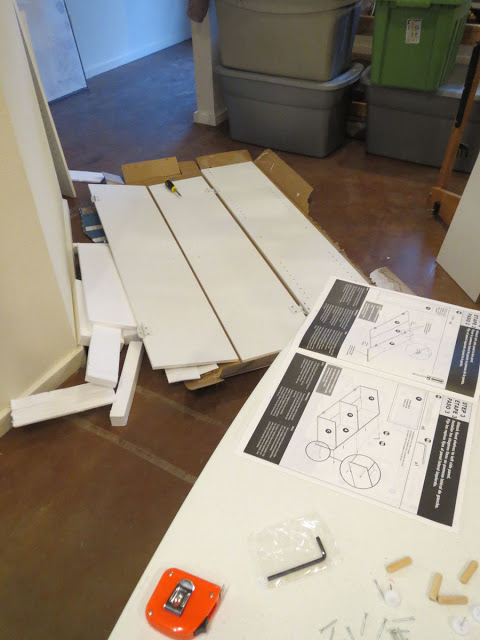
Little by little this studio is coming together. There has been a lot of furniture assembly. Somehow I feel like furniture should come in one piece, and I suppose it is possible to buy it that way. But if you go with an IKEA sort of decor, you're going to be following those little pictures and putting it together yourself.
I have a collection of those little hex wrenches this furniture all comes with. I save them religiously in my red toolbox, though honestly I expect never to take any of this furniture apart. I pulled the baggie where the collection resides out of the bottom of the toolbox today. There are many of them. Maybe 20. I have no real recollection what most of them were used for. (Emily put them in the baggie. I would have just thrown them in the bottom and never been able to find the one I need... in the unlikely event that I needed one of them. Emily is smart like that.)
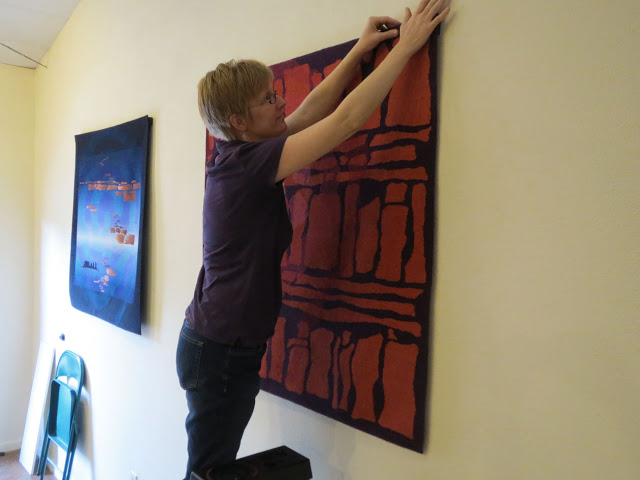
And with the assistance of the taller of my helpers for the day, I got these tapestries on the wall.
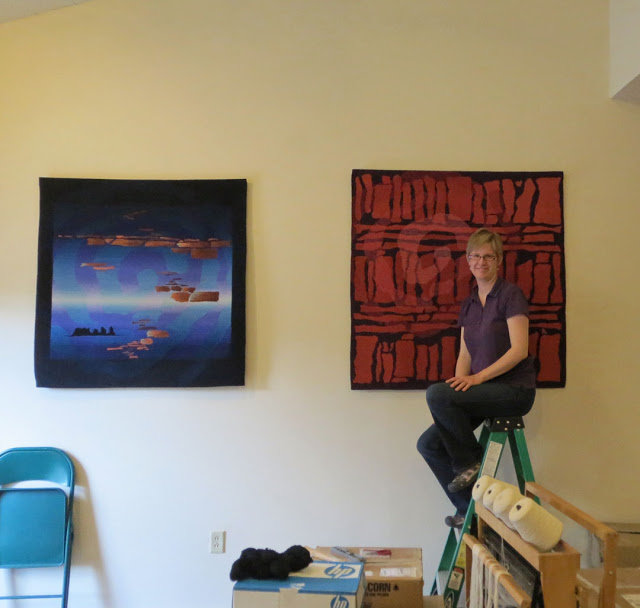
These two pieces have never hung side by side and I enjoy seeing them this way. On the left is Emergence V: The Center Place (45 x 45 inches). On the right is Emergence I (48 x 48 inches).
And here is the shorter of my two helpers for the day... without which I would not have gotten the yarn re-arranged on the floor, the spool rack spun, or the boxes climbed upon. Great to have a little niece in the studio!

Harrisville warp extender

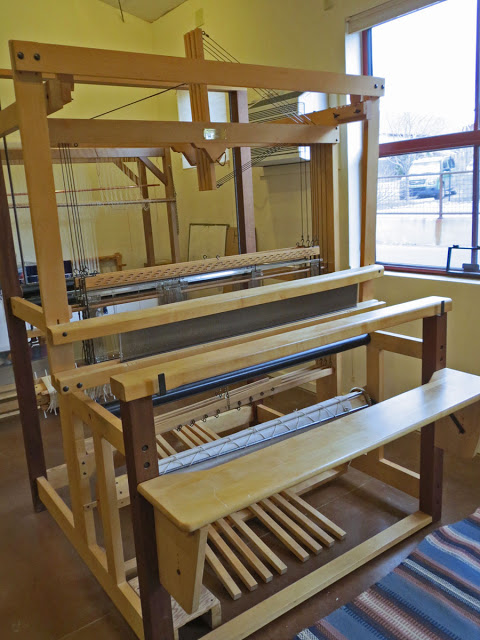
This is my Harrisville rug loom. I don't know anyone else who weaves tapestry on one, but I would like to recommend it as a fantastic tapestry loom.
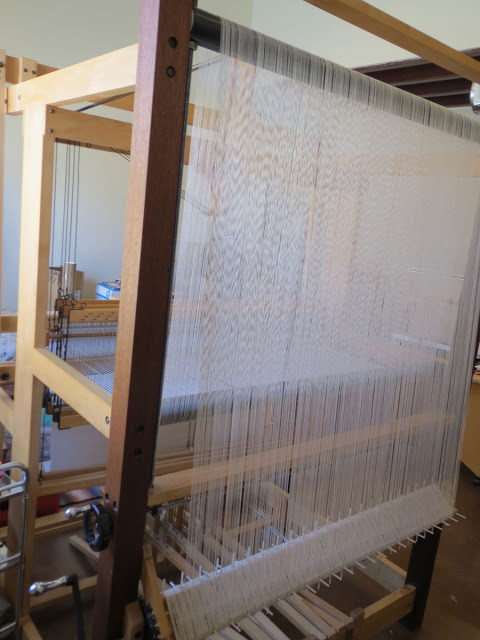
I love one feature of the Harrisville rug loom especially. The warp extender. This ingenious little addition to the countermarche loom keeps the tension even throughout the piece. The tension is superb both because it is a big floor loom with a worm gear and because of this warp extender. The warp extender allows me to raise the warp away from the warp beam as far as I need to for the piece I am going to weave.
When the warp threads are wrapped around and around a back beam, they fall in between each other and the tension in my experience is never even when you start advancing. Even if you are one of the million-stick-club and you are very meticulous about winding your warp with sticks, things can go awry easily. The warp extender pulls all the threads up evenly around a smooth steel tube. You start your tapestry with the extender raised, tie on and get everything even, and then as you weave and pull the piece forward, instead of unwinding the warp beam, you lower the extender. Genius.

And of course it is a countermarche loom and I love the fact that the warp threads get pulled evenly from either direction on each shed. I like things even. Perhaps it is a good thing for tapestry or perhaps I just have a touch of OCD.

This picture is looking from the front of the loom toward the back with the warp extender raised.
This picture is from the back of the loom looking at the raised warp and the warp beam.
Incidentally, I never warp sectionally even though both my floor looms have sectional beams. If I knew I was going to use a fairly consistent warp width on this loom, I might consider it just to get a lot of yards on at once. But I find sectional warping picky and not actually that great a method if you're looking for a very even warp. (I felt guilty about not warping sectionally for a long time--I have the spool rack and the tension box and the little counter to count yards, but I finally reached a place where I decided I could do things my own way and didn't have to listen to all the old teachers voices echoing in my head. My head is much quieter now.) I usually just put on enough warp for a couple tapestries, which, after all, are going to take many months to finish... and by the end of all that I'm probably going to want to try something different anyway.

The Great Dye Experiment of 2013, Part 2

I dye my own tapestry yarn. And I dye yarn for my students to use in my classes. And sometimes I even sell it to them. I posted a little bit a few months ago about some dye projects gone bad.
A bad dye job
and
The Great Dye Experiment of 2013, Part 1

This weekend was my first dye run in my new place... the dye studio residing in my garage now. I took some good advice from my expert dyer friend Cornelia Theimer Gardella and watched the pH of my pots much closer. I usually just dump in enough citric acid to drop the pH all the way to 3.5 and call it good. But I think sometimes that makes the dye hit too hard (and Conni was sure of it, so I decided to listen to her). So this time I used much less acid and monitored the pH. The results were excellent. Even the light colors which are always the most difficult to level turned out great.

Here are the oranges I dyed in March which were so bad.
And here are the ones I just dyed.
The first batch will be overdyed and turned into something lovely.


My biggest question for all of you out there who dye in various parts of the world is, did the water have anything to do with this difference?
The water I was using in Alamosa, CO was well water with large amounts of minerals in it and no water softener. The water I used in Velarde, NM before that was also well water but I had a water softener and had less trouble getting even dyeing than I did in Alamosa. Now I am on Santa Fe city water and I would bet there are still a lot of minerals in the water, this being NM and all, but as far as I know, there is no water softener in this house...
Does the water make a difference in how the dye takes up and how even it is? Have any of you had this experience?
(I'm using Lanaset/Sabraset acid wool dyes and dying Harrisville-milled wool.)

Not a bad days work though... nice, even, hand-dyed yarn ready for another workshop.