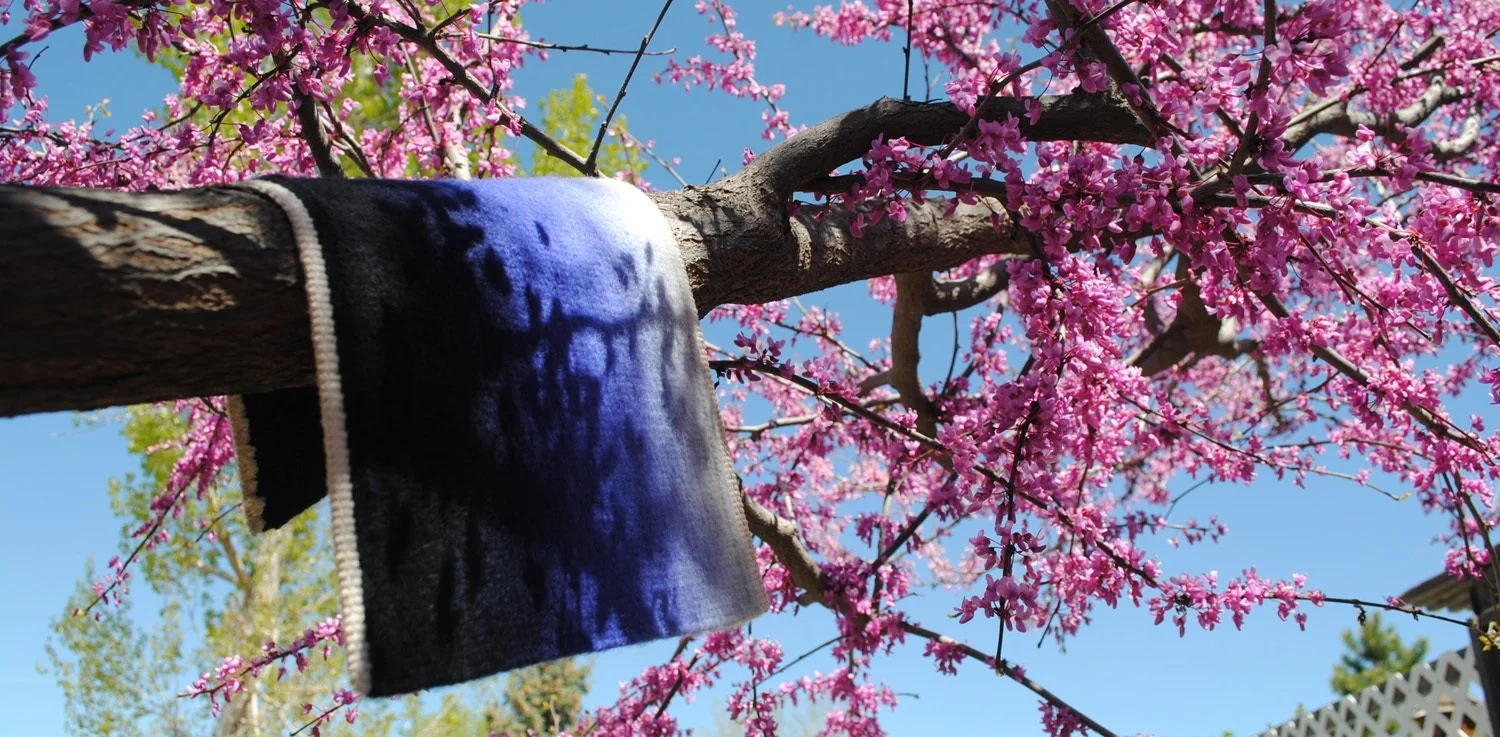
Growing up on the edge of the Navajo...

I gave a lecture for Las Tejedoras Fiber Arts Guild on Saturday morning. I had a lot of fun putting the lecture together and it was well received.

I was talking to a group of fiber artists, many of whom did not weave tapestry. So I wanted to give a talk that told them something about myself, my experiences growing up in New Mexico, and my evolution as an artist. I was reading Stanley Crawford's book River in Winter recently and the first essay in it is about various sorts of lines in Northern New Mexico. It starts like this: "As a straight line person who has settled in a crooked line region, I think a lot about lines." And it goes on to talk about the curved lines of the first acequias and then the introduction of barbed wire and private property:
There are two ways lines have been drawn in Northern New Mexico, to two purposes: one, to draw a circle, to enclose a community, much in the way an acequia flows out away from the stream or river and then arcs back to it; and two, to section up the land in angular grids for the purposes of quantifying property, the better to speculate in it or market it.
There is of course another way, a primordial way, the way that nature draws lines: the edges formed by streams and rivers, ridges, escarpments, mesas, and lines of vegetation that shadow contours of geology and altitude, and the tracks of creatures and the trails of men and women on foot that interconnect campsite, spring, forest, meadow, and river. It is places like this we go when we wish to escape our own too straight and too confining fences, and the sharp pointed barbs of our quantifying civilization [...]
photo: Emily Haire
I love the native concept of circular time. I feel somewhere deep within that it is very important and that my linear, stress-driven world is somehow way off the mark. There are things about New Mexico's "land of manaña"* status that drive me crazy in my anglo, straight-lined head. But I have to say that when I sit still and feel the places that life really speaks to me, time feels circular. The times that are most like that for me are when I am weaving a tapestry or out in the backcountry hiking for days and days.

I grew up attending a mission school on the edge of the Navajo reservation. I was a white girl in a sea of otherness. And I think in the long run, it did me a lot of good. Learning about feeling different taught me how to find ways to belong. And those skills I learned as a kid have come in handy lately as I face the struggle of being a tapestry artist in an art world that doesn't recognize tapestry as an art form.

Growing up among Navajo kids also jump started my fascination with the weaving traditions of New Mexico. The first tapestry techniques I learned were traditional Hispanic Rio Grande-style tapestry though I left the program after a year, feeling like I needed to make my own kind of art. My own weaving traditions, even though my grandparents were weavers, are far less defined than especially the Navajo way. Perhaps so many anglo people are drawn to Navajo traditions because we lack or don't understand our own.

I can't weave in the Navajo or Hispanic ways because these are not my traditions. I don't have the necessary spiritual or cultural background to weave "Navajo style" as I often hear classes in such techniques referred to. I love my Navajo colleagues and I hope that through collaboration with each other we can learn new ways for all kinds of tapestry... but I'll still listen for the thunk of the Navajo forks when I wander across the rez.

Piedra Lumbre, Cerro Pedernal, Rio Arriba County, New Mexico     photo: Emily Haire
__________________________
manaña is the Spanish word for tomorrow. Sometimes in New Mexico it feels like things will only ever happen tomorrow... and tomorrow never actually comes.

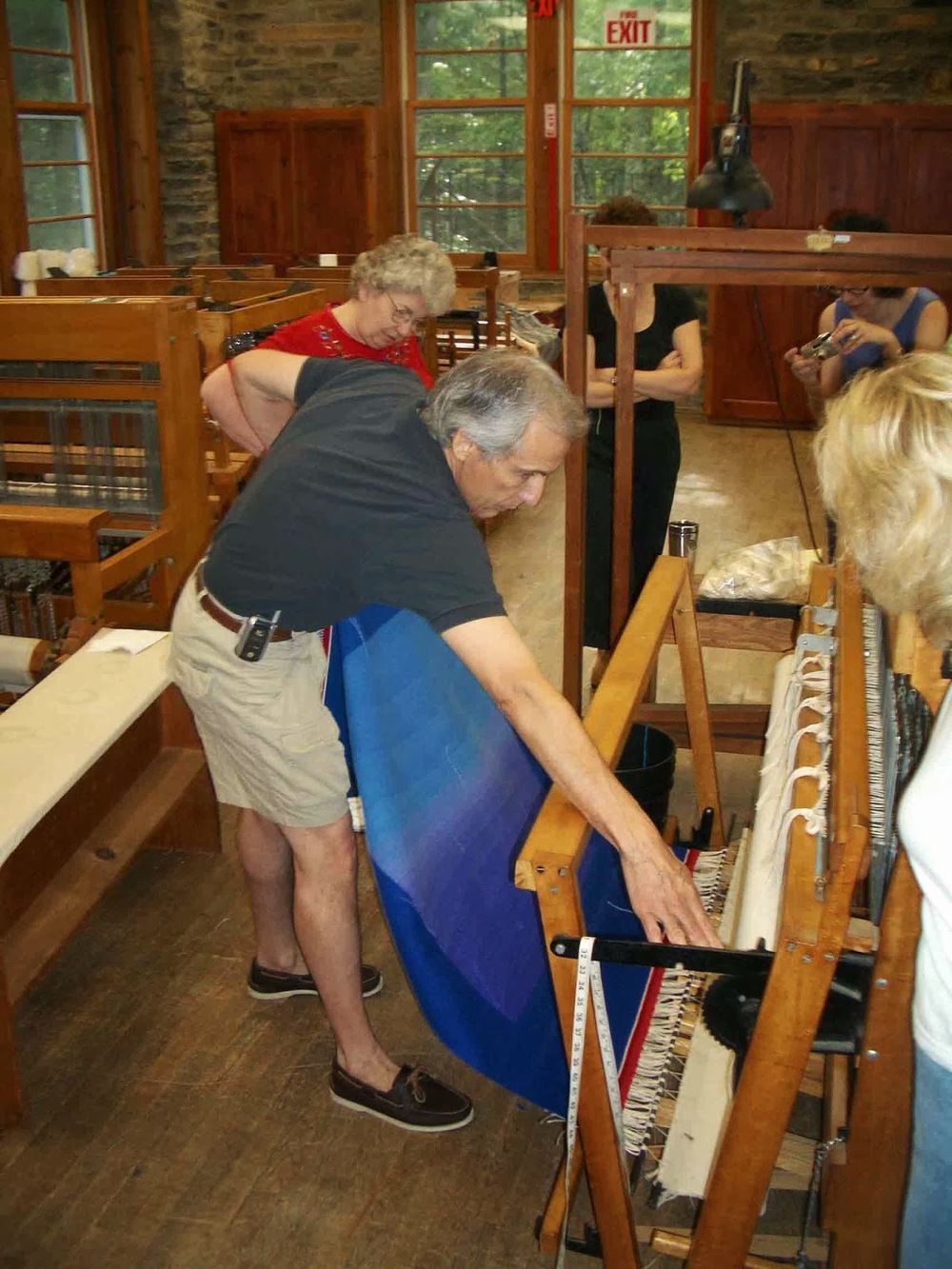
Penland School of Crafts with James Koehler

I'm currently working on a lecture I have to give this Saturday and in preparation for it, I was digging through some old discs of photos looking for some images of my first tapestries. It is amazing what you can dig up on such an expedition. One thing I found on a disc labeled "July 2005 pictures to print" was images from my two weeks at Penland School of Crafts in North Carolina. (But beware when taking such a journey. There were some other photos on that disc I would have preferred not to see again. It was a long month.)

I took a two-week color and design class from James Koehler in the summer of 2005. I think I can safely say that that experience was life-changing. From that time, I realized that I loved weaving tapestry so much I would do it 16 hours a day and that I wanted to make contemporary art tapestries.

James, for whatever reason, wove a piece during those two weeks. It was wonderful to see him working there for the first time. Here is one of the Ensnared Light pieces coming off the loom.

These pictures are somewhat remarkable because it is the only time I saw him cut a piece off the loom. He would finish a piece in the studio while there were students and apprentices working, but he wouldn't cut it off until everyone had gone home. We would come back the next morning and find the finished and steamed piece lying on the glass-topped studio table. Sometimes it was even already hemmed. James always said he didn't like anyone else to see the piece when it first came off. And as you can see in the photo below, immediately after he cut it off, he rolled it up. I seem to remember he let us look at it in more detail the next day... after he had done some initial cleaning-up. He was not a "cut off party" kind of guy.
Oddly enough, I went to someone's house a few weeks ago on some studio business... someone I didn't know at all, and she offered to show me her James Koehler. This piece was hanging in her bedroom. It was good to meet it again 9 years later! You never know where different life paths will cross I suppose.

Here are a few other assorted photos from my weeks at Penland. If you were there or know someone who was, send them the link to this post! I'd love to hear from them. I met two of my good weaving friends, Betsy and Klaus, in this class.

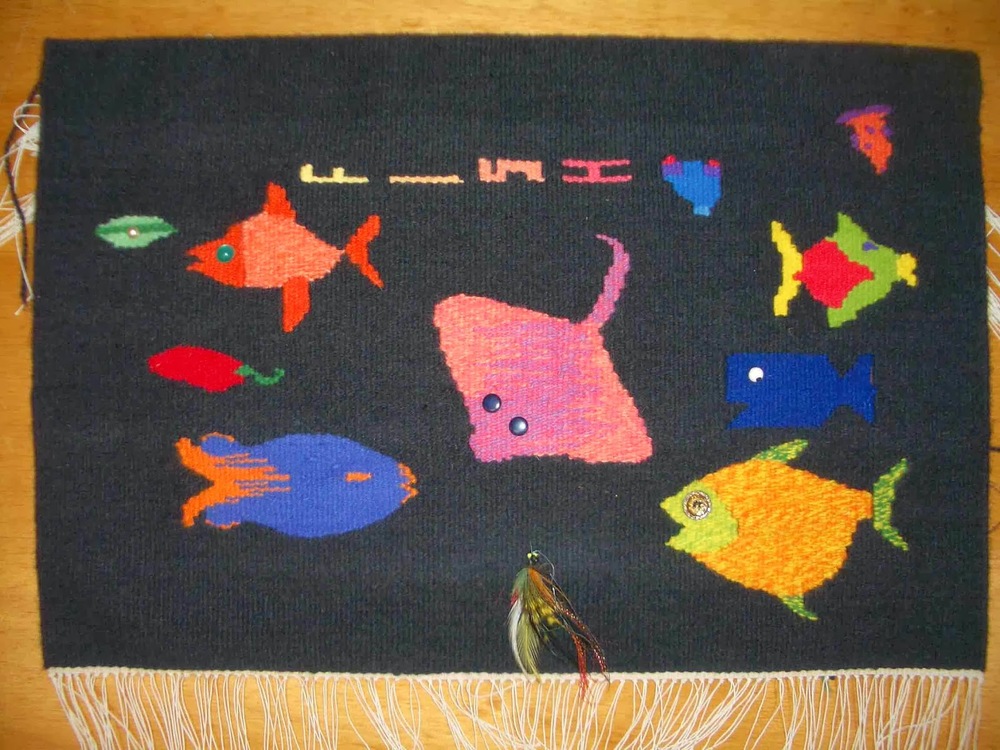
As a weaving studio, we decided to participate in the auction they have during each session. The class wove this piece, and we were so pressed for time that these two were weaving at the same time! We each wove a fish and James filled in the background.
Mine was the "chili fish"... being from New Mexico and all. I think it was supposed to have an eye on it but clearly I didn't weave it in. You really have to coordinate as you change the sheds when you have two people weaving on a loom like this at the same time!
This is the Lily Loom house. The entire second floor is the weaving studio.
The class at work.
I was a lot younger then... and it was hot.
Some of the session's work hanging for discussion. I wove the tumbling triangles in the top middle and the green and orange piece to the right of it.

Penland was an inspiring place... and so was that first class with James.


By the way, if you're interested in hearing the lecture I'm giving on Saturday, it is at 9:30 am at Westminster Presbyterian Church on the corner of St. Francis and Manhattan (841 W. Manhattan) in Santa Fe. It is a lecture for the Las Tejedoras Fiber Art Guild but they welcome anyone to their meetings.

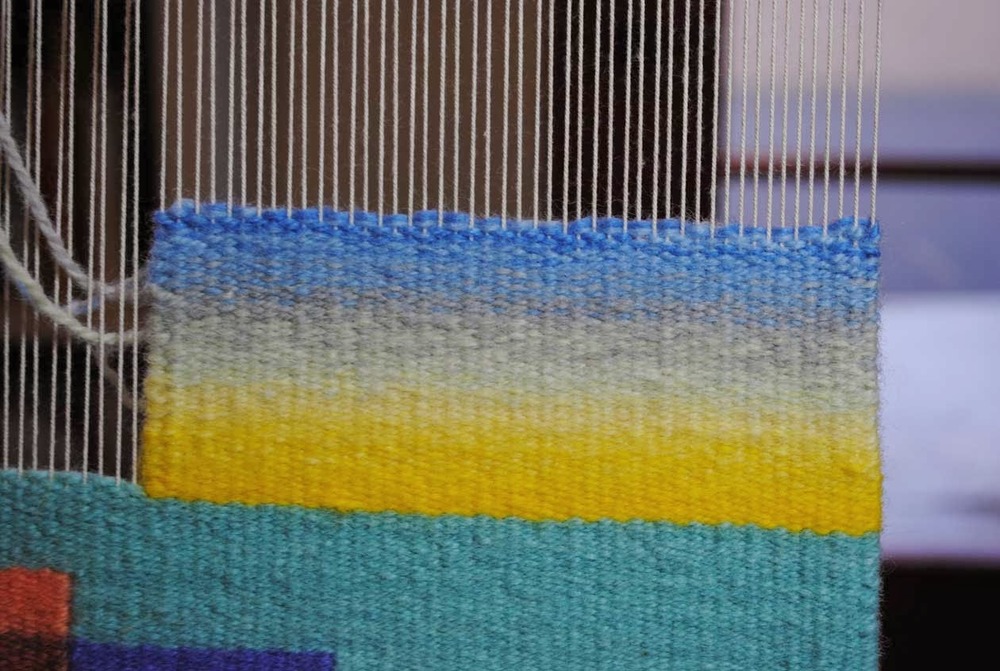
Making yellow into blue. Color Gradation in yarn.

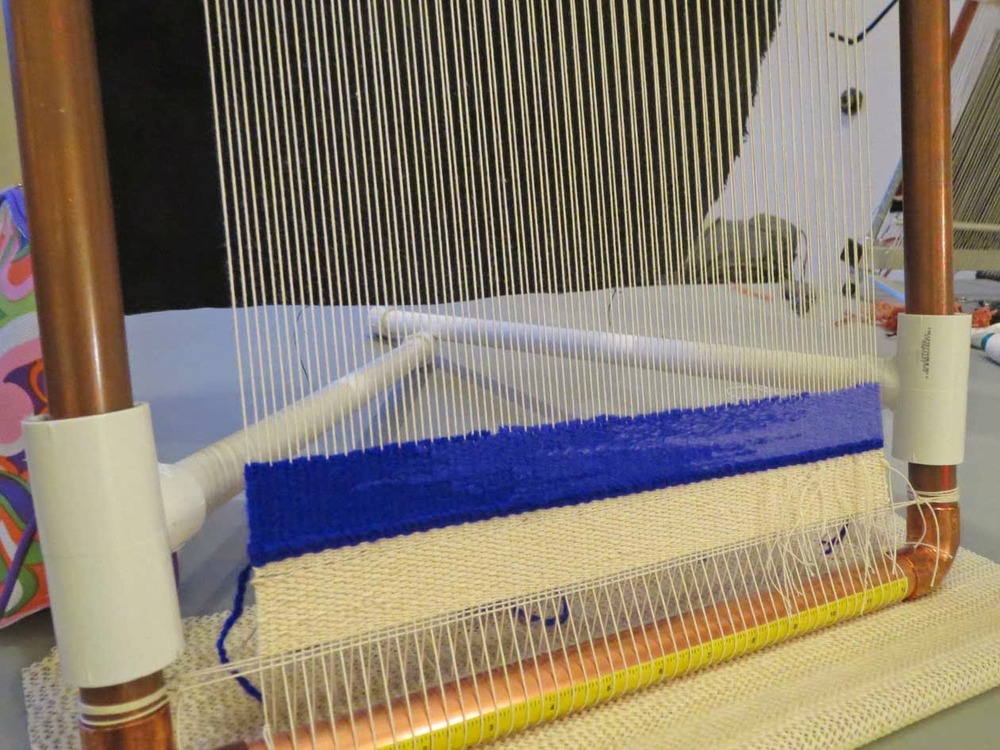
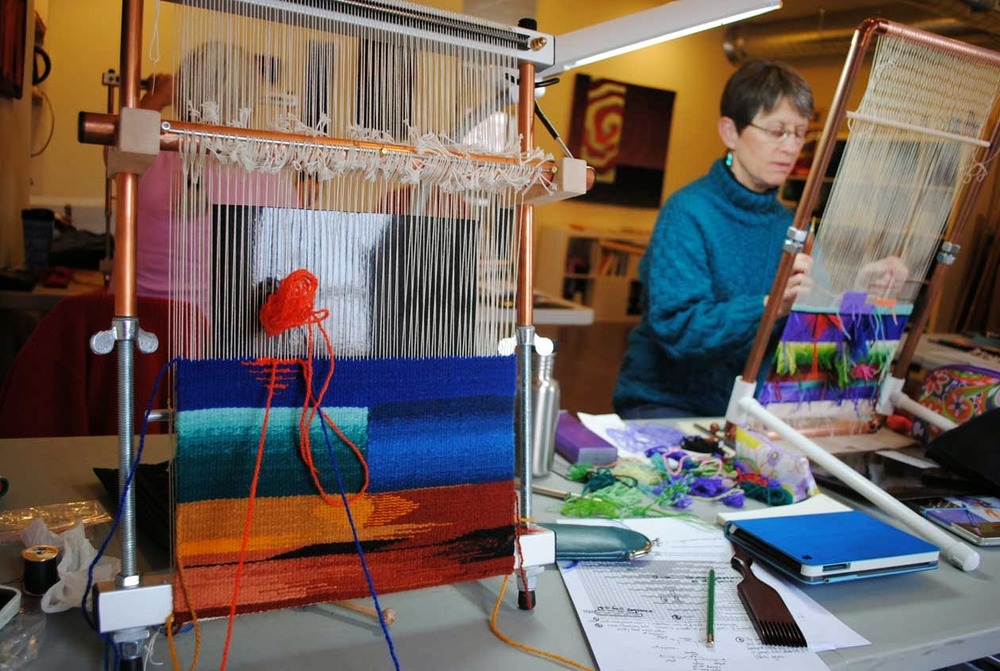
I have spent this week teaching a color gradation technique class in my studio in Santa Fe. We have been practicing how to move color in tapestry using various techniques including hatching, hachure, use of texture, weft bundling, and pick and pick. The class has done a wonderful job and many new innovations surfaced during our work. Here are some photos. And if you missed my newsletter on 1/23, make sure to hit the link at the bottom as it shows a great transparency exercise.

After the usual argument discussion about weaving from the front or the back (in which I was soundly defeated--every single student chose to weave from the front much to my chagrin), we dove into irregular hatching. Hatching is one of the cornerstones of tapestry work and an important tool for moving color horizontally.
But the favorite exercises are usually the ones where we move color vertically.
This is really rewarding to do and after experimenting with moving one hue from light to dark, some people got crazy with grading between hues while changing values. (I expect great things out of this lot, I have to tell you.)
A big thanks to Kevynne Layne for getting this particular class off the ground with a group of weavers from the Damascus Fiber Arts School in Oregon. Marcia and Heather joined the group from Colorado and California and we had a wonderful group of 6 plus me.
As a teacher, you're always on alert at the beginning of a class to try to figure out which students are going to understand the way you best like to teach and which ones are going to need you to re-arrange your brain to explain things in their thinking style. And then there are the students like Janet who pick everything up right away and run with it.
That progressive hachure exercise she did in peach and orange is always the hardest exercise in the class. This time around I even printed out a whole instruction sheet just for this figure. Janet nailed it without a word from me and then proceeded to weave the pink meander with color gradation in the figure. Smarty pants.

This class was a whiz at color. Everyone had so much natural ability to mix and use color. It was astonishing.

And then Kiki pulls out this green sampler (eventually she added other colors and even had to use someone else's loom when she filled hers so full she bloodied her fingers trying to pick the tight warp)... Blood = dedication.
The techniques done all in green were so striking.

The whir of the swivel...
The thunk of the handbeaters...
The call of the double chocolate cookies at the coffee shop across the parking lot...
It was a really good week.


I am teaching some of this material in a two-day class at Convergence 2014 in Providence, RI. Join me!

NEWSLETTER ALERT!

My newsletter this week showed an example of a wonderful exercise a student in this class did with transparency. You can see that newsletter HERE. You'll be surprised which colors you need to mix to create illusions of transparency.

You can sign up for my newsletter at the top right corner or the very bottom of the blog... so you don't miss the next one!

Tapestry Tuesday at the Met

Here is a little something that came my way through some social media channel last week.

The Metropolitan Museum of Art is having a show of 20 rarely seen royal tapestries from the early 1500s in October, 2014. In preparation for that, they have launched "Tapestry Tuesdays" on their social media sites. The show which is scheduled to open October 7th, is titled Pieter Coecke van Aelst: Tapestry and Design in Renaissance Europe. Between now and then the MET is going to have tapestry tuesdays which highlight tapestry from their collection.

This week's offering can be seen at THIS link.

Screen shot from the MET's website. See further photos HERE.


American Tapestry Biennial 10

I had some great news recently. I submitted my newest tapestry to the American Tapestry Biennial 10 and it was accepted. Juror Dr. Jessica Hemmings, Professor of Visual Culture and Head of the Faculty of Visual Culture at the National College of Art & Design, Dublin, chose 37 tapestries out of 230 from 118 submitting artists. I feel quite lucky to be on the accepted list. I actually found out quite awhile ago since I am one of the co-chairs for this particular show. It was rather difficult for me to keep that secret for a number of weeks. I have learned a great deal from volunteering for ATA. The most valuable lesson is that if you don't get into a juried show, it isn't necessarily a statement about your work. It is quite possible that your work just didn't fit into the juror's vision for this particular body of work or show. Next time it just might.

The complete list of accepted artists can be found on the American Tapestry Alliance's website HERE.

The show will be at three venues.

Visions Art Museum
San Diego, CA
May 2 – July 20, 2014
http://www.visionsartmuseum.org/index.asp
Opening reception: May 10

Kent State University Museum
Kent, Ohio
September 25, 2014 – January 4, 2015
http://www.kent.edu/museum/index.cfm

Kaneko
Omaha, Nebraska
February 6 – April 24, 2015
thekaneko.org

Rebecca Mezoff, Emergence VII, 44 x 44 inches, hand-dyed wool tapestry

Here is another tapestry artist's experience with being accepted to this show along with a photo of her beautiful piece. Link: Tommye Scanlin.

I am 2 for 3 on ATB shows (I entered work for consideration into ATB 8, 9, and 10. I got into ATB 8 and 10). At this point I think a 50% acceptance rate would be phenomenal, so I completely expect to not get into ATB11. I'm just planning ahead. You can't be too careful.

A furious week of work

There has been crazy stuff happening in my studio, or perhaps mostly in my head. I think things have come back under control and perhaps I can find a few moments to devote to the blog.

I spent last weekend in the dye studio. I have had various dye "studios" over the past years, but this one might be the best so far. I loved the shed I had in Colorado, but when it is -38 degrees out as it was last January, dyeing outside is absolutely not an option. It turns out that a garage makes a pretty good dye studio. It is fairly cozy on a weekend afternoon in Santa Fe with the dye pots heating it and the sun shining. I made a pile of yarn, some for the class that started yesterday.
What you can't see is the table of dyes and jars behind me and the big stove to my left.
When I wasn't dyeing, I was re-envisioning handouts and exercises for the 5-day studio class. I pulled it all together and so far the class has been excellent. A studio full of students who are excited about tapestry and are enjoying some time in Santa Fe is a great experience. So with all that activity, I have felt like I needed about three of me the last couple weeks. Fortunately Emily helped me clean the studio Saturday evening and it was all spit-shiny and new for the arrival of 6 students from Oregon, California, and Colorado Sunday morning.

Secrets of a tapestry volunteer (Part 1... "Don't worry")

I have learned a great deal about shows from being one of the co-chairs for the American Tapestry Biennial 10 this year (the American Tapestry Alliance's biennial international juried show). I have little to no decision-making power, but I do have an inside seat into how the thing works. And it has been eye-opening. I'm not going to tell all the secrets here because frankly, we need volunteers (and honestly, it has been totally worth it anyway). But here are a few tips for entering an international juried show.
  1. If the show is in the USA and the dimensions are asked for in inches, please don't send me centimeters. I have to go and convert each and every one of those numbers because the size of the show is measured in feet which correlates to inches. And I know that it is crazy we still use feet and inches over here when the rational world uses the metric system which frankly makes way more sense, but trust me. It is a lot of work to convert all you metric-people's centimeters to inches. (Don't worry, I converted all the centimeters.)
  2. If the prospectus says "show the edges of the tapestry if they will be visible when the piece is shown," then don't crop them out of your photograph. A photo with the edges showing looks very different than one with the edges cropped. (Don't worry, we took both this time... but next time, don't crop!)
  3. Photo sizes. Yoy. I can't believe the variety. Some photos were 35 KB (WAY to small by the way) and some were 20 MB (WAY too big by the way). This is just something I have to deal with, but try to find a happy medium. There are pixel requirements on the prospectus. (And don't worry, I fixed your photos or asked for new ones.) I see a blog post coming about how to resize your photographs! It actually isn't the easiest thing especially if you don't have the right software.
  4. Send photos. Seriously. Some people didn't. (Don't worry, I asked you for them if you didn't.)
  5. If the prospectus says that October 31 is the "received-by" date, this means we aren't accepting any after that date. It is not a postmark date. Many shows use postmark dates. Make sure you check! (Don't worry, I emailed you if you missed it.)
  6. If you are challenged by the online entry, consider getting your entry together and mailing it early. I would far prefer the online method as it is faster for me, but some people have weird browsers or old computers and the online entry just didn't work for them. And what the juror sees is the same in the end regardless of whether you entered online or through snail mail.
  7. If you use someone else's PayPal account to pay, especially if you have a different last name from them, please leave a note that it is a payment for you. (Don't worry, I think we finally sorted all those out.)
  8. And lastly, if you are snail mailing an entry from a place that may take a long time to arrive or may actually get stuck in some mail-person's carry-bag for a couple weeks or whatever happens to random pieces of mail, send your entry really early. There is nothing worse than having to tell someone they weren't considered because their entry took over a month to get here. (Don't worry, if I didn't tell you this was you, it wasn't though I am super disappointed for the person it happened to!)
But don't worry....

Disclaimer: All of this is completely from my head. Please don't hold ATA responsible for my random grousing! I do hope these little tips help when the next show comes around however. I know I'll follow them (lesson learned!).

Seeing the entries for ATB10 was enlightening. It reinforced something Thomas Cronenberg and Jennifer Sargent said in my rejection letter for ATB9. The juror may well be a person we respect who has worked a long time in the fiber field and who we desperately want to hope will like our work. But that juror is attempting to create a cohesive show and the work that gets in does have something to do with the other pieces submitted. Just because your piece didn't get in doesn't mean it isn't amazing (believe me, there was some amazing, wonderful, fantastic work submitted to ATB10). It just means it didn't fit the juror's vision for this particular show. Or maybe it just means that she ran out of room and those last 5 huge tapestries just couldn't be accepted. Or maybe he just doesn't like green or flowers or hanging installation pieces or whatever. Don't take it personally. Keep entering. And above all, keep weaving.

(What the ATB9 co-chairs actually said was, "Please keep in mind that the selection for this show is that of one juror. He chose works that fit his vision. Many tapestries not selected for this exhibition could easily be selected for another show.")