An experience of northern Georgia

I haven't spent any time at all in Georgia. I've flown through Atlanta a few times and marveled at the size of the airport. But I had never left the airport bubble until last week.

After teaching for the Chattahoochee Handweavers Guild in Atlanta, Tommye Scanlin* picked me up and we had a wonderful adventure in northern Georgia.

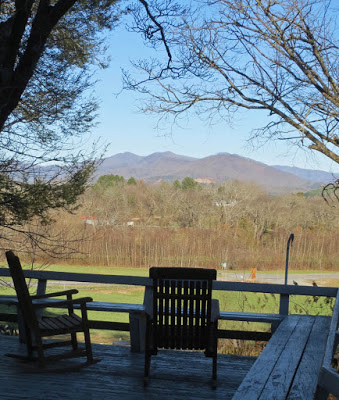
Remember that I am from the American Southwest. I am used to adobe and sand and canyons. North Georgia is a place of big trees, rolling hills and mountains, houses with big porches and white columns, and an accent that I love to listen to.

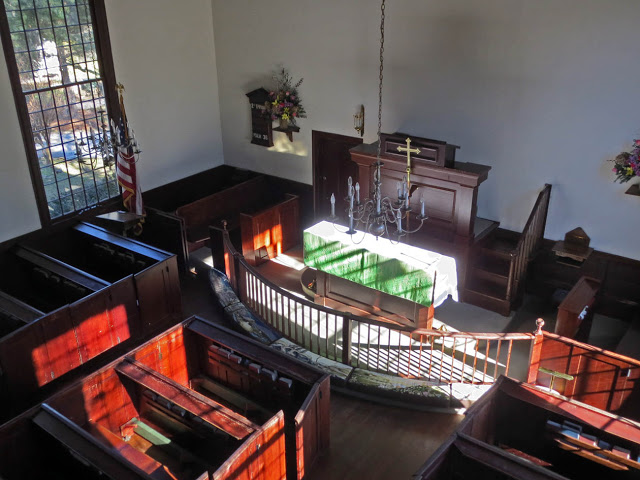
We started our adventure with a visit to Patricia William's Communion Tapestries at Grace-Calvary Episcopal church in Clarkesville, GA. The church is a beautiful old white building tucked into this little hillside town. It is the oldest church building still in use in north Georgia, dating from 1838.
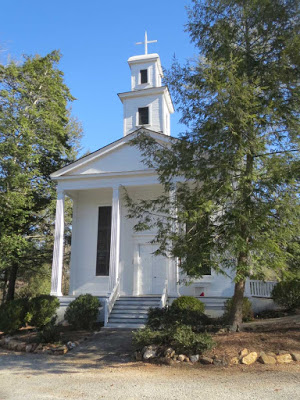
Grace-Calvary Episcopal Church, Clarkesville, GA
The tapestries are a set of five panels installed as communion kneelers. Yes, the fact that people actually kneel on them makes me gasp. But they have been in use for quite a few years now and they look fantastic. They look like they are woven at 8 epi and shaped are to fit the curve of the kneelers. They are themed for the liturgical year: Advent, Christmas, Lent, Easter, and Pentecost. In typical Pat Williams whimsy, they tell the stories well.
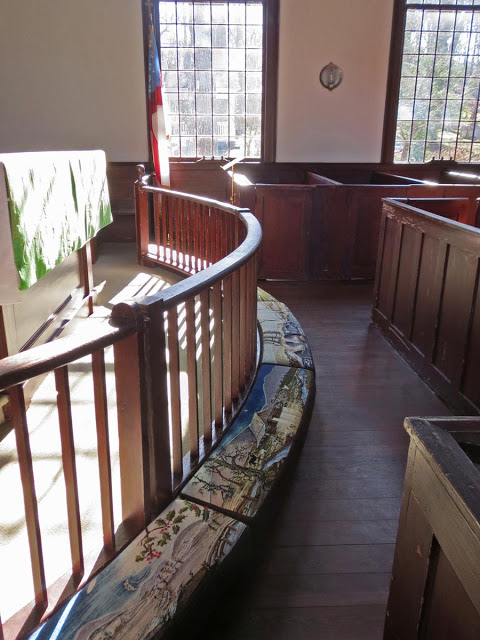
Pat Williams Communion Tapestries
Here are a few details.
Pat Williams, Communion Tapestries, detail of Easter panel
Pat Williams, Communion Tapestries, Christmas panel
This detail captures the wonderful movement Pat has in her work. It is so engaging. I would recommend visiting her tapestries wherever possible (she has one in the upcoming American Tapestry Biennial 11) including a stop at this church to view this series.
Pat Williams, Communion Tapestries, detail of Pentecost panel
From Clarkesville, we visited some wonderful residency centers: Lillian Smith Center and The Hambidge Center. Inspiration winds its clever way through both of these places and I will be drawn back in the future.

We went to John C Campbell Folk School. Unfortunately the weaving class was not in session, but I was able to get a good look at the studio through the windows. What a wonderful place.
John C Campbell Folk School
John C Campbell fibers building
After a very chilly walk around the grounds (who knew I'd need my warm winter coat in Georgia?), we stopped in at this wood-fired cooking class. They didn't have samples for us, but it was very warm in there.
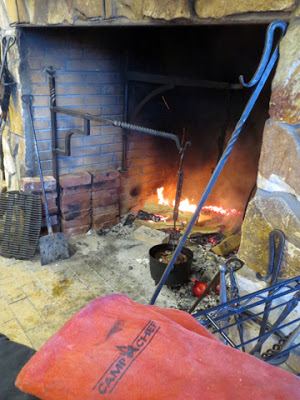
cooking class at John C Campbell Folk School
The stairs are steep in parts of the folk school!

This is another place to which I would like to return.

We passed the Appalachian trail a few times on the trip. I have read many books about this trail and perhaps will return one day to hike the whole thing. My favorite recent read about the AT is Grandma Gatewood's Walk by Ben Montgomery. If Grandma Gatewood can walk 2,000+ miles on that crazy-difficult trail twice in her late 60s and continue hiking for another decade all over the US, certainly I can manage it once.

The most amazing things I saw on this adventure, I don't have images to show you. Tommye Scanlin's tapestries are endlessly inspiring. I was able to see her workspaces and learn a little more about how she achieves the effects she does in her work. Tommye also has a piece in the upcoming American Tapestry Biennial 11 and I got to see it in person. It is a stunning piece. You won't want to miss Because of Memory.
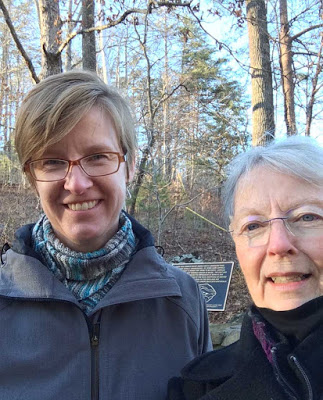
Tommye and Rebecca out for a walk in the woods in north Georgia.
Thanks for the wonderful time Tommye!
_____________________________________
*If you are not familiar with Tommye or her work, make sure to visit her blog. It is a rabbit hole you won't regret jumping down. Works in Progress. Tommye is the best sort of fiber person. She is gracious and giving and her skill in tapestry weaving is incredible. She was an art (and fibers) professor for over 30 years and at her "retirement" party a few years ago, when asked what she wanted to do now that she was retired, she said, "Teach!" She continues to teach workshops and I highly recommend any time you can spend with her. I know she has some wonderful workshops coming up in 2016 and 2017.
A visit to the south... tapestry weavers of Atlanta, Georgia

I had a great trip to Atlanta. I'm completely busted-up tired today. I kept struggling and struggling and finally admitted that I was not superwoman and that I perhaps needed to have a bit of a rest. So I'm ensconced on the couch with a glass of wine and my Beatrix Potter biography. As soon as I catch you all up on this part of my trip, I'm back to the fascinating land of Peter Rabbit and the Lake District of England.

Chattahoochee Handweavers Guild is a great group of weavers. I gave my Creating Without Pain: Ergonomics for Fiber Artists talk to the group and then the tapestry-dedicated among them joined me for two and a half days of intermediate tapestry techniques. Here is some of what they did.

This table of yarn explains my massive suitcases. Every single time I flirt with that scale at the baggage counter. Southwest Airlines will let me take two suitcases under 50 pounds and I push it to the limit. Even yarn is heavy in mass quantities.

The class was Intermediate Tapestry Techniques and I encouraged them to bring their design ideas to class and to think about which of the techniques I was presenting would best be used in their work. There was a wide variety of responses to that from Jean using alternative materials in eccentric weaving to Holly's work with water in different seasons.
Molly's value studies, transparency, and Jean working with raffia and eccentric weaving
Nancy's gorgeous color gradation with some pick and pick variations following
Katie's excellent value study resulting in come color gradation, eccentric weaving, and color blending.
Milissa's eccentric weaving. 
I really had a wonderful time with this great group of people. I had an opportunity to visit some of northern Georgia following the workshop. I'll tell you more about that tomorrow!

Rebecca Mezoff lecturing for the CHG workshop; photo: Terri Bryson

A sense of place means you bring the right shoes

There are places that resonate. Places that make me want to come back and experience them again and again. Most of those places for me are in the western USA. I grew up here. They are familiar. I love them deeply.
Emily has a sense of place rooted in the Mississippi Delta. I have the feeling it is also a very deep sort of place, but it is as foreign to me as an island in the South Pacific. I don’t know the culture or have an affinity for the smells or the bugs that are still around at New Years. I am not used to the mud and the water that is everywhere, and I don’t know what shoes to bring along.

The holidays went on for a very long time this year. We visited my childhood home in northern New Mexico. This is a place where I know I will need tennis shoes for the sand and some Gore-tex boots for the few inches of snow that will fall and then melt the next morning. I know I will find myself out on the desert or high on the hogback watching the light and the long coal trains flying down Route 66. And I know what the wait staff at any restaurant means when they say, “red, green, or Christmas?”

I try to find the same thing in Mississippi. I search Google for any place where there might be a trail in the woods and I do find one about 30 miles away on a wildlife refuge. It is only .9 miles long and the 9-year-old we take along is, though he grew up here, perhaps understandably afraid of cottonmouths. From the trail we Google a picture of them and decide we would probably see them among the leaf litter before we stepped on one in this winter-bare landscape. He is brave and we do get a walk.
But it isn’t my place. I also try to be brave and pretend that it doesn’t matter that I don’t understand the food or have the right shoes or even know what all the words I hear mean.

Now on the way home, somewhere in Arkansas, I have just finished James Rebanks’ second book, The Illustrated Herdwick Shepherd. His first book, The Shepherd’s Life, was probably my favorite read of 2015. And I think it was because of the sense of place. Rebanks is rooted to his land in the Lake District of England. That deep sense of attachment is something I think we all need.
Having a sense of rootedness in a particular place is what makes me feel safe in the world.

It helps that I know what shoes to bring.


What about you?


And the winners are...

If you haven't tuned into the American Tapestry Alliance's Tapestry Unlimited Blog Tour yet, jump on board! It is six weeks of wonderful information-packed posts from some great tapestry weavers.

If you like to start at the beginning like I do, THIS post by Vancouver Yarn is the place to go.
Janna talks about how to warp a simple loom and how to get started with the actual weaving.

The second post from last week was written by me. I give you two videos which review the basic tapestry concept of meet and separate and then help you use that concept for shading and color gradation in irregular hatching.

And the winners from my week are... Mary M. and Elysse M. You'll be hearing from ATA soon!

The third post by Terry Olson went up today. Terry gives you a look at how to use slits to create vertical lines. She also gives some great examples of tapestry artists who use slits this way. Outlining or making very thin lines can be difficult in tapestry depending on the orientation of the work, so having Terry's tips in your tool box of techniques is important.

Oh, and there are prizes for following the tour. Unfortunately, ATA members are not eligible for the prizes, but those of you who are not ATA members are going to want to make sure you enter. The best prize is a free membership because ATA is a fantastic place to learn all about tapestry. You can also win a free entry to the next unjuried show, Tapestry Unlimited, which will be shown at Convergence in Milwaukee this summer. Look for directions in each post to enter.

Here are the links for the tour! I hope to see you all there.

The Blog Tour Line-Up

December 23rd: Vancouver Yarn
December 30th: Rebecca Mezoff
January 6th: Terry Olson
January 13th: Mirrix Looms
January 20th: Elizabeth Buckley
January 27th: Sarah Swett

As for me, I just got home from an extended road trip where I did a lot of this.


Using tapestry techniques to blend color: irregular hatching

A painter can add a bit more red to her blue and make the purple she wants. A tapestry weaver has no such luxury. We either need to dye another color or use tapestry techniques to make the colors of our yarns blend optically.

One of the easiest color blending techniques is irregular hatching. Let's look at how we create this effect.


Most contemporary tapestry weavers use a method of weaving often called meet and separate, though I've had many students call it "meet and greet". This means that adjacent yarn butterflies or bobbins are moving toward or away from each other. It looks like this:
I find that this little graphic can be rather helpful for people to remember how this works.

Understanding meet and separate is essential to blending colors using irregular hatching. Let's talk more about meet and separate in a short video. (Remember that if you get my blog posts via email, you will have to go to my blog on the internet HERE or on YouTube to view this video.)


Once you understand how meet and separate works, it is a short jump to understanding irregular hatching.

Meet and separate can be used with butterflies of the same color. If two different colors are hatched together using the meet and separate technique, irregular hatching is the result.


Much of what I achieve with color gradation in my own work is done with irregular hatching. For example, in this piece, Emergence VII, all the darker shading in the teal band is done this way.
Rebecca Mezoff, Emergence VII, 45 x 45 inches, hand-dyed wool tapestry
Rebecca Mezoff, Emergence VII detail
Using irregular hatching is a great way to change colors horizontally across your warp. In the section where the two colors are overlapping or hatching together, you'll create a third perceived color. Depending on the hues and values used, this can be very subtle or look like distinct stripes.


In the image above, examples 1 and 2 were done with simple two-color irregular hatching. Notice that the places the colors meet change with each sequence and are random. When you use more similar values as in examples 2 and 3, the blending is more subtle. In example 4, the colors were mixed even further and the points where individual colors meet is lost. This is the point at which you can start to create horizontal color shifts that are seamless.

Let's look at a how to weave irregular hatching in a video. (You can see this video larger on my YouTube channel HERE. Subscribe to my channel while you're there!)


Why would we want to use irregular hatching?

If you are trying to create effects with color blending, irregular hatching is an important tool. Certainly many tapestry weavers use sharp delineations between colors in a very graphic style. Others like to blend colors to achieve more subtle gradations and movement of color. Irregular hatching is the first of many tapestry techniques that allow this kind of expression in tapestry weaving.
  
Below is another example from my own work. Notice that the colors in the five rectangles moves from yellow to red. In each of the rectangles, there were three colors. I hatched those three colors together to make the color change horizontally. There were fifteen colors total in those five blocks, three in each one.

Rebecca Mezoff, Emergence III
If you are interested in learning more about the other ways to create color movement in tapestry, consider my online course, ColorGradation Techniques for Tapestry. If you are just beginning your journey in tapestry weaving, I recommend my beginning online course, Warp and Weft: Learning the Structure of Tapestry.

Information about the blog tour

The Blog Tour Line-Up
December 23rd: Vancouver Yarn
December 30th: Rebecca Mezoff
January 6th: Terry Olson
January 13th: Mirrix Looms
January 20th: Elizabeth Buckley
January 27th: Sarah Swett

This blog tour is in celebration of ATA's upcoming international, unjuried small format exhibition, Tapestry Unlimited, which hangs in Milwaukee next summer. We hope you'll consider participating!

The American Tapestry Alliance is a nonprofit organization that provides programming for tapestry weavers around the world, including exhibitions (like Tapestry Unlimited), both juried and unjuried, in museums, art centers and online, along with exhibition catalogues. They offer workshops, lectures, one-on-one mentoring and online educational articles as well as awards, including scholarships, membership grants, an international student award, and the Award of Excellence. They also put out a quarterly newsletter, monthly eNews & eKudos and CODA, an annual digest. Members benefit from personalized artists pages on the ATA website, online exhibitions, educational articles, access to scholarships and more.

There are PRIZES for participating in the blog tour. Unfortunately, American Tapestry Alliance members are not eligible to win, but if you are not yet a member, consider entering. All you have to do is complete one of the easy social media options in the Rafflecopter box below, one of which is leaving a comment on this blog post. During each of the six weeks of the tour, there are two prizes. One is a free ATA membership and the other is an ATA membership plus a free entry to the unjuried small format tapestry show (tapestries are not due until March, 2016). You can enter every week by following the instructions in the blog post. Many of the bloggers will be using Rafflecopter. Others will choose winners from those who commented on their post.

Some options can be done every day to increase the chances of winning one of the prizes. ATA is a fantastic source of information about tapestry weaving, so don't miss this chance for a free membership!

a Rafflecopter giveaway


And even if you don't want to enter to win, please leave a comment below and share this post with your friends and weaving buddies.


Road trip!

It is always good to get back to the land of big skies.
On our way through northern NM, we stopped at Mabel Dodge Luhan house in Taos. It was a magical place with snow falling on the adobe walls and flagstone walks... just a few days before Christmas.

Mabel Dodge Luhan hosted many famous artists in the 1920s including D.H. Lawrence, Willa Cather, Georgia O'Keeffe, Ansel Adams, and Frank Waters.
We arrived in Gallup ahead of a snow storm and settled in for a Christmas with some little girls.

A new dollhouse was made by grandpa-Santa for two little nieces. Aunt Becky put her Hokett loom to work to make this silk rug.
And it was put to good use.
There was much book reading, coloring, glueing, and general hilarity. The Lorax went over well, but the favorite is always Richard Scary.
I visited an old tapestry which was a commission for this church in Gallup, N.M. The piece is called Anthem. It still looks great! It was one of my favorite color gradation pieces to weave.

I hope you all had a wonderful week.

The hardest decisions of all...

I decided Sunday was the day to tackle the most difficult set of decisions before the upcoming extended holiday visit to family. I care very little what clothes make it into the suitcase and I know if I grab my Kindle I can always find something to read.

Nope. Which projects to bring along is the big question. This gathering of fiber is fraught with a fair amount of fear. After all, being caught without anything to spin, knit, or weave when far from home is bound to cause some anxiety. If it lasts for two weeks, I might be looking for some valium (or more likely a yarn shop).

There are many considerations. The first is space in the car. I really wanted to bring the spinning wheel, but a few sweet and well-timed comments from Emily made me realize that there wasn't room... besides, did I really want my father, nephews, and brothers-in-law to mess with it? Seriously. These people can't keep their hands off a spinning wheel even though they have no idea how to spin actual yarn. Nope. The Ladybug stays home where she is safe.

But that meant I packed the Jenkins Lark spindle. I even picked up a little Sweet Georgia braid to have something entertaining to spin (passage through the state of Oklahoma warranted this purchase all on its own).

From there things got harder. There is a definite need for simple projects. There will be much sitting about, talking, and potentially even some mandatory football-watching (though I can hope to escape that). In a football-type situation, I can knit something harder. I know nothing about football and as long as I look sufficiently jolly when the team I'm supposed to be rooting for makes the ball go through that post thingy, I can concentrate on the pattern. But there will also be a lot of people. The couch will be crowded. There is no room for a sweater or other large knit. For this situation I have packed a ball of sock yarn (which I have already swatched!) and my Two-At-A-Time-Toe-Up book. I finished my first set of sample socks and I think I'm ready to try a real pair.

For the situations involving Christmas movies with fewer people, I can pick up the larger projects I have to concentrate on. The Aventurine sweater that Emily has been waiting for for almost two years WILL get done this holiday... especially if the nieces and nephews get enough movies to watch and I am allowed some illumination. I got a little discouraged when I couldn't get the Kitchener stitched hood top to finish correctly (resulting in a lengthy stubborn insistence that this sweater didn't even exist). But eventually I decided I had to move on and maybe my mother could help me fix it. Now I'm on to the plain stockinette of the body and sleeves. Home free baby.

For the rest of the time when I have to be participatory in the family conversation, board games, or just generally look like I'm paying attention, I have packed yarn for a cowl (which I have already swatched!). This was a request from Emily and she is REALLY hard to buy holiday gifts for. I couldn't find an appropriate pattern, so I found a stitch that I liked and I'm going to make the rest of it up on my own. I already respect knitwear designers a LOT more.

And of course there has to be a backup project. What if I run out of knitting? I have finally realized that my spinning teacher is right and I have to actually use my handspun if I want to become a better spinner. My winter hat is an old purple thing I knit about a decade ago. I think it is time to attempt a new hat with my handspun. I even bought 40 inch needles to try the magic loop method.

And as always, I'm still knitting these. I pretty much have a forest now.

I also had to bring some weaving. There are a certain pair of little girls who's grandfather has made them a dollhouse. I am anticipating a sudden need for small doll blankets (thus the Zoom Loom) as well as rugs and tapestries for the new house. I believe a 6 and an 8-dent Hokett loom should be able to produce the required floor coverings and artwork.
Now all I have to figure out is how to hide the fact that I just packed nine different fiber projects for a two-week trip. Maybe I can use decorative cookie tins for project containers... then they'll just look like gifts, until someone gets hungry.