How long did that take you to weave?

I get that question a lot.
How long did that take you to weave?
Sometimes the question is half-shrieked. The silence as they wait for an answer feels a little tinged with anxiety, perhaps fraught.

The answer in the past has always been some vague statement about the process being more important than the time it takes. There is undoubtedly some actual number of hours that a tapestry took to produce, but frankly I have little idea what that number actually is. One time I kept track on a medium-sized piece and the number was 210. But I didn't subtract the trips to the bathroom or the making of tea (those two things are related). And I never to counted the months of designing or the weeks of dyeing yarn and winding balls. Or the finishing or photographing. I'm getting a little woozy thinking about it.

All in all, a tapestry takes a long time to be born.

So I have a new answer to that most troubling of questions.
The answer is, "It depends on the number of decisions I have to make." (Frankly it also depends on the number of cups of tea I drink because of the bathroom thing and how many times I get interrupted by annoying life details which usually involve email or money.)

Decisions. Of course they all have to be made at some point. But I can tell you that if I'm in a stretch of weaving where all the colors and forms have been decided, the weaving flies by. So a piece that is part of a series might actually take a lot less time if it is related to something I've done before. I've already made the decisions.

I'm pretty sure most tapestry weavers hate the "how long did that take" question. We're not sure if it is better for it to be a small number or a large one or if the person asking even really understands what any number at all means anyway. Until someone sits at a loom and experiences the placing of pick after pick themselves, the way time flows while weaving won't be something they understand. Time is different at the loom. It is both slower and faster.

And so the length of time a tapestry takes is the time it takes. But I maintain that number of decisions play a big part in it.


There is always that person who won't back down until a they get a number. I now just say something like, "It took 593 hours to make this." Then I smile sweetly and walk away. They shouldn't argue with the price after that.

Don't waste your time with explanations: people only hear what they want to hear.
 -- Paulo Coelho                            

What is your experience with this question? I'd love to hear it in the comments.
If you liked this post, please share it!
You can follow my daily process photos on Instagram at @rebeccamezofftapestry. I am almost done with a big tapestry. No, I don't know how many hours it took. Probably 593.

The last bits of childhood

Over the holidays, my sister instigated a little rummage through the basement at our parents house. After all the toys and dollhouse furniture for the kids was found, this box surfaced.

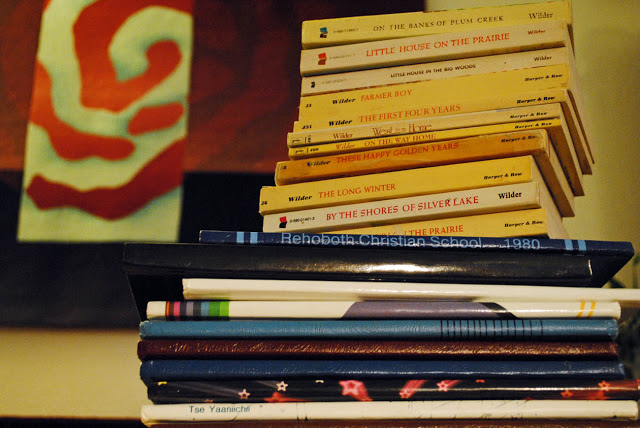
There were many things in that box I had long forgotten about. I had written off the school yearbooks as lost and thought the book collection had gone to a library donation. But there they were. Eleven yearbooks and the full set of Little House on the Prairie. (I was especially thrilled about those as I just finished reading Laura Ingalls Wilder's annotated autobiography, Pioneer Girl. I know. Geek.)
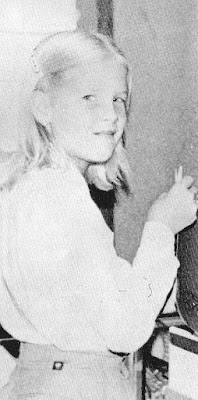
I thought perhaps those yearbooks might contain some good blackmailing material, but alas, the yearbook photographer (me, for a few years), was too conscientious about choosing photos that didn't look completely stupid.
Sixth grade...
Apparently in my senior year at Gallup High School, I won a couple band awards. I have no memory of this at all. But there they are. Photographed and ready for recycling in my father's woodshop. What I do wish is that I had a kindergarten diploma. That is the kind of thing you want hanging next to your college diplomas. Actually, I don't even know where my college diplomas are. The kindergarten one is probably the most important. What we learn there is what gets us through life, right?
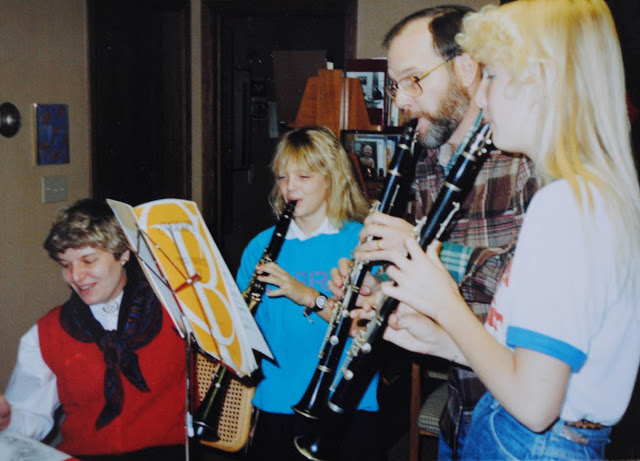
I played the clarinet. It is upstairs in the closet. I still remember how it sounded when I was good (for a high-schooler). I don't get it out now. I don't want to go back to junior high ever, even in my mind. But here is a flashback for you that I use in my ergonomics for fiber artists lecture. I am the slouching blonde with the 80's feathered hair. The other blonde is my younger cousin Molly. She went on to be an outstanding violinist and is now my most favorite children's book illustrator, artist, and superb art teacher to inner-city kids ever. If you want to see her work, her name is Molly McNeece and her website is HERE.
I had some trouble with my wrists from playing the clarinet. That is why this photo is part of a class I teach called Creating without Pain: Ergonomics for Fiber Artists (see my YarnFest schedule if you want to take it). I translated the musical interest to weaving drafts and eventually to tapestry weaving. Yep. From nerdy clarinetist to super-hip mid-life tapestry artist.

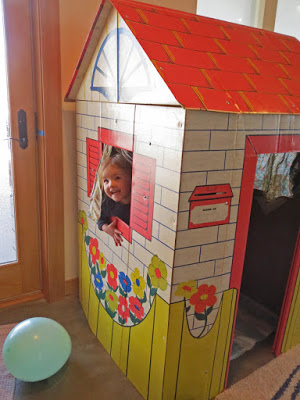
The digging in the family basement went on for awhile. The cool metal and wooden toys we played with surfaced, now adored by my nieces. This playhouse circa 1976 also emerged... and was set up for the little ones. The good thing about it is that it is entirely cardboard and can be recycled when my sister is tired of tripping over it.
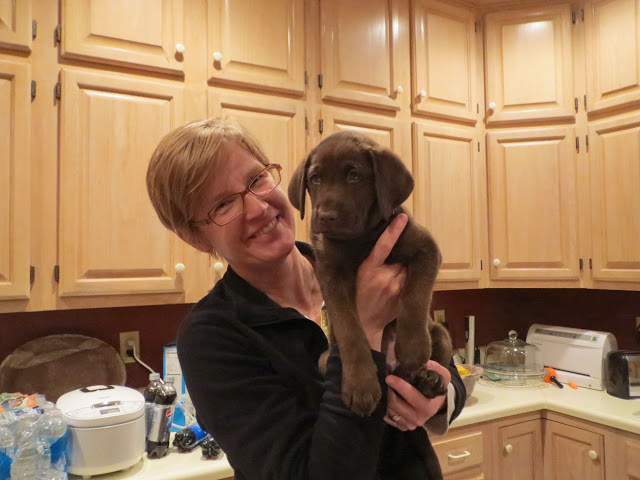
My brother-in-law has a new chocolate lab. Six weeks old and cute as a button. I think there is a family conspiracy to drive his wife nuts by calling the dog by the three-year-old's name for him. "Woop" is a great name for a dog, right? (His real name is Luke, but who wants to call a dog that? Three-year-olds can't say the L very well.)

Somewhere in Kansas the gas is $1.49/gal. Makes you feel like you're in high school again and filling up the car from the money you earned working weekends at the fabric shop.

If I haven't told you yet, Happy New Year. (a month late)


So Warped. Startitis for weavers.

Kathe Todd-Hooker sold these bumper stickers at one point.
Knitters talk about startitis. It is that thing that happens when suddenly you have to cast on another project even though you have four projects you're willing to admit to in your knitting basket and five or six more in the back of your closet that you're not. I had a similar affliction last week on the weaving front.

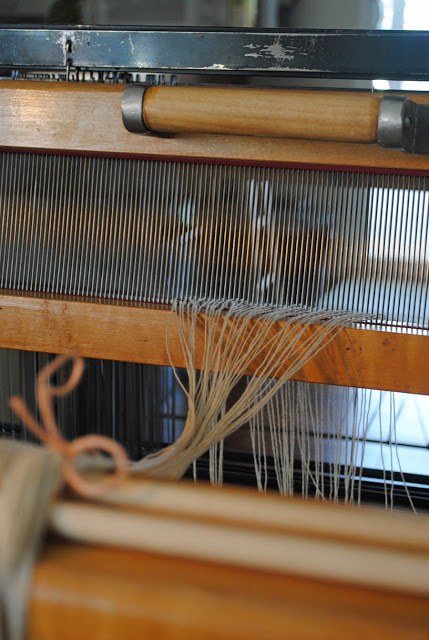
I warped three looms. Sometimes these things just happen... and looms get warped. They were all small projects as the big lifeline project on the Harrisville is not done yet. Maybe I just needed something small to work on until that big thing in the studio is finished. Something I can wrap my head around. Something simple.

Loom #1
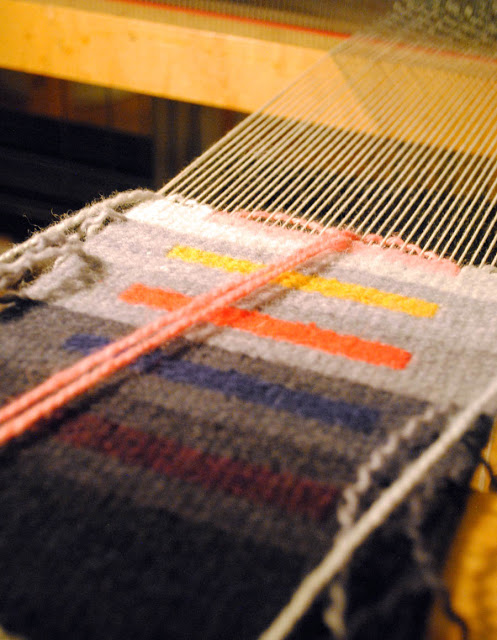
I warped the big Macomber for some samples for the Simultaneous Contrast color class I'm teaching at YarnFest this year. I'll be trying some new color combinations for examples in this fascinating perceptual thing that is color. It is all rather Itten/Albers, isn't it? The exercise below is a value study. I bet you can see where I am going to dye another step in the grayscale?!

This loom is a 48 inch Macomber floor loom, 16 harness (of which I only ever use four). It is the only jack loom that I currently recommend for tapestry weaving.

Loom #2
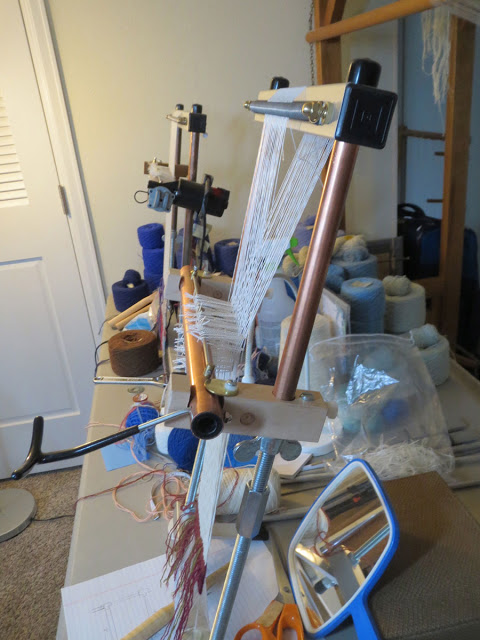
After reading Sarah Swett's fantastic blog post about four-selvedge warping, I had the bug to try it myself. I had been putting it off until I make a pipe loom, but decided that since I had some empty Mirrix looms sitting around (the "empty" part being fairly rare), I should just try it now. That project involved a trip to the fly shop. Not being a fisherman, it was quite the adventure. I thought for a second I had wandered into a bead shop with the rooms full of little boxes with little things in them! (turns out those were flies for fishing, not beads) At any rate, the men working there were not so sure what I was going to use the fly line backing for, but the word "weaving" seemed to ring a bell.

After the fly store, I made a trip to the hardware store for some PVC to make a jig. Worked like a dream. With computer next to me, following Sarah's instructions, the deed was done.

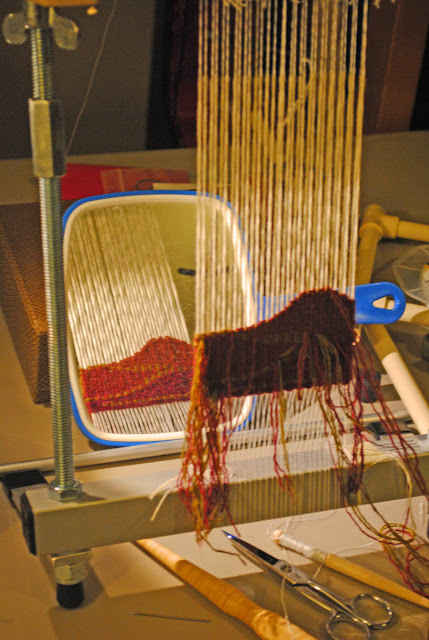
Here is the problem with the way I warped it. Usually on a Mirrix there are two complete layers of warp. For four-selvedge, the two layers of supplemental warp have to be pulled together and the fat beam at the top of the Mirrix means that the shedding device isn't going to work at the top of this piece. And I even put the short extenders on this Little Guy loom. Next time I do this on the Mirrix, I am going to suspend a thinner rod under the top beam. This will mean I can't use the coil for spacing, but in this case I think it will be a worthy sacrifice. Or this would be a case to consider using the long extenders (which I do not own yet).
Here is the work so far! This is the late-night magic weaving this week I talk more about in my newsletter today. (Sign up here if you haven't already!) It kind of looks like magic, doesn't it?

Loom #3
The third loom was the baby Macomber. This was my grandmother's very first loom which she bought after seeing a cottage neighbor at Eight Point Lake weaving. It is a very old piece of equipment (and still going strong, BRAVO Macomber!) I warped it for an experiment in Swedish weaving I participated in at Shuttles, Spindles, and Skeins in Boulder last weekend. Joanne Hall was teaching. This is a linen warp in three colors, three ends woven as one.
I went to the workshop hoping to broaden my horizons with some options for my own work. I found that I was frustrated with the chunky nature of the weave. Joanne presented some excellent reasons why you might want to use this weave structure for very large pieces. It is lighter than a weft-faced work would be (I'm not actually positive this is true since there is so much more yarn going in there even though it isn't packed as tightly) and it is faster to weave (this is absolutely true--it flies off the loom).

I took a class from Helena Hernmarck in 2013 and you can see the images from that class and Helena's show HERE. This class was not like Helena's class and I struggled for the take-away. I'll let you know what I come up with.


Three different warping methods. Three different weaving methods. Mixed results in all cases.
The possibilities in tapestry weaving are many! I think we may only be limited by our imaginations.
No more warping until I finish the big tapestry.

Snowmageddon showed up after all

I am always amazed at how freaked out people in Colorado get at the threat of a little snow. I expect it from people in the South or even in New Mexico (where it does snow sometimes!). But I really think Colorado should be able to handle the white stuff.
I blame the hype entirely on the media. Days and days of, "the world is going to screech to a halt as a massive storm slams into the Rockies undoubtedly stopping the world on its axis and causing your corner supermarket to be out of white bread. Prepare yourself! (here is how to do it... watch Channel X news continuously for the next week and talk endlessly with your colleagues about how horrible it is going to be and maybe we should just stay home)"

When the promised storm brought little snow on Sunday, I scoffed. But the hype continued.
Yesterday it started snowing.
And it didn't stop.
And I shoveled.
Twice.
And still it didn't stop.

I went to the grocery store.
There was still white bread, but I was hard pressed to find Swiss cheese.

I got some unexpected help from TWO neighbors with snow blowers at dusk last night. Turns out the 40-something dads who have kept that old rusty thing in the back of the garage for the last five years unused, will bust it out when the snow total exceeds 10 inches. Or maybe they just felt sorry for the sweaty lady with the deep corner lot.

And still it didn't stop.
And today Colorado State University and all the schools were cancelled and the roads were quiet except for the snow plows.
It has stopped.

I gave up the shoveling effort after two-thirds of a two-car driveway and 50 yards of a 200 yard sidewalk.
I'm hoping one of those neighbors gets frisky with that snow blower again.
I'm going back to weaving.
Because that is my post-apocalyptic life skill.


That sign with your name on it in the airport greeting area.

You know that thing when you come up the impossibly long escalators at Hartsfield-Jackson Atlanta International Airport? The one where you've just told yourself thirty times not to look behind you because it is a long way down and you're not sure the 100 people behind you on the escalator are going to appreciate you toppling them all like Dominoes (but you can't hold on because of GERMS!)? That thing where someone is standing there with a sign with your name on it waiting just for you and you are so relieved because managing two carry-ons and two suitcases big enough to fit small children in is always more adventure than you want after a three hour flight? I didn't either until my last trip. It made me feel kinda great in that rather self-conscious way. I mean, who gets a greeted with a sign upon arrival? Unless of course you're returning from a tour of duty for the armed forces or you've just had a new baby or something. Those people totally deserve it.
(Thanks for the sign Molly. Next time I'm taking a picture to prove it happened!)

Today I was updating the Reviews page on my website. This is the place I put the kind words people send me about my online courses. The comments make me feel kind of like that sign at the airport. I mean, I work really very hard at making my courses the very best I can, but still... the review page is a little embarrassing. The comments are wonderful and they keep me working hard at new content and at updating the current courses as I improve my video and technical skills. There are so many comments that I now have to rotate the ones I leave up. I have enjoyed teaching these online courses every single day. And I have learned more than I will admit to so much from all of my amazing students.

If you want to see some of the great things they have said about my current two online courses, Warp and Weft: Learning the Structure of Tapestry and Color Gradation Techniques for Tapestry, you can find the good stuff here:

http://www.rebeccamezoff.com/reviews/

Thanks to everyone who has contributed and for being willing to share your work in the videos I make. The variety of work that comes out of these classes astounds me. And that is what makes me get up in the morning. Well, that and the fact that no one really probably needs more than 10 hours of sleep a night.

Once my brain clears, I have had my green smoothie and a cup of tea, and I have a little sit-down at the loom myself, I am curious to see what new marvels these students will have created and sent me photos of. They never disappoint! In fact one of them was just accepted to the American Tapestry Biennial 11. I am in no way taking credit for that one. She was always awesome. But still. Pretty cool.

Thanks to all of you!

If you're interested in either of my online courses, you can find more information here:

http://www.rebeccamezoff.com/online-learning/

Look for the links at the top of that page for even more information about each class.

I just opened some new classes for 2016 and they are waiting for new ideas and energy.
I'll see you online!

An experience of northern Georgia

I haven't spent any time at all in Georgia. I've flown through Atlanta a few times and marveled at the size of the airport. But I had never left the airport bubble until last week.

After teaching for the Chattahoochee Handweavers Guild in Atlanta, Tommye Scanlin* picked me up and we had a wonderful adventure in northern Georgia.

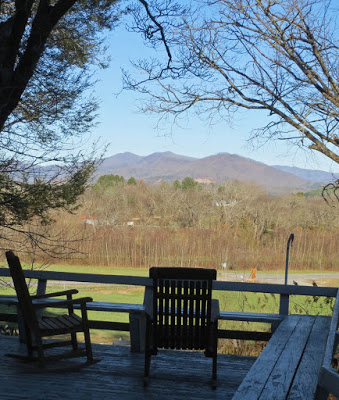
Remember that I am from the American Southwest. I am used to adobe and sand and canyons. North Georgia is a place of big trees, rolling hills and mountains, houses with big porches and white columns, and an accent that I love to listen to.

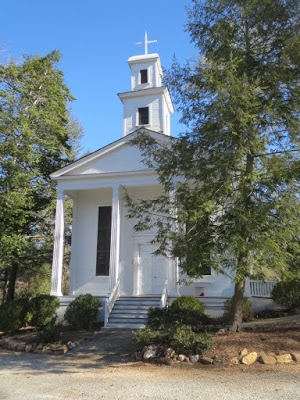
We started our adventure with a visit to Patricia William's Communion Tapestries at Grace-Calvary Episcopal church in Clarkesville, GA. The church is a beautiful old white building tucked into this little hillside town. It is the oldest church building still in use in north Georgia, dating from 1838.
Grace-Calvary Episcopal Church, Clarkesville, GA
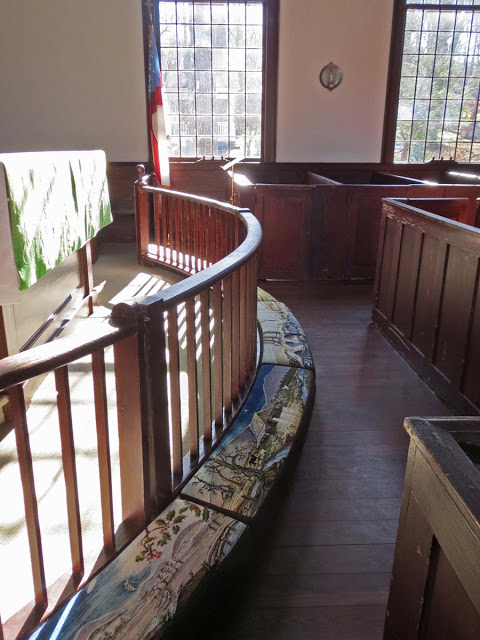
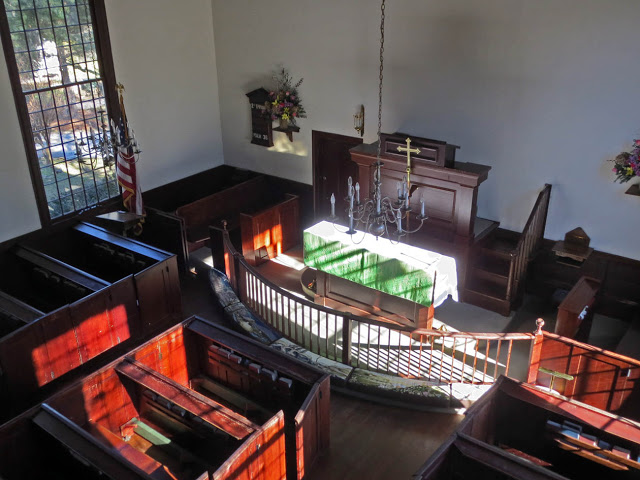
The tapestries are a set of five panels installed as communion kneelers. Yes, the fact that people actually kneel on them makes me gasp. But they have been in use for quite a few years now and they look fantastic. They look like they are woven at 8 epi and shaped are to fit the curve of the kneelers. They are themed for the liturgical year: Advent, Christmas, Lent, Easter, and Pentecost. In typical Pat Williams whimsy, they tell the stories well.
Pat Williams Communion Tapestries
Here are a few details.
Pat Williams, Communion Tapestries, detail of Easter panel
Pat Williams, Communion Tapestries, Christmas panel
This detail captures the wonderful movement Pat has in her work. It is so engaging. I would recommend visiting her tapestries wherever possible (she has one in the upcoming American Tapestry Biennial 11) including a stop at this church to view this series.
Pat Williams, Communion Tapestries, detail of Pentecost panel
From Clarkesville, we visited some wonderful residency centers: Lillian Smith Center and The Hambidge Center. Inspiration winds its clever way through both of these places and I will be drawn back in the future.

We went to John C Campbell Folk School. Unfortunately the weaving class was not in session, but I was able to get a good look at the studio through the windows. What a wonderful place.
John C Campbell Folk School
John C Campbell fibers building
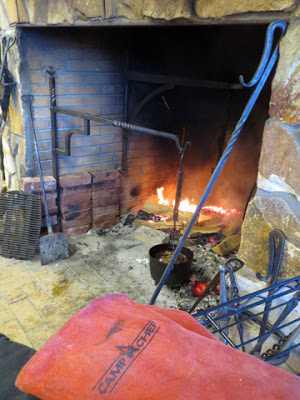
After a very chilly walk around the grounds (who knew I'd need my warm winter coat in Georgia?), we stopped in at this wood-fired cooking class. They didn't have samples for us, but it was very warm in there.
cooking class at John C Campbell Folk School
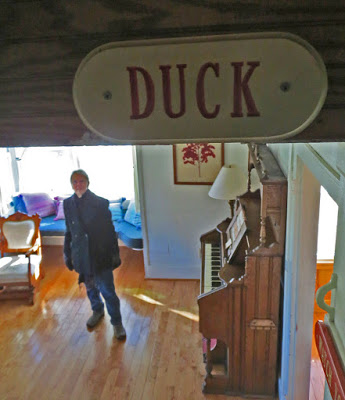
The stairs are steep in parts of the folk school!

This is another place to which I would like to return.

We passed the Appalachian trail a few times on the trip. I have read many books about this trail and perhaps will return one day to hike the whole thing. My favorite recent read about the AT is Grandma Gatewood's Walk by Ben Montgomery. If Grandma Gatewood can walk 2,000+ miles on that crazy-difficult trail twice in her late 60s and continue hiking for another decade all over the US, certainly I can manage it once.

The most amazing things I saw on this adventure, I don't have images to show you. Tommye Scanlin's tapestries are endlessly inspiring. I was able to see her workspaces and learn a little more about how she achieves the effects she does in her work. Tommye also has a piece in the upcoming American Tapestry Biennial 11 and I got to see it in person. It is a stunning piece. You won't want to miss Because of Memory.
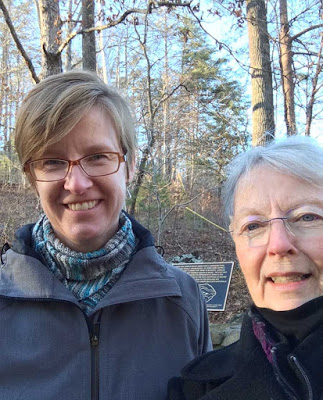
Tommye and Rebecca out for a walk in the woods in north Georgia.
Thanks for the wonderful time Tommye!
_____________________________________
*If you are not familiar with Tommye or her work, make sure to visit her blog. It is a rabbit hole you won't regret jumping down. Works in Progress. Tommye is the best sort of fiber person. She is gracious and giving and her skill in tapestry weaving is incredible. She was an art (and fibers) professor for over 30 years and at her "retirement" party a few years ago, when asked what she wanted to do now that she was retired, she said, "Teach!" She continues to teach workshops and I highly recommend any time you can spend with her. I know she has some wonderful workshops coming up in 2016 and 2017.

A visit to the south... tapestry weavers of Atlanta, Georgia

I had a great trip to Atlanta. I'm completely busted-up tired today. I kept struggling and struggling and finally admitted that I was not superwoman and that I perhaps needed to have a bit of a rest. So I'm ensconced on the couch with a glass of wine and my Beatrix Potter biography. As soon as I catch you all up on this part of my trip, I'm back to the fascinating land of Peter Rabbit and the Lake District of England.

Chattahoochee Handweavers Guild is a great group of weavers. I gave my Creating Without Pain: Ergonomics for Fiber Artists talk to the group and then the tapestry-dedicated among them joined me for two and a half days of intermediate tapestry techniques. Here is some of what they did.

This table of yarn explains my massive suitcases. Every single time I flirt with that scale at the baggage counter. Southwest Airlines will let me take two suitcases under 50 pounds and I push it to the limit. Even yarn is heavy in mass quantities.

The class was Intermediate Tapestry Techniques and I encouraged them to bring their design ideas to class and to think about which of the techniques I was presenting would best be used in their work. There was a wide variety of responses to that from Jean using alternative materials in eccentric weaving to Holly's work with water in different seasons.
Molly's value studies, transparency, and Jean working with raffia and eccentric weaving
Nancy's gorgeous color gradation with some pick and pick variations following
Katie's excellent value study resulting in come color gradation, eccentric weaving, and color blending.
Milissa's eccentric weaving. 
I really had a wonderful time with this great group of people. I had an opportunity to visit some of northern Georgia following the workshop. I'll tell you more about that tomorrow!

Rebecca Mezoff lecturing for the CHG workshop; photo: Terri Bryson