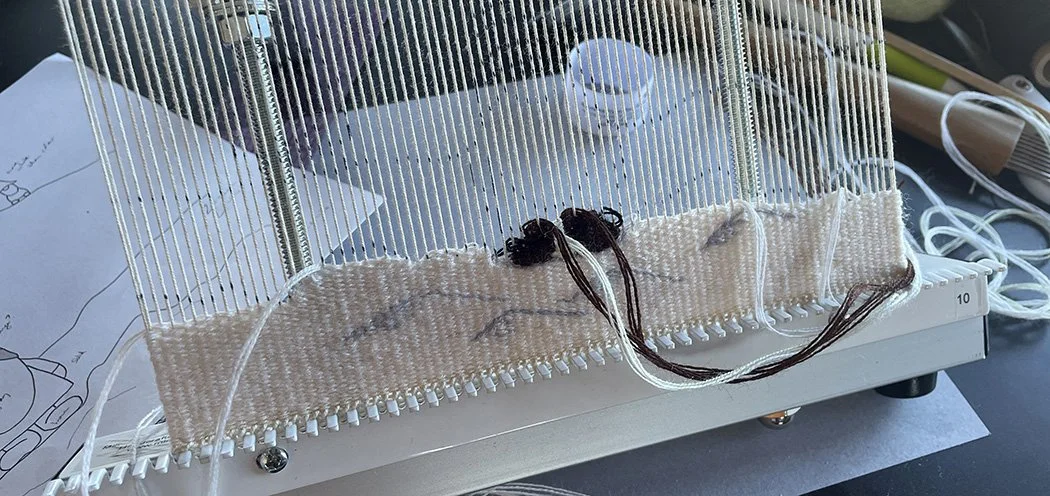
I recently got one of the new Mirrix 10 inch Chloe looms. If you’ve been watching Change the Shed you can see me weaving on it there (links below).
If you haven’t seen this new version of the Chloe loom from Mirrix, it is different from the 5 and 8 inch Chloes because it has two threaded rods. It still has interchangeable sett combs though you have to purchase the set separately. I like that I can work at 8, 10, or 12 epi on this loom with an easy warping just by changing those combs. Sure, you can warp an 8-dent loom irregularly for other setts, but the ease of warping something like this is pretty attractive!
Mirrix 10 inch Chloe loom
I’ve included a video of me putting this loom together with the following focuses:
I warped the loom with the original shorter rods and quickly decided that for me, I wanted more length. So I was changing out the regular length rods for the longer 20 inch ones when I had some issues with the nuts. These are not Mirrix problems, these are basic physics problems. Thanks to a smart student in a recent retreat (Thank you Jon!), I knew what to do to fix the problem. In the video I’m using the two-nut technique to loosen another nut on the threaded rod.
The second half of the video is me putting the loom together. If nothing else, you’ll appreciate that even people who are supposed to know what they’re doing can be a mess when it comes to using wrenches (apparently). 😜
NOTE Feb 2026: The amazing Sandy from Mirrix manufacturing let me know that the way I put this loom together was not quite right. I wondered in the video about the washers and I did not put them where Mirrix intended them. It all works, but is probably better for the aluminum beams if you do it the way Mirrix says! There is a washer that goes with each hex and wing nut except for the bottom cap nuts. The stand gets two washers, one on each side of each of the feet. There are very clear instructions on this page of their website which I recommend following when you put your loom together! https://mirrixlooms.com/pages/set-up-and-warping-instructions
Change the Shed episodes where I’m weaving on this loom:
I suspect I’ll be weaving on it more in future episodes as well.
What do I think about the new Mirrix Chloe tapestry loom?
I believe I will be using this loom a lot. I like the narrower Chloe looms as well, but this 10 inch loom has two rods so it doesn’t twist at all. I find that the 5 and 8 inch Chloe looms are wonderful small looms and my only reservations about them are that until the warp is on and tight, they will twist because there is only one supporting rod. I warp those looms flat on a table and usually have no issues. But the addition of another threaded rod on the 10 inch Chloe is a game changer for me. This loom is stable and solid and a really nice addition to the Mirrix line.
They’ve added powder-coated combs and the teeth are bent backwards 5 degrees to help the warp stay on them.
I like that the loom can be fairly small and portable but because of the two rods will work nicely propped on my lap or even on the couch. I can use my classic 8 inch Lani loom in a similar manner with the Shasta combs, but that isn’t a loom that is quite as easy to use on my lap being heavier and having legs.* I tend to use that loom with extenders for long samples or long narrow pieces. The 10 inch Chloe give me the option of making a small piece that is wider with the advantage of the quick warping that pegs give you and the ability to change out the pegs for different setts.
Looms are just device to keep warp under tension so we can weave across it and they don’t have to be fancy. There are looms out there that work for whatever it is you want to make and matching your intended creation to the loom is an important step. A Mirrix is a fancy pipe loom and you can make a pipe loom for a lot less money. But a Mirrix does give you some advantages!**
*If you order a Lani loom which is one of my most used Mirrix classic looms (8 inches wide, weaves to 5 inches and is great for samples or small pieces), order a second leg. The loom doesn’t come with two legs and that is the most frustrating thing! It is not stable without the second one, so yes, you have to purchase it separately, but do it right from the beginning.
**What are those advantages? From my experience teaching thousands of people online, here are some reasons to get a pre-made loom over making one yourself:
You don’t feel you’re handy enough to manage making a pipe loom (I might argue with this, but it is fine if you don’t want to go to the hardware store!).
The classic looms have shedding devices which are really nice for faster weaving.
The pocket Mirrix looms have pegs that mean you can warp them very quickly.
Of course pipe looms and Mirrix looms all have tensioning and that is a really nice feature for a tapestry loom. It isn’t absolutely necessary, but it sure helps a lot!
I have a whole course about tapestry looms if you want to dive further into how to choose one for yourself.
Match your dreams with the perfect Loom
Choosing a tapestry loom can feel difficult. It is hard to know what is out there and then to settle on one you can afford but that will also do what you want it to do… if you even know what you want it to do!
We’ll discuss why particular looms are best for some projects and not great for others as well as other concerns such as where in the world they’re available, what yarns you can use on them, and price.