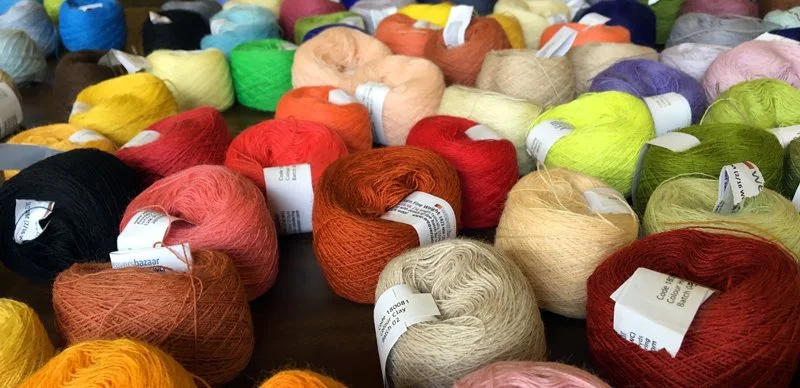
This article was written for and published on the weaversbazaar newsletter in February of 2026. You can sign up for your own copy on their website.
Ah yarn, the most fabulous of materials!! I suspect many of us love yarn quite passionately and we’d fight fiercely for our stashes. My tapestry yarn stash is full of a wide variety of yarns, but I have favorites that I come back to repeatedly depending on what I am weaving. The most important consideration in my opinion when choosing a weft yarn for tapestry is what idea you’re communicating and what material will do that the best.
weaversbazaar in a small sketch tapestry
For example, one of my favorite yarns is weaversbazaar. I suspect it is one of yours too if you’re reading this newsletter! I love that it comes in two sizes and that I can mix them easily in a weft bundle. I love that it is worsted spun, a little shiny, and it lays nicely in the shed. I have a conversation with my yarns as I’m using them and weaversbazaar is not a yarn I ever have to swear at. It stays where I put it.
Another yarn I use a lot is Gist Yarn’s Array. This yarn is less firmly spun and about the same size as the medium weaversbazaar. It is also a bit fuzzier than weaversbazaar. I like that the strands play well together when bundled and that this yarn also stays where I put it.
What about color? I see huge differences in yarn lines in the colors they offer. For my bigger scale personal work I dye my own yarn to take away this variable, but when weaving smaller pieces, I most often use commercially dyed yarns. Weaversbazaar and Array both have a lot of colors but the palettes are very different. Gist has chosen a base number of colors and then dyed them in 5-6 depths of shade (values). Weaversbazaar doesn’t have this consistent approach to gradation, but they do have a much wider range of colors that feel deeper and more complex than Array’s. And WB does have some beautifully dyed gradations in the same formula as well. Palette is obviously very important to what you’re depicting in your woven art, so the colors available in a yarn line are important to consider.
Color cards: L —> R are weaversbazaar, Gist Array, and Appleton crewel/tapestry
One of the fun thing about these two yarns is that you can use them together in a bundle. While I haven’t done this extensively, I have had good luck mixing Array and weaversbazaar in either weight in small tapestries. This means that if I am weaving something with Array and using their Sapphire blue color which sometimes isn’t violet enough for me, I can add a strand or two of weaversbazaar Periwinkle or Red-Violet and warm that blue up a bit. Mixing these two yarns really expands my available palette.
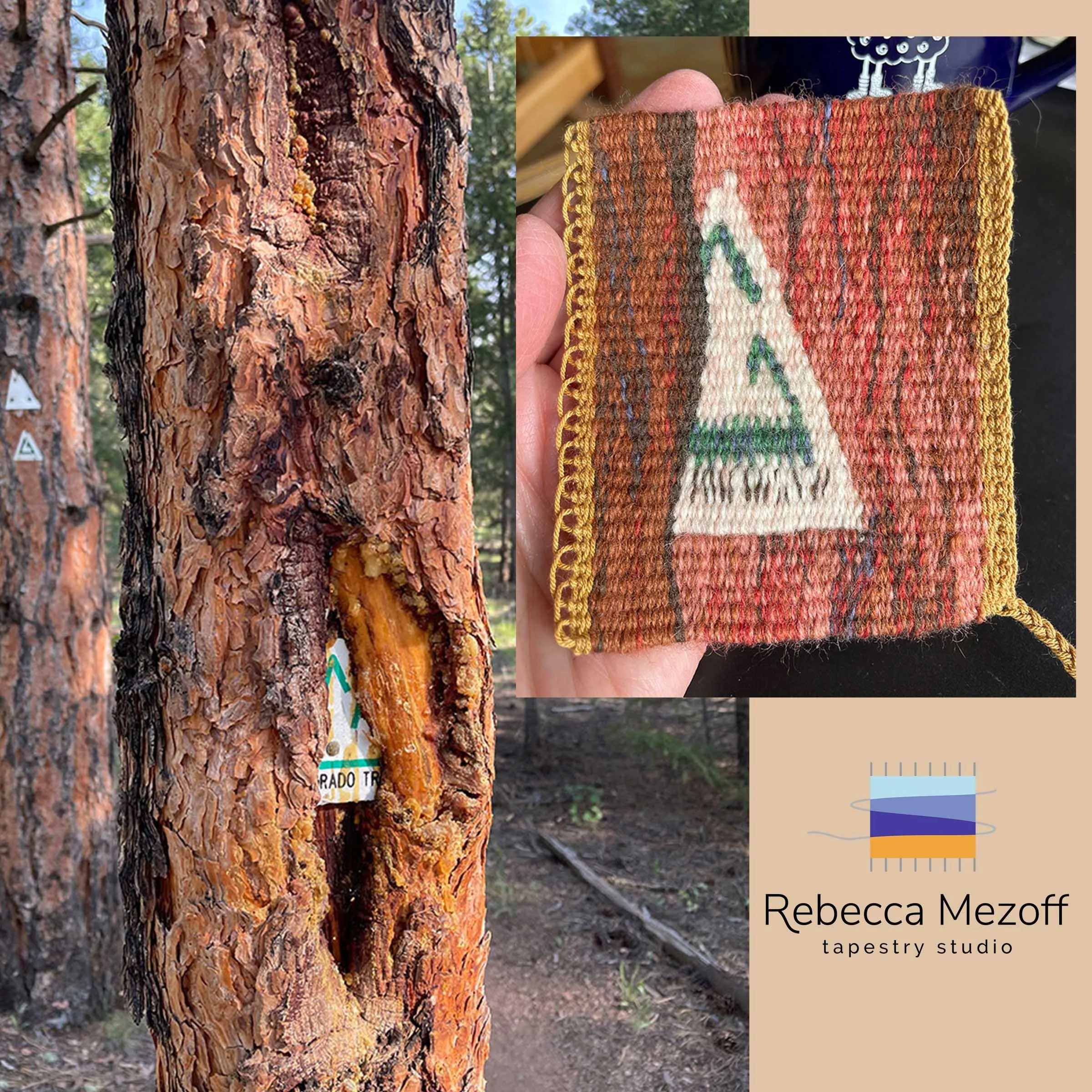
Sketch tapestry piece based on a Colorado Trail confidence marker using Gist Array weft.
There are other yarns I love. My large format works are woven with Harrisville Designs Koehler Singles which I dye myself. But a similar commercial yarn is Farö made by the Swedish company Bockens. (Bockens makes a few other yarns that work for tapestry as well, some thicker, some thinner). Farö is very different in character than Array and WB in that it is thicker and fuzzier. Yet you can also mix WB with Farö to good color and textural effect. The fuzziness of the Farö just seems to accept other yarns mixed with it.
A sketch tapestry done with handspun after this lazuli bunting on my bird feeder.
Other yarns that people frequently like to bundle are Appletons crewel and EPiC (just announced it is coming back into production). These yarns are also thin yarns but they are not as firm as weaversbazaar or even Array and they act differently in a bundle. Sometimes you might want to use one of Appleton’s myriad of colors (over 400) to find just the right hue and in that case, mixing it with weaversbazaar can make the yarn less squishy. After all, Appletons yarns are made for embroidery and they’re a bit soft for tapestry.
The bottom line for me is that I do tend to use weaversbazaar or Array separately. I like the cohesiveness that comes with using just one type of weft yarn at a time or at least in one shape. But they play well together. I think beginners can successfully use these two yarns mixed in a bundle and with more experience, experimenting with Appletons crewel, Farö, or EPiC. I’d say most of the time if I’m mixing different weft yarns in my bundle it is for reasons of color. For this I love having a lot of weaversbazaar fine lying around because even one strand can shift a hue that isn’t quite right to what I want.
What characteristics should I look for in a tapestry yarn?
I often get questions about what makes a good tapestry yarn in general and my benchmarks are these:
Not stretchy—I don’t want my yarn to have much end to end stretch because it makes it hard to control in the weaving.
Firmly spun—this impacts the point above but also means you can weave a form that isn’t going to keep squishing and squishing as you beat. Embroidery or knitting yarns are quite soft and tend to pack in a lot. And a firm spin means that since the yarn isn’t getting packed to death, the character of the fibers can shine through because they aren’t compacted into cardboard. I especially appreciate weaversbazaar for this factor. It is very firmly spun.
How does the yarn reflect light? A more firmly spun yarn will look shinier than a fuzzy yarn. Also a yarn that is made with a longwool will be shinier than one that is made from a shorter staple wool. Farö is shinier than Harrisville Koehler Singles even though they’re almost identical yarns because Farö has a longwool sheep breed in their fleece mix. A shiny, firm yarn WILL show the weft relays a lot more than a fuzzy yarn. Make sure to consider this when deciding what the priority is in your finished image.
How thick is the yarn? Can you bundle it or can you only use one strand at a time? The more strands you put together, the more color options you have. But a bundle with more strands can be a little trickier to manage in the weaving depending on the equipment you’re using and you may not see the super smooth surface you could get with a one strand yarn option like Harrisville Highland or Crown Colony.
Sample! Materials are fascinating. I recommend purchasing a few colors of weft yarns you’re interested in and weaving a sample or a small tapestry with them. This is the only way you’ll know how the yarn fits into what you’re trying to create and whether it works well with your particular equipment and weaving style.
The bottom line should be your image. What are you trying to achieve and is the weft yarn helping you get there? Weaversbazaar is one of my favorite yarns because it is firm, comes in a wide variety of sophisticated colors, offers two different weights, and is just a fabulous all-around tapestry yarn. And yes, I like that I can mix it with other yarns and capitalize on these strengths if the colors or textures I’m looking for in my weaving mean I need to use a different weft yarn.
Sketch tapestry using weaversbazaar fine about a shelf mushroom
Rebecca Mezoff is an artist, author, and educator. She is the author of The Art of Tapestry Weaving and she runs an online school with courses about tapestry technique, design, and dyeing. She offers a short online class about how to choose weft yarn called What Makes a Good Tapestry Yarn? Find out more at www.tapestryweaving.com.