Do you have a closet full of various looms but you struggle with choosing the right one for a project? Or are you a beginner and need some help choosing the right loom perhaps after choosing one that isn’t working?
How do you choose the right loom for your project?
The answer I find myself giving first for so many questions in fiber art is: It depends.
Mirrix looms pictured are the 8 inch Lani, 12 inch Tall Guy, and the Saffron on a stand. Note that you have to buy the second leg for the Lani loom separately and I like the Tall Guy version of the 12 inch Mirrix MUCH better than the Little Guy loom. The Lani loom pictured has 6 inch warp extenders on it because I like to weave multiple small tapestries on this loom and often use it for class samples.
Tools are important and they should ideally serve your vision in the finished artwork. Of course not all of us has a full complement of different kinds of looms just laying around empty waiting to be used. So sometimes you have to compromise in your project design (or buy a new loom).
I’ll start by staying if you’re very new to tapestry weaving, sometimes it pays to purchase a fairly simple loom until you’ve experienced more of the medium and you can make better choices about what your next loom needs to be. That original loom won’t go to waste as it is very helpful to have a simple loom for sampling.
So what do you want to make and which loom will best serve your needs?
Questions to ask yourself about your tapestry project goals
What warp and weft will best support my vision and why? For example, do you want to have a lot of color variation and you have a stash of thin yarns you can bundle to create that? (Or maybe you’re a dyer and are willing to keep dyeing until you have the colors you want!) Or do you love solid, graphic colors and want to use a thicker yarn like Taos Wools Chica, Lamb’s Pride Worsted, or Harrisville Highland? In those cases your sett needs to match the yarn because you can’t add or subtract thin strands.
What sett* does the weft yarn and potentially bundle size you’re using work best at? Many are designed for a particular sett and you have to learn to warp the differently if you want to achieve other setts.
Do you have a loom you can achieve that sett with?
What is the finished size of your tapestry? Is your project large enough that you need a warp longer than the face of your loom? In that case you’ll want a continuously warped loom where you can rotate the warp around the loom as you weave. Either that or a loom with beams where the warp can be wound forward.
Do you need shedding device for this project or can you pick the shed? Picking the shed on a loom without a shedding device is actually quite soothing and works well for small size tapestries especially.
Other important questions might be:
Do you have ergonomic considerations such as vision, reaching, or body positioning that might need to be considered when choosing a loom?
Do you want to weave a lot while traveling? Do you need to be able to take the loom to a workshop? Will you fly with it?
Will you only be using the loom at home? Do you weave sitting at the couch or do you have a formal studio table or space you use?
What kind of space do you have for a loom or do you need to be able to take it off your dining room table and put it under your bed or behind a door?
What is your budget? (A pipe loom you make yourself is great for a low-cost alternative and before you know it you’ll have 5 of them in various sizes.)
The above questions can apply whether you’re pulling a loom out of your own closet or shopping for your first or fifteenth loom. The rest of this post talks about particular kinds of looms and gives you a few places to start looking if you are going to purchase one.
Weft yarn bundles on my low-warp Harrisville Rug Loom.
Choose your loom
Depending on your answers to the questions about your project goals and particular use situation, you’re ready to move forward with loom selection. It would be possible to create a whole flow chart to help you select a loom, but few people are willing to go out and buy the right loom for one project. Considering what you are most likely going to want to weave as you choose a loom is a good place to start. Remember that eventually if you weave a lot of tapestry, you will have more than one loom, so if you start with a simple one, you can continue to use it even if you get another larger loom later. I’ll look at three different kinds of looms briefly in the sections below. See resources at the end of the post for where to find more information and further narrow your choices.
Small peg or slot loom (or any untensioned frame loom)
These are looms that do not have tensioning. Often they have pegs or slots to put the warp in top and bottom, but they can be as simple as a sturdy picture frame. These looms are very good for small projects, travel, samples, and general portability and ease of warping.
A few of these sorts of looms are:
Everlea Looms (reviewed recently HERE)
Schacht Lili Loom
Lost Pond looms
Because they don’t have tensioning, the larger an untensioned frame loom gets, the looser your warp is going to be with time and there aren’t great ways to tighten that warp up. In my opinion if you are weaving large, you want a tapestry loom with tensioning. Untensioned looms are best for small work.
Schacht’s Lili Loom is on the left and a Lost Pond loom is on the right
Tensioned frame loom
These looms provide tension which is a very helpful thing. They’re all some sort of rectangle that puts pressure on the warp by increasing tension outward against the applied warp. Some of these are peg looms with tension and some are continuously warped which gives you a longer warp to weave on as it can turn around the loom.
For smaller looms in this category consider:
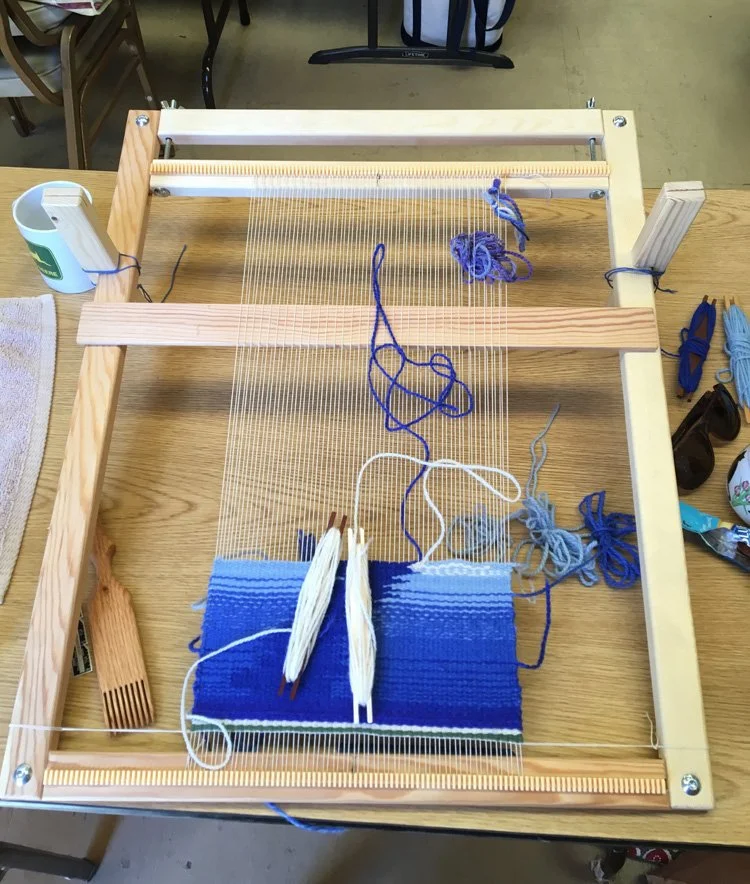
This is the Glimakra Freja loom with the stand applied. It has tensioning from the bar at the top. The warp is wrapped around plastic pegs. This is a student image from a workshop and I can’t remember who’s work it was, but it was a very long time ago.
Mirrix Pocket looms: they come in 5, 8, and 10 inches (See end of post for a discount through 6/1/26)**
Glimakra Freja
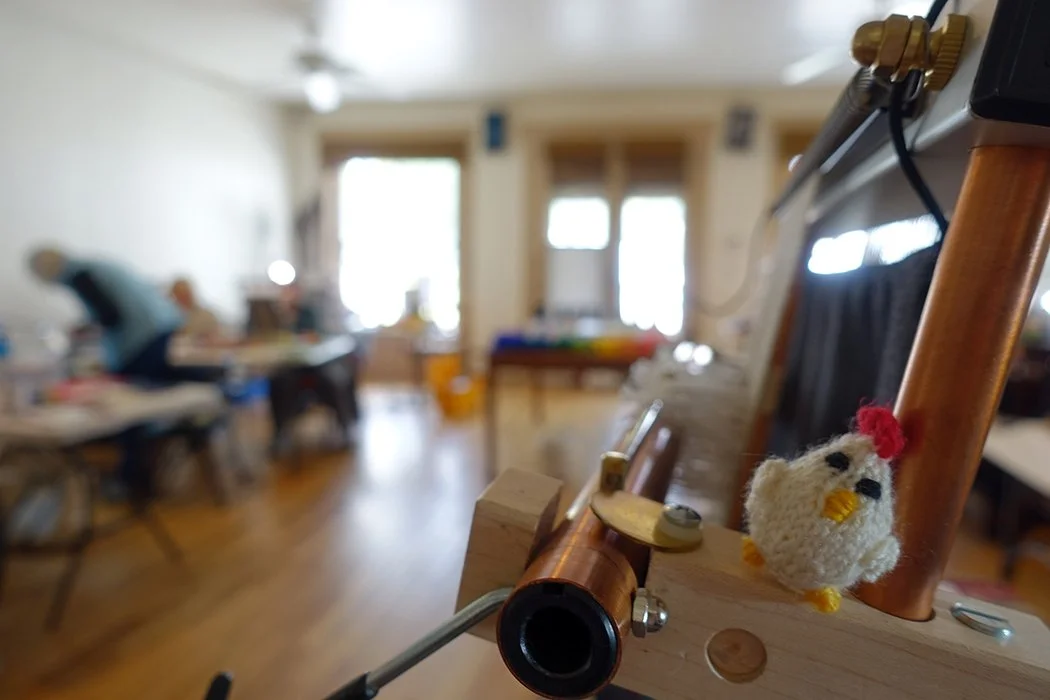
a copper pipe loom that you make yourself could be a great option if you’re even a tiny bit handy
tapestry frames sold in Europe often have a piece of wood top and bottom and two long pieces of threaded rod. They work similarly to a copper pipe loom and you could make one of these yourself or check out ones sold at weaversbazaar or Artisan Bobbins.
For larger looms in this category consider:
Mirrix classic looms which come in many sizes and configurations (useful things like continuous warping, Shasta combs to make it into a peg loom, pre-made heddles, and coils to help space the warp are part of this line)**
Ashford tapestry looms (I am thinking of the frame-style looms here)
Schacht Arras which does have a stand and treadle assembly available (love it!)
You can make a very large pipe loom with black pipe or scaffolding pieces
A loom with beams
These are large floor looms with beams back and front to roll the warp and finished tapestry on. The beams have braking systems that provide tension. Lighter weight looms don’t do this well, so your common small jack loom might not be the best choice for tapestry weaving. Looms with beams can be high-warp where the warp is perpendicular to the floor or low-warp where the warp is parallel to the floor.
These are looms for people who want to weave large tapestries and have room for a serious piece of equipment. Most of these looms are quite large even in the high-warp varieties but they almost all have treadles to change the shed with your feet.
High-warp looms might include:
LeClerc Gobelin (the only high-warp tapestry loom I know that is still being made in North America).
Shannock, Fireside, Tissart, Ruthie are all looms no longer made but that I see used ones of for sale often.
Low-warp looms might include:
My Harrisville Rug Loom. This is a countermarche loom.
Harrisville rug loom
Leclerc counterbalance looms
Aubusson looms (very hard to find in North America but if I lived in Europe I’d be looking for one)
Scandinavian looms like Glimakra countermarche. There are other brands you might find more easily in Europe. Cranbrook is a similar loom that was until recently made by Schacht but used ones are out there.
Macomber (the only jack loom I think works well for tapestry in the 40 inch or larger size)
Rio Grande walking looms (counterbalance). Often found in New Mexico, USA or in Mexico, central, or south America.
Ergonomic considerations for tapestry looms
Schacht Arras loom with stand and treadle assembly
If you have problems with pain or mobility in your body, you need to consider that when choosing a loom. There are solutions to change the position of many small looms for weaving such as easels or using something to prop a loom in a better position for your shoulders or neck. If you have shoulder issues, the rotating shedding devices can be an issue as you have to reach up to shift the shed with every pick. In that case, consider the Schacht Arras loom with the stand and treadle assembly. This package is not cheap, but it is a fantastic loom and the treadles are wonderful. You can see me weaving on this loom in most of the Change the Shed episodes in 2025 and early 2026.
Further resources about tapestry looms
I have an FAQ page on my website with a list of looms and other tools that I like. You can find that here: https://rebeccamezoff.com/resources
There are lots of articles on this blog about tapestry looms. You can find them under the Looms category: https://rebeccamezoff.com/blog?category=Looms
Tapestry Looms Simplified: I have a short course about tapestry looms that goes through each of these types of looms. It was a live course I did in 2022 on Zoom but the materials are all there along with the recording of the Zoom event. You can find it in my course library here: https://rebeccamezoff.pathwright.com/library/tapestry-looms-simplified-183295/422409/about/ The course information goes into more depth than this post about each kind of loom and of course you can ask me questions in the class about your own particular loom needs. The goal of the class is to help you understand what looms area available and how to make a good choice for your artistic needs.
Here is an older post with more in-depth information about smaller looms: https://rebeccamezoff.com/blog/2025/4/10/weaving-tapestry-on-small-looms
A fun summer opportunity
My Summer of Tapestry 2026 class will be opening in May. The smaller looms I talk about in this post are perfect for the sketch tapestry we’ll be doing in that class. If you’re interested in a class where you weave tapestry diary-like pieces from things you experience in your everyday life (or a trip or even from your memory), this class might be for you. We always have a great community of students posting wonderful stories and weavings. You can find out more here: https://rebeccamezoff.com/summer-of-tapestry
*Sett is the number of warps per inch. A standard sett for beginners (and often advanced) tapestry weavers is 8 epi. If your sett is a higher number than that, it will be harder to weave on and your weft will need to be thinner but you’ll be able to weave more detailed designs. If the sett is a lower number, your weft will need to be a lot thicker and you’ll give up a lot of detail in your designs. I highly recommend a sett of 8 epi for beginners.
**For a brief time, Mirrix is giving my community 10% off their looms with the code REBECCA10. Or you can go to the Mirrix site directly here: https://mirrixlooms.com/discount/REBECCA10 (This is an affiliate link.)
Mirrix’s terms and restrictions: Valid on all items in the “looms” category of the Mirrix online store (except versions with heddles included, those can be purchased as separate items.) Cannot be applied to past purchases (no exceptions). Cannot be combined with any other offers or discounts. Coupon expires at midnight on 6/1/2026. Only valid at mirrixlooms.com.
Match your dreams with the perfect Loom
Choosing a tapestry loom can feel difficult. It is hard to know what is out there and then to settle on one you can afford but that will also do what you want it to do… if you even know what you want it to do!
We’ll discuss why particular looms are best for some projects and not great for others as well as other concerns such as where in the world they’re available, what yarns you can use on them, and price.