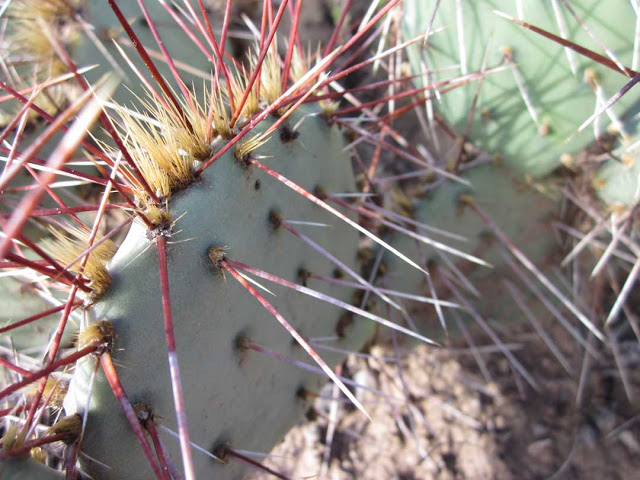
Cochineal: there is bug blood in your cherry coke!


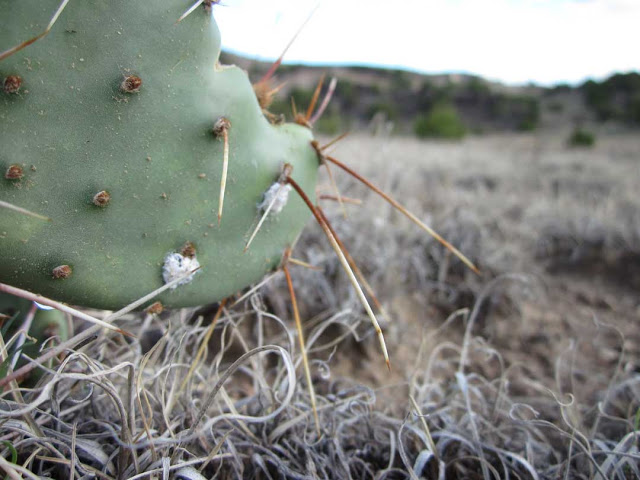
My landlady wrote a book (Life on the Rocks by Katherine Wells) which mentions cochineal on the mesa and I remembered a couple years ago seeing some white fuzz on some prickly pear cactus a mile or so from the house.  This morning in the rain I went back to check, and sure enough, it was cochineal!
After some online research and a return to the Colorways Summer 2011 online magazine (there are some fascinating photos in the article in this emag of the bugs on the cactus: "Sell me your gold, silver, cochineal..." by Linda Ligon) I learned a few more things about cochineal:

  • There are about 70,000 bugs in a pound of cochineal.  I won't be using the ones on my mesa any time soon for dyeing.
  • The insect produces carminic acid (17-24% of the weight of the dried insect per Wikipedia--which we all know is ALWAYS correct) which is used to make cochineal dye.
  • It used to be used extensively for dyeing fabric, but now is used largely in the cosmetics and food industries as a red dye.  At least it isn't carcinogenic!
  • The insects create the powdery/webby patches for protection, camouflage and to prevent dessication.  My cochineal bugs were very well protected as the bugs were deep inside their webs.
  • They like prickly pear cactus the best.
  • They do range into NM but are generally at lower elevations than this mesa (about 5,600 feet)


  • When their eggs hatch, the nymphs crawl to new areas on the cactus or using the waxy substance they are surrounded with, "balloon" to a new host cactus.  Then--get this--they start feeding on the cactus, molt and lose their legs. (!)  That would seem to make further transportation a bit difficult.
  • It looks like cochineal currently sells for twice the price of silver by weight.
  • I found this interesting cochineal farm in Oaxaca that gives tours.  And they have a workshop you can take about cultivating cochineal.  This sounds like my kind of vacation!  Unfortunately I'd probably have to move south to grow them in the US.  It'll be hard to dye much yarn with 10 bugs... and I don't want to kill the entire crop either.  Unfortunately dyeing with them seems to involve death on the part of the bug (when they are pregnant!).


  • And after all this fascinating information, I had to pull out my color books.  From Colors: What they mean and how to make them by Anne Varichon, I found out that there are actually three primary kinds of cochineal.  Besides the Mexican kind that live largely on nopal (prickly pear) cactus, there is the Armenian cochineal which lives on reeds and grasses in Armenia and Turkey and the Polish cochineal which feeds on German knotgrass and lives near the Baltic Sea and in the Ukraine (p 124).
  • Some history from the same book (p 124): dyeing with cochineal seems to have been done since about 700 BCE in Peru and large fields were cultivated long before the arrival of the Spanish.  The Conquistadors realized that this insect represented enormous wealth and escalated production.  Starting in 1520, they exported hundreds of tons of cochineals to Europe and around the world.
  • The annual yield of the nopales fields in southern Mexico can be 264 pounds of insects per acre.
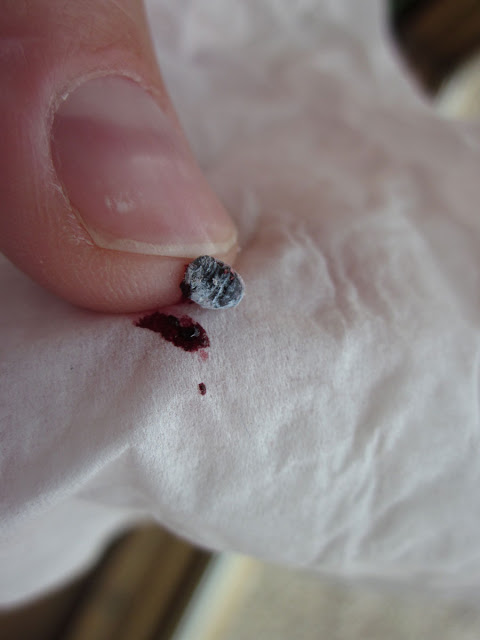

"Spanish Red, I noted in my diary that night, is usually born between the fog and the frost in places where land is cheap and the prickly pear, on which it is a parasite, grows in abundance on the desert sands. It is a holy blight, a noble rot where the treasure is rubies rather than the gold of dessert wine. It is a deep, intensely colored organic red, but it will never be used for Buddhist robes because there is too much death in it. In the twenty-first century women around the world coat their lips with insect blood, we apparently dab our cheeks with it, and in the United States it is one of few permitted red constituents of eye shadow. 'And finally,' I wrote with a happy frisson, 'Cherry Coke is full of it; it is color additive E120.'" [Finlay, V. (2002). Color: A natural history of the palette. New York: Random House. p 137-8.]

Weave well friends! (and when you dye with cochineal, remember all the little bug souls)


Of bumblebees and Taos Fiber Arts

I went to a needle felting class yesterday at Taos Fiber Arts.  Julie and Ashley Cloutman (a mother-daughter team) are a great combination--and they are a lot of fun.  I know Julie because she has sold a whole whack of my tapestries at Weaving Southwest... and anyone who has that much good to say about me must be one fantastic lady. 

Ashley spent a couple hours teaching me the fine art of 3D needle felting--and repeatedly reminding me how not to stab myself.  She was really good at this.  I think she has been stabbed a few times (sharp needles with barbs!).  I only caused myself to bleed once in two hours which I thought was pretty good considering my unfamiliarity with the techniques and my general clumsiness.  Her set-by-set approach and excellent creativity (not to mention humor) makes her a very fun teacher.  (She also has a great line of zombie attire and felted objects. I suspect with the right marketing these could become a craze which would support Ashley for a very long time.)

Julie and Ashley Cloutman of Taos Fiber Arts.

 SHARP needles!

My project started out looking like this (and though it looks simple, it was not easy to get a head and body to the shape I wanted!):
And within a couple hours, had become this funky sort of bee dude:
Notice his little stinger... and purple shoes... and long purple hair...
Ashley started this great Frankenstein figure.  I love the neck bolts... not really sure how she did that.

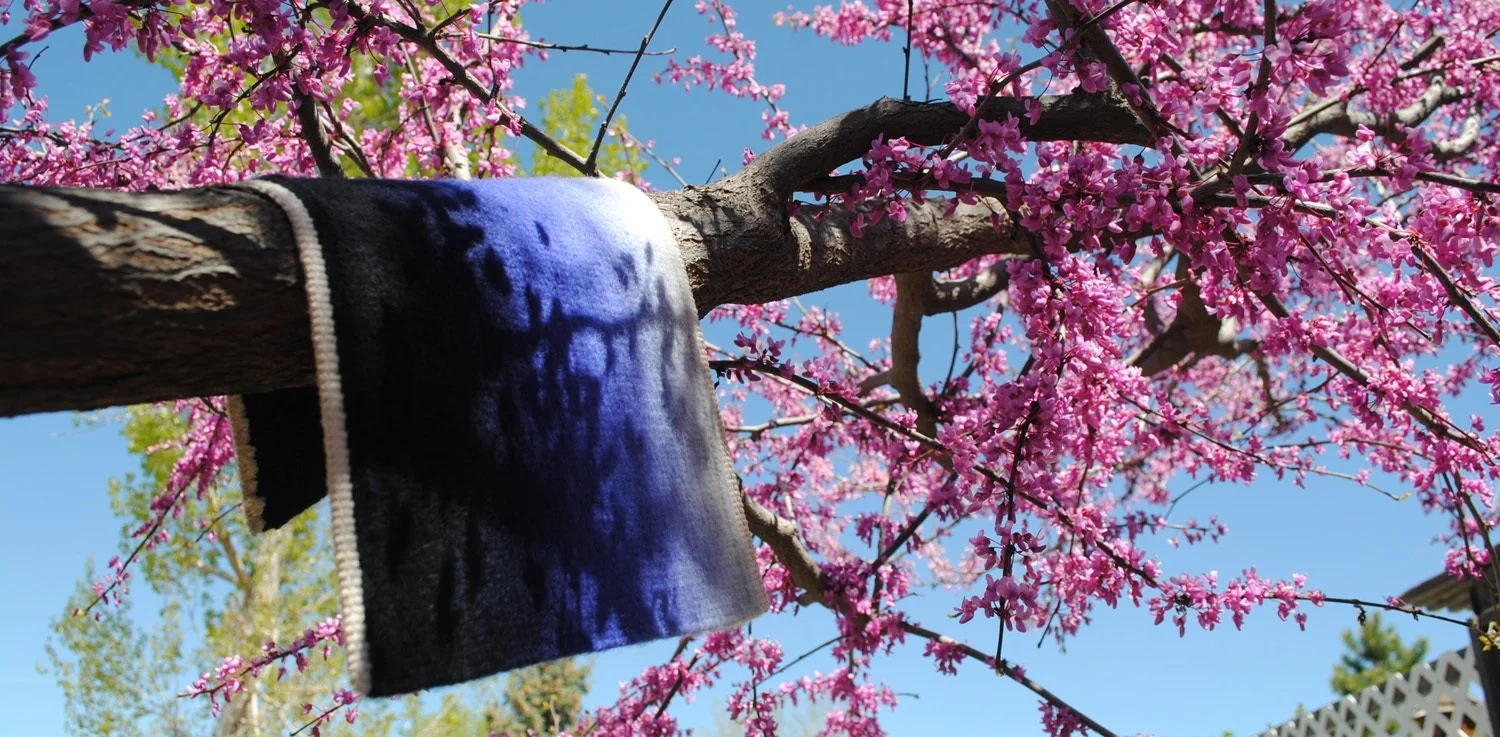
Taos Fiber Arts has beautiful fiber like this detail of a felted shawl with yarn trapped between the layers (made by Ashley).  They have hand-dyed yarn, roving, clothing, felted scarves, weaving, and will teach you many fiber techniques (including multiple felting techniques--I'm going back for a nuno class sometime and maybe another needle felting class.  Julie also teaches weaving!).

They also have a great collection of old signs (many from Taos Ski Valley) and other fun elements.


Go visit them. 
(P.S. They are fairly easy to find behind the plaza and... they have parking!)

Oh, by the way, the inspiration for the bee I made was this baby sock I knitted this weekend.  Now I just have to knit the other one!  ...unless someone is having a one-legged baby... which might give me some occupational therapy business, but overall would not be desirable to the parents, I'm sure.

I hesitate to give the pattern (because I don't want my ultra knitting-talented relatives to steal my very cute knitting patterns before my niece or nephew is born), but will do so in the interest of not being accused of copyright infringement... because I am not a talented enough knitter to come up with this by myself.  I leave the creative coming-up-with-it-ism to tapestry design.  It is Bumblebee Socks from Knit Baby Head and Toes (ed Gwen Steege).  The pattern is by Barbara Telford.

LeClerc Dorothy loom for sale

Since this is my blog, I suppose I can use it to advertise a loom I am trying to sell!  Sorry for all of you who read this blog for more interesting content.  I once sold a Gilmore loom through the blog though, so maybe this will work.

The loom belonged to my grandmother.  See THIS post for the story about her.  Grandma hasn't used this loom for a long time.  In fact at least 15 years ago (maybe longer, the years have gone faster since high school ended), she gave it to either me or my sister (can't remember which!  My memory is kind of like a big room full of post it notes with vital information written on them and sometimes someone turns on an oscillating fan--yes, I stole that metaphor from Ellis Delaney).  We have passed it back and forth since and rarely used it.

It is a fantastic loom for weaving workshops.  You know the ones--you warp the loom up with some specified sort of warp and cart it into some conference center (usually 3 miles from the car and you wished you had brought that dolly that is in your garage) and all wide-eyed and eager, you are ready for your round-robin class... and everyone hates the colors your chose.  Or maybe they don't and you warped the loom beautifully and everyone else wants to weave on it and you never get the chance...  Anyway, it is a great workshop loom.  It doesn't work worth a toot for tapestry though.  Don't say I didn't warn you.

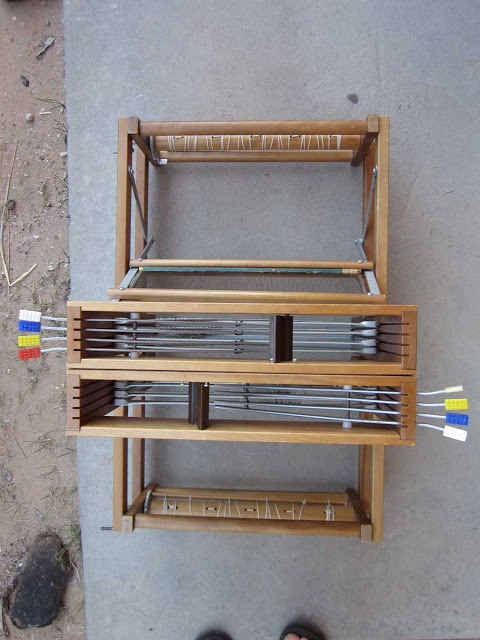
It is a great little loom.  15 3/4 inches weaving width, 8 harness with the ability to add 8 more.  It comes with a 12 and a 10 dent reed and the heddles that are on it (unless I can locate more in the depths of my studio--and believe me, there are depths!).


Side view
LeClerc Dorothy
View from the top.  Yes, one of the little plastic pieces is missing.  It may have been chewed by a dog or swallowed by a child (perhaps me!), or it might have just fallen into the junk heap of time.  It works fine without the plastic piece, though one could probably be fashioned out of sculpey clay if it really bugs you. The red one is missing.  Kids like red.  Maybe that explains all the gut troubles over the years.  Sigh.
Removing one of the castles.  Note the four sets of holes--two more castles could be added to make this a 16 harness loom.
These braces hold the loom rigid and can be lifted if you want to fold it.
Loom with one castle removed and folded. It will not fold unless you remove one castle (it is a physics thing--believe me, it won't)

If you look at this link to the LeClerc website, this loom is the one pictured in the box that says 8 and 12 shaft loom.  You might also note that the price for a new loom like this is $1172.

I'm asking $350 plus shipping to wherever you live.

If you, or someone you love would like to own this loom preferably sometime before October 1st, 2011, let me know!

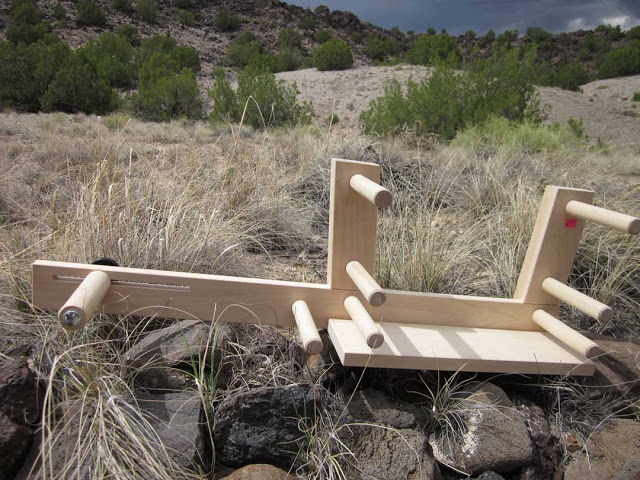
As an almost complete aside,  I also have another loom for sale.  It is a brand new inkle loom made by Schacht.  I know this is kind of cheating, but I received it as a door prize at a conference a few years ago and I already have an identical loom.  I really really don't need two.  So this one needs a new home.  They are about $75 new.  I'll send this one (in the box it came in no less!) to you for $45 plus shipping (and I'll only charge you exactly what the shipping actually is--I promise.  You can check the label when you get the thing).

Isn't this a nice product shot?  That is the price tag still on it.
I have a real fondness for Schacht.  Maybe it is the sheep in their logo.
You have to make your own heddles.  Sorry, that is how it is with inkle looms.
Those are all the looms I can bear to part with right now.


Come take a tapestry class!!!


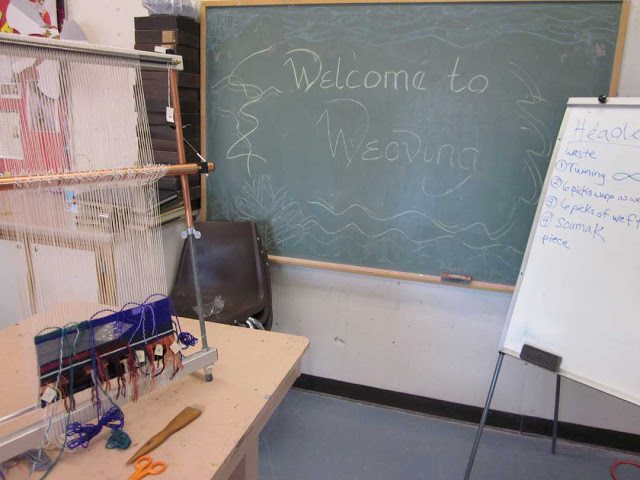
I am teaching a class in a couple weeks at Espanola Valley Fiber Arts Center in Espanola, NM.  The class is Color Gradation Techniques for Tapestry.  It is three days and there are still some openings!  This class is a benefit for the center and I am hoping to fill the class to maximize their profits.  So this is a great time to take a class in tapestry if you never have.  Here is a recent blog post I did with more photos of the center and some of its offerings.

photo: Laura Barger
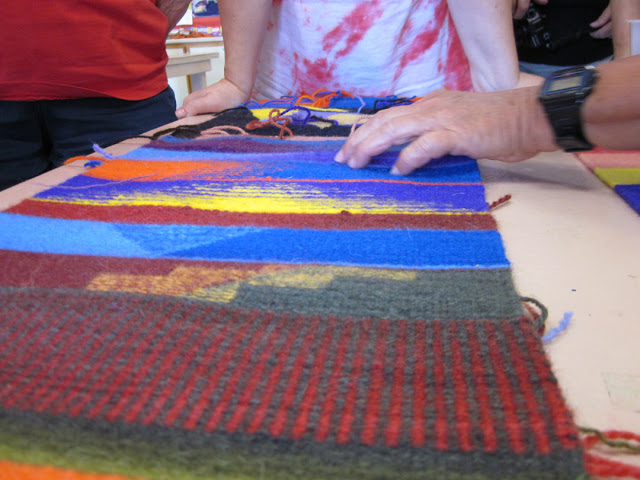
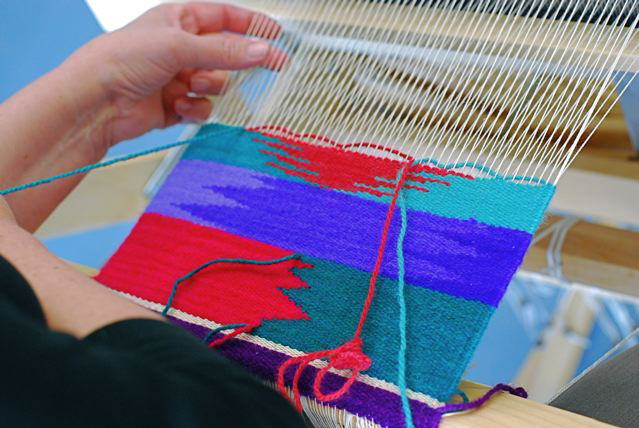
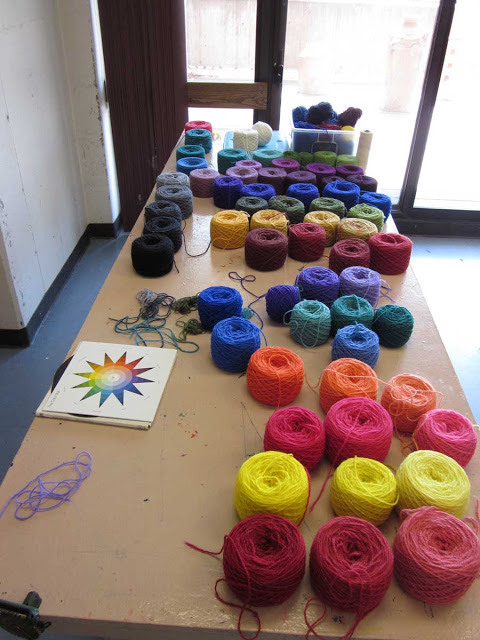
The class focuses on technical ways to grade color in a tapestry including using hatching and hachure.  I have some great hand-dyed yarns we can play with and the class promises to be a lot of fun.  As a bonus I will also be showing a slide show about the Bauhaus Tapestry Project (Interwoven Traditions: New Mexico and Bauhaus) I did with Cornelia Theimer Gardella and James Koehler which was completed six months before James passed away.


photo: Laura Barger
photo: Laura Barger
photo: Laura Barger
photo: Laura Barger
photo: Laura Barger
From the class description:
 In this three-day class, students will weave a sampler exploring 
color gradation techniques in contemporary tapestry.  A small tapestry 
may be started if time allows.  We will learn different forms of hatching 
and hachure along with various methods of grading color.  Color mixing 
techniques along with some color theory will be investigated.  Hand-dyed 
wool yarn in a large range of hues suitable for gradation will be provided. 
  Rebecca Mezoff was a student and apprentice of James Koehler for 
6 years and as part of the class, will offer a presentation about their 
Bauhaus project which included his last shows, photos of some of his 
work as it relates to color gradation techniques, and discussion about 
how James used the gradation techniques we will be studying in his work. 
  James was an avid supporter of EVFAC and this class is offered as a 
benefit for the center with all proceeds going to help EVFAC keep its 
doors open.  Basic knowledge of tapestry weaving is recommended, a 
desire to learn and have a great time is a requirement! 

My return from the mountains...

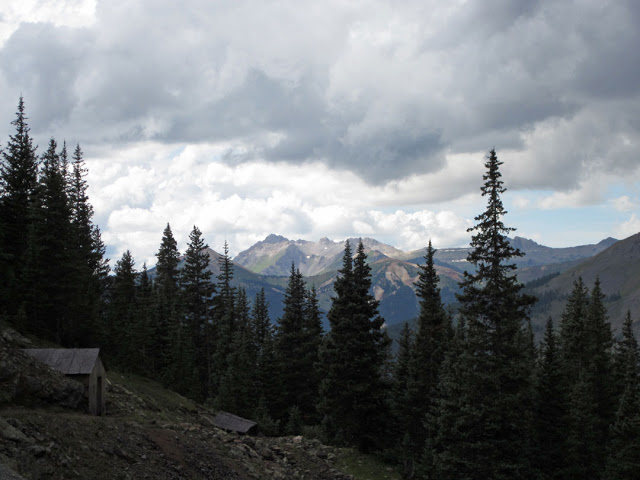
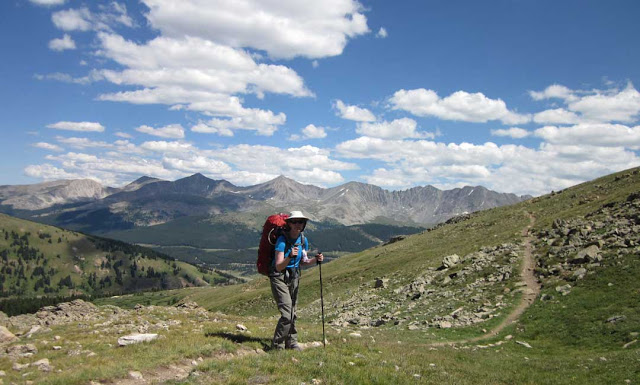
I've been sitting in a campground near Silverton, CO for a few days reading a book about indigo (Indigo: in search of the color that seduced the world by Catherine E McKinley--I recommend it!).  How I came to be car camping near Silverton instead of walking the Colorado Trail south of Silverton is a long story.  If you're interested you can read about it in my trail journal HERE.  The short version is that I hiked 100 miles of the 300 I had planned to hike along the Colorado Trail this summer and a knee injury took me off the trail.  I am home again after some beautiful days with my family in a fantastic campground outside Silverton.  We saw two moose, a plethora of mines, did some four wheeling thanks to my sister and brother-in-law, and sat in the rain reading about indigo.

I am lucky to be able to walk 100 miles.  I am disappointed that I couldn't do the whole hike, but know that with a little rehab I will be out there again very soon.

I am ready to finish a tapestry and look to new horizons.  Colorado is unbelieveably beautiful and I enjoyed my three weeks at high altitude immensely.


Mine near Silverton
We saw two moose!  What is the plural of moose?
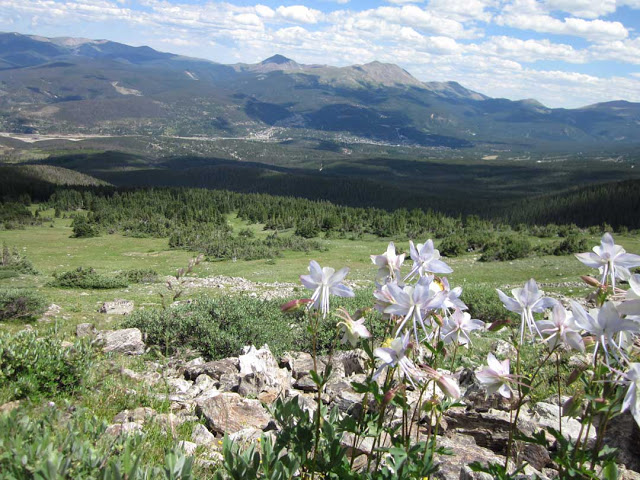
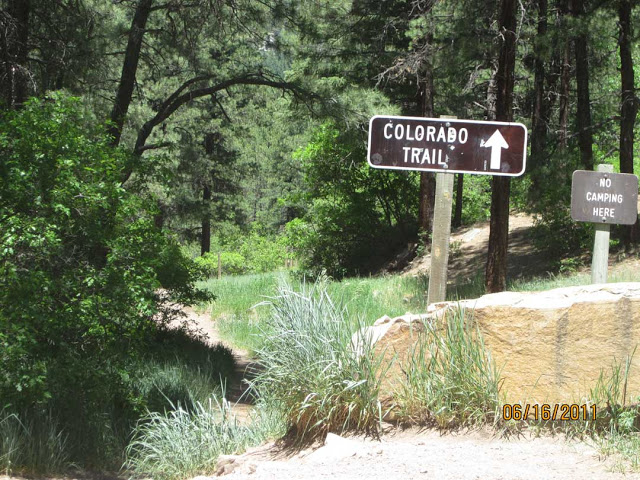
Between Searle and Kokimo passes on the Colorado Trail


At the top of the Ten Mile Range between Breckenridge and Copper mountain--first day out

Twin Lakes at sunrise from a lakeside camp

I'm off for a hike... Colorado Trail

After I leave Pueblo tomorrow I'm headed out on the Colorado Trail.  I'm looking forward to some weeks of hiking and a simpler life... for a little while.

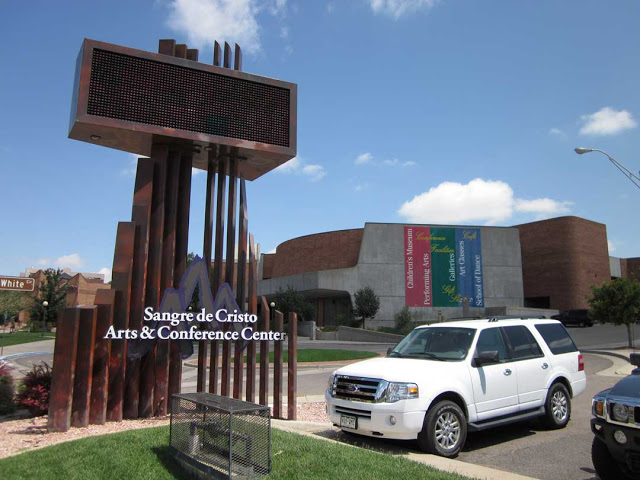
The Pueblo class has been marvelous.  What a great bunch of students!  I have enjoyed teaching and will be developing new classes about color and design for tapestry for the spring.  Thanks for the inspiration all you Pueblo-ites!


What a great facility--the staff and classroom were both wonderful.


I am leaving from Breckenridge heading towards Durango soon now.  You can follow my progress HERE if you are interested.  I'll be back in several weeks with more from the land of tapestry...

In the meantime, hike your own hike.
~Rebecca


Chaco Canyon


I found out James Koehler died not many hours after he passed.  I was on my way to Chaco Canyon March 4th, 2011 with Emily and some good friends and I got a phone message somewhere between Regina and Cuba.  

Chaco Canyon is a place of stillness.  It has a long history which is much debated--and is one of those places I like to go to because there aren't any answers to why it exists or what really happened there during its centuries of occupation.  

Chaco is a place that can push you.  Camping the first weekend in March was cold and the wind and blowing sand can needle you incessantly.  There is little shelter out on the desert and you are forced to take what comes at you when walking out on the mesas.  But I find that the discomfort that first appears at Chaco quickly disappears as I am forced to let go of noise and electronics and remember to look at the vastness of the sky and appreciate the brightness of the stars.
 
The great houses and kivas are a marvel and a mystery.  I love to trace the patterns of the rock walls with my eyes.  It is a place of repetition.  It feels old and unchanging, but even when it was being built it changed all the time.  We like to think of the Anasazi as a particular group of people in one time and place, but they were much like us—building and changing and creating and destroying their society all the time.


Chaco is a place to go when questioning.  It was a good place to be when I found out my tapestry teacher had died... a good place to wonder what that meant for me personally and in a more general sense.


Chaco is about doors and passageways and empty questions.  It is also about sand and sky and stars.  It pushes my boundaries and I will return.


All content copyrighted Rebecca Mezoff, 2011.