The sound of tapestry bobbins

I ran across this beautiful video today while browsing about the internet. It is worth a watch. It is titled Jilly Edwards: How to weave from an original design and it does show her inspiration and design process. It also shows her weaving on an upright tapestry loom with bobbins. I loved the sound of the bobbins knocking together.

And then she shows you the cutting off. And the tapestry is gorgeous.

Today I am from Santa Fe.

For most of the last decade I have lived in small villages north of Santa Fe, NM. Santa Fe was always the big town that I went to for the wonders of Trader Joes and Vitamin College for gluten free pizza crusts and Nut Thins.  Even when I lived in the South San Juan mountains near Alamosa, CO, Santa Fe was the big town and the three hour drive for a trip to Target and Artisan not to mention a few yarn stores and maybe Collected Works was a trip to the big city. So for ten years I have been dodging around Santa Fe and thinking about it as an artist community and not really a place that I live... until now. Now, I'm from Santa Fe.

Santa Fe is a place that seems grounded in some ways with its attractive, curvy, adobe-lined, narrow streets and 400 year history. And in other ways, it is a town with widely ranging ideas politically and socially and it doesn't seemed grounded in anything. Santa Fe is relatively small especially compared to Albuquerque's sprawling, gridded, valley-bottom messiness. I can drive from one side to the other in 15 minutes. But it is not the little villages I came from. I'm hoping that Santa Fe's small city status will be something that I can deal with being the girl from the mountains who searches for by-ways out of the way of mainstream America and likes to live on the tops of mountains and mesas in spots that are sometimes not strictly accessible by her Volkswagen Golf.

Rural New Mexico is a place where dusty sedans and pickup trucks filled with people and dogs sit on pull outs on the side of the highway every day every few miles waiting for their kids to get off the bus at 3:23 in the afternoon. It is a place where we struggle to educate our kids, our teachers, and our professionals. We have a large drug culture and low rankings in education and health care for children.

NM is a place that is brutally dry and only getting drier. The land around El Rito where I used to live has been chewed through by pine beetles and all of the pinon pine are dead leaving juniper sentinels standing alone surrounded by pockets of rotted and falling over pinon trees.

SF river is a bone of contention among Santafeans. It is dry most of the time. The town is trying to find water to make it run but there isn't any water. I recently took a hike into the Santa Fe National Forest and came just to the edge of the forbidden zone--Santa Fe's watershed. Here is one of the touted three "lakes" that are Santa Fe's emergency water supply. Does this look like enough water to fill hot tubs and water grass for 60,000 plus people? (Fortunately very few people in Santa Fe actually have grass.)

Those mountain and mesa tops will always be places that sustain me and will be places that I return to over and over again. But I need to look toward a more sustainable future and that means living somewhere where I can ride my bike down the rail trail to my studio and to the hospital to work. And it means choosing the house and studio in town instead of the place on the mesa with a view.

Perhaps it remains to be seen whether the drying of the southwest will continue and my favorite part of the country will become one big ghost town because of lack of water. If we as humans continue on the current path with global warming and unsustainable living practices, I don't see how the American Southwest can survive because it will be completely dry. But for today, maybe we can start a revolution. (Forgive me. The drought and the heat and the fires have prodded me upon a little soapbox.)

I know that my peripatetic tendencies have been a little frustrating to people in my life at times. Some people can't fathom moving as frequently as I have. Some people say I just can't figure out where I want to be. I think the truth, in part, is that the particular place is something I need to experience and then somehow life shifts and I need to move on to another experience. So I can't say that I will always be from Santa Fe. But I am here now and I will make the most of it.

A little time in the woods.

Life has gotten too busy lately. And time in the woods, which is very important to me, has fallen by the wayside. In desperation, I begged my family to go car camping over Labor Day weekend... and they weren't too hard to convince.
Four days in the high country of Colorado with a toddler, my hammock, a bag of knitting, and assorted wildlife did me good. I wish I could have stayed another couple weeks though. I wasn't ready to come home.

On the way out the door early Saturday morning, on a day which I knew was going to involve a stop halfway to my sister's house to transfer the contents of the carefully packed Volkswagen to my brother-in-law's old diesel Toyota 4 x 4, picking up lunch in Alamosa which was uncharacteristically packed with people attending a car show, picking up an 18 month old and her parents, and driving another couple hours to find a campsite as far from the ATV-driving Texans as possible (my apologies to all Texans who don't spend their summers tearing up the Colorado mountains on ATVs. I am sure there are some of you out there)... I turned around, grabbed anther skein of yarn from the stash, whacked the swift onto the dining room table, and wound the skein I suddenly was sure I would need in case the project I had planned but hadn't started didn't work out. Emergency yarn. Knitting in the woods is important. I did try to hide this activity from Emily, fearing ridicule. But the large cherry swift is a hard thing to hide. (It turns out if after passing the fields packed full of RVs pulled by massive pickups you keep driving far enough to actually need the four wheel drive you painstakingly transferred all your gear into, the camping opportunities are wide open.)

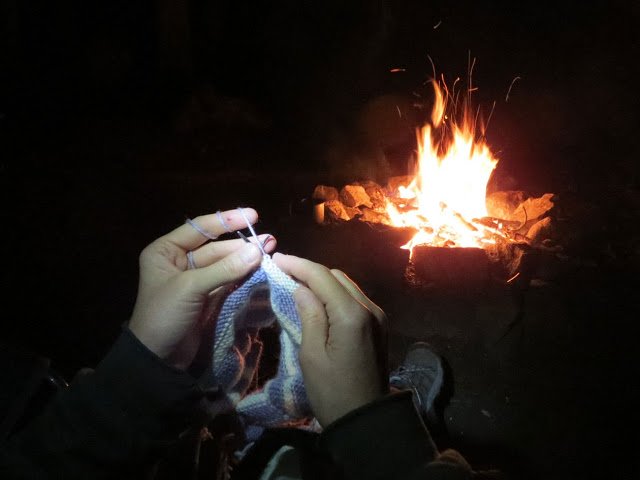
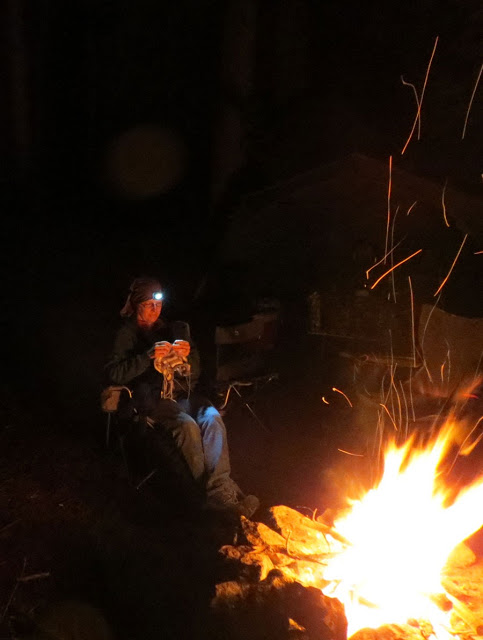
I knitted about half of a baby sweater... some by the light of my headlamp.
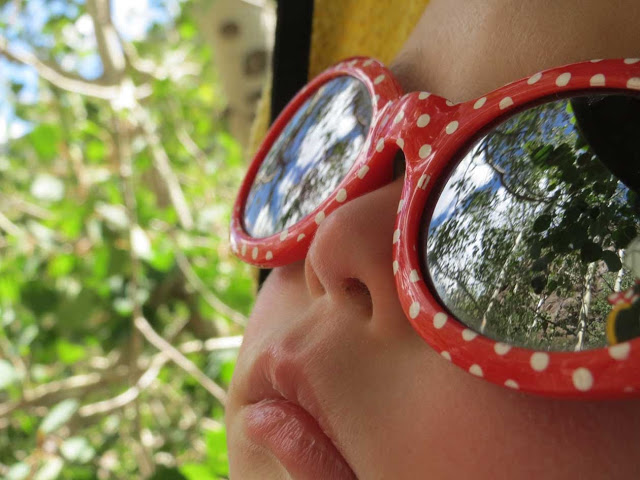
The baby was adorable. She learned approximately one million words over the weekend and used them all appropriately the minute the neurons connected. I'm sure she is going to win a Pulitzer Prize for fiction one of these days soon.
She was especially impressed by the bull we encountered soon after setting up camp and walking up the road. She was even more impressed the next morning after hearing the story of how the bull woke me up in the middle of the night standing just outside the tent. He left a huge calling card and as she is learning about the potty right now, she was very intrigued by the large pile of bull poop left 10 feet from my head while I slept. Two days later as I sat in my hammock reading a hiking book (not, you might notice, actually hiking), that same bull sauntered right through camp pretty as you please. Walked right through the middle of all of us without a glance to either side. I think we were camped in his toilet quite frankly.

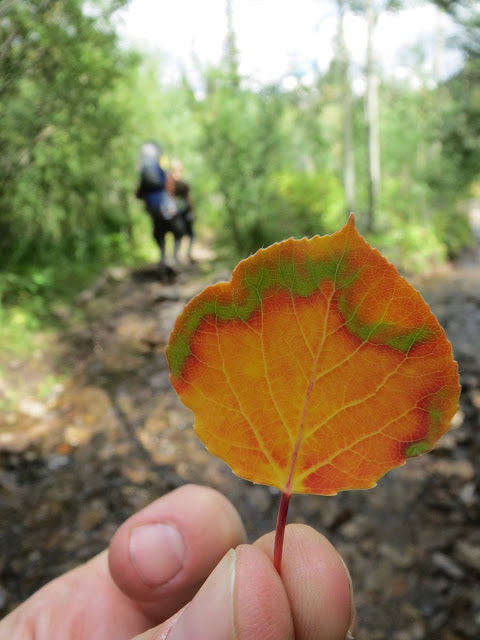
The signs of fall are undeniable. I love the fall. But I hate the end of the hiking season.

Barn Burned Down

I sold a piece in a show in Colorado recently. I actually am quite fond of this piece. It was inspired by a specific moment when I was in Austria in 2010. I was hiking up a mountain and there was an old barn next to the trail. I peered through the slats in the barn and could see the sunlight coming through the other side and making patterns. One day much later as I was working on some tapestry designs, I started thinking about the barn and about a haiku that I like a great deal.

The poem is by Mizuta Masahide, a 17th-century Japanese poet.
Barn's burnt down --
now
I can see the moon.
For many reasons, this poem has been helpful to me over the years. I think it is mostly a reminder that things change and simplification, even when it seems catastrophic, can lead to better things.

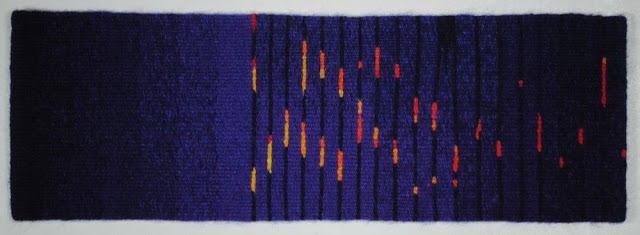
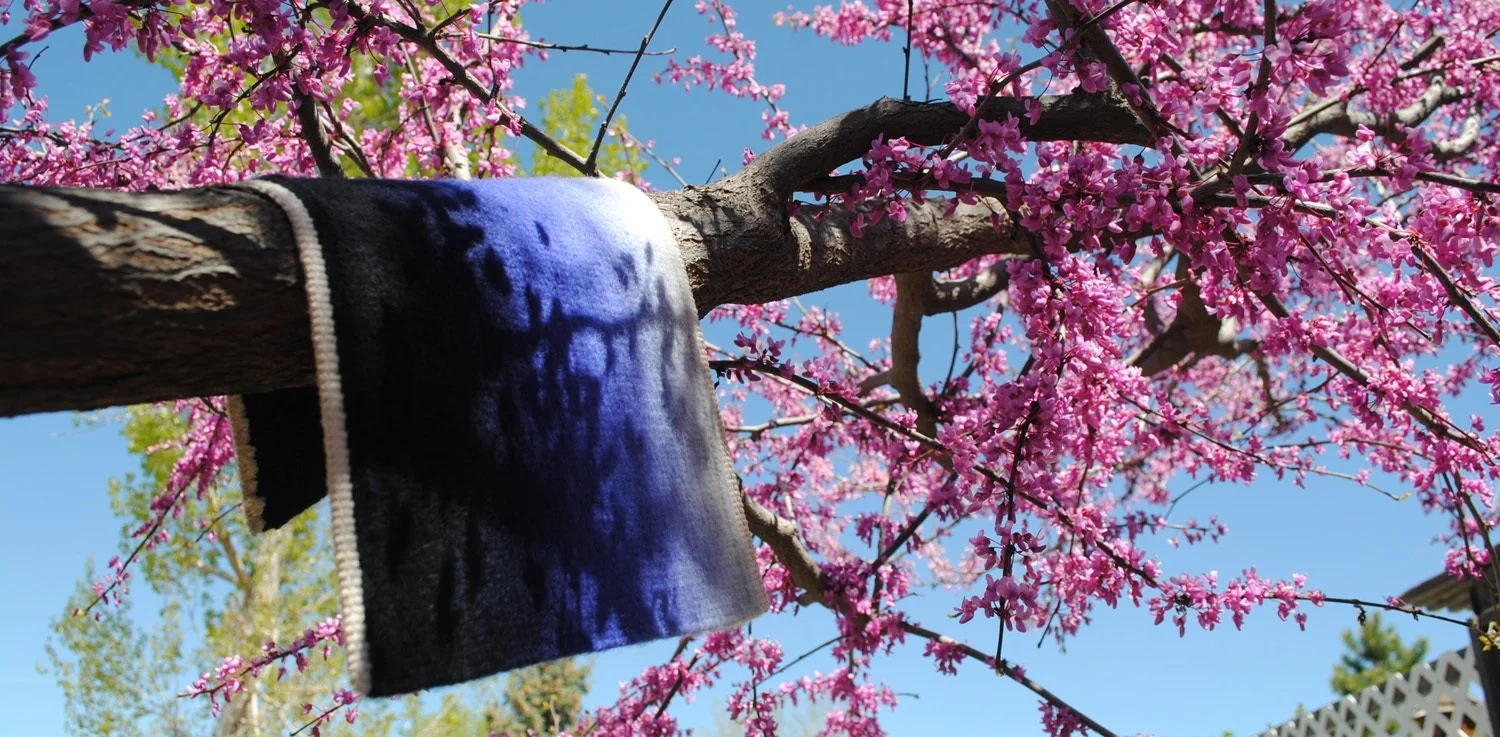
Here is the tapestry. It is called Barn Burned Down (Now I can See the Moon).
Barn Burned Down (Now I Can See The Moon), 5 x 17 inches, hand-dyed wool tapestry
It was bought by a tapestry artist who I respect a great deal. I am happy to think of it being enjoyed by him for years to come.

That piece had a companion piece called (Barn Burned Down) Now I can see the Moon. I don't recommend ever naming two piece with the same words in the same order with only parenthesis as a distinction. I submitted both of the pieces to the show and it was hard for me to figure out which one actually got in! And you can see that if you go to my website which has the names reversed. Perhaps it doesn't matter that much as both tapestries were about the burning and I have yet to weave one about the moon. Perhaps that should be up next on my list.
(Barn Burned Down) Now I Can See the Moon, 5 x 17 inches, hand-dyed wool tapestry
The show was a special event in itself. The link to the show information, Woven Together: Firestorm,  is HERE. There are photos of the show near the bottom of the page in a slideshow. The show was a response to the 2012 fire season in Colorado which was catastrophic to say the least. Fire is a reality we live with more and more in the western USA. We have had years of drought and lots of beetle-killed forests. Things burn fast and hot. People die fighting the fires. Hundreds or thousands of homes are lost in many fires every year.

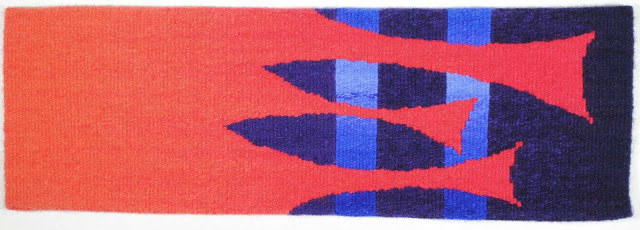
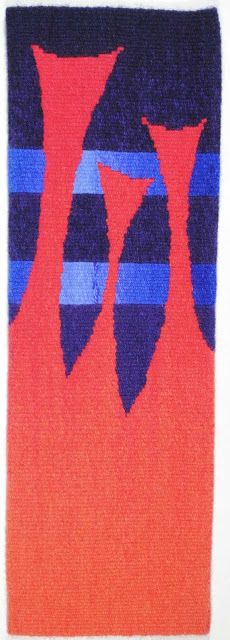
By the way, I accidentally set the second tapestry on end in my studio one day and a student said she liked it that way. I think I do also. What do you think?

Weft yarn recommendations for tapestry

The tapestry technique book that I recommend to all my students is Kathe Todd-Hooker's Tapestry 101. Kathe is a brilliant woman and knows her way around tapestry. The book is packed with information. I was rather amused to hear from one of these students that in this book which I recommend frequently, Kathe specifically does not recommend the weft yarn that I have used in all my tapestries for a decade. On page 28 she talks about yarns NOT to use for weft and the two she lists are Nehalem/Willamette yarns and Harrisville yarns. I have no familiarity with the first yarn, but I have used Harrisville yarns in Shetland, Highland, and a singles yarn they spin for me since I started weaving tapestry in 2005.

After visiting the mill and having some students use the Harrisville yarns that come on cones, I do understand her comment in the book (p 28). She says
Harrisville yarns look great on the ball or cone, but the colours grey out when beaten into the tapestry and when combined in the weft bundle. This is probably because they are spun in the grease and are very tweedy looking.
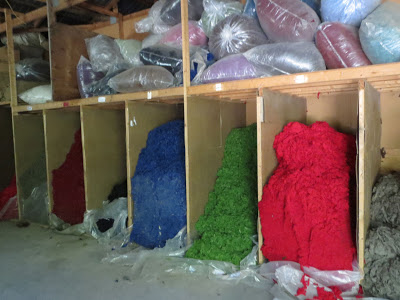
Harrisville yarns are spun from dyed fleece. See my lengthy post on my recent visit to the Harrisville spinning mill HERE for photos and more information. The yarn comes to the mill in 500 pound bales of pre-dyed fleece like this:
They mix the different colors to get their yarn and, as Kathe suggests, they do indeed look very heathered. I like this textured look in tapestry and it is partially why I dye my own yarn as hand-dyed yarns tend to be slightly uneven in color. The Harrisville yarns are not uneven, but the mixing of colors in the carding process does create a yarn that does not look like a solid color.

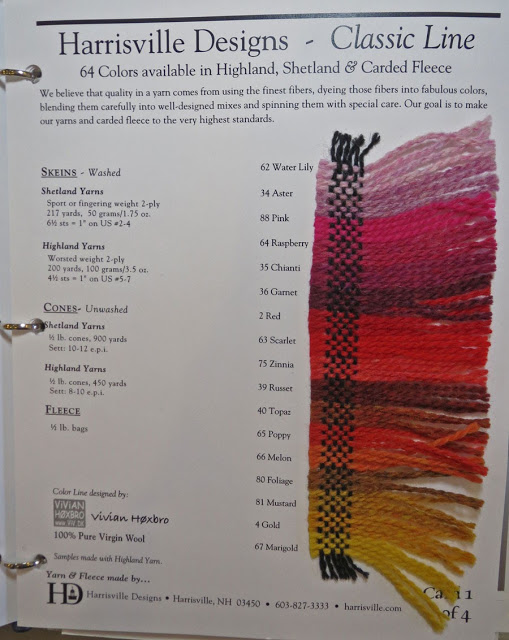
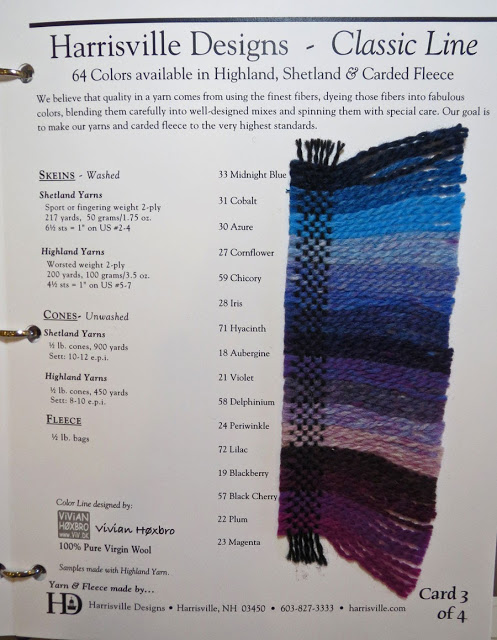
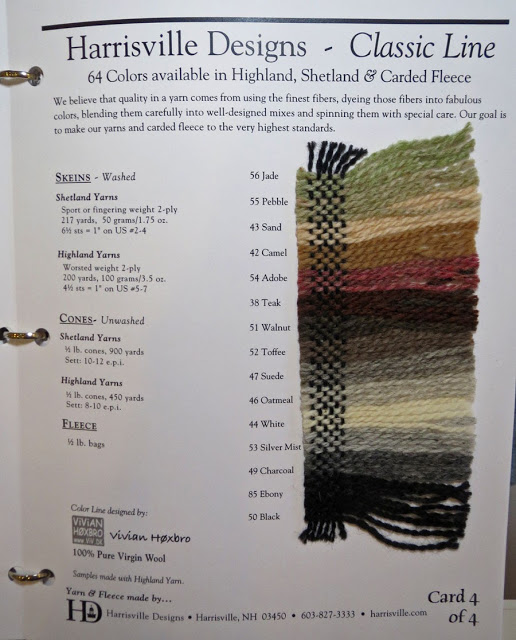
In this instance, you have to remember your color theory and consider what happens with yarn and color which is very different than paint and color. These yarns are made by mixing pre-dyed fleece. The varied effect in the yarn from doing this is very engaging, but it does affect the vibrancy of the color. If you look at the color cards at the end of the post, you can see that the colors are all somewhat muted. When you mix these already-muted colors of yarn with other already-muted colors of yarn, depending on the hues and values involved, you really can create a very subdued palette. Consider what you want to achieve and choose your yarn accordingly.

I buy Harrisville yarns in white and dye them myself. But at my recent workshop, I was able to try out some of their colors. What struck me was the difference in the feel of the yarn. The fleece has been cleaned when it arrives at the mill and in the picking process (see video HERE), some oil is added back into the yarn to help with the spinning. The yarn is never washed again. So what you get on the cones still contains a fair amount of oil. The yarn is much flatter and doesn't really resemble the fluffy, beautiful yarn that I use (which does, after all, come from the same mill). If I was going to use their colors, I would skein the yarn and wash it before I put it in a tapestry. This would restore the loft and it would also mean that your finished tapestry didn't have that oil in it which may be an attractant to bugs. Harrisville Designs actually recommends washing your piece after weaving to restore the yarn's loft. Of course they are assuming you are weaving cloth and not tapestry. You would never wash a tapestry in the washing machine or even bathtub, right?

Another option is to buy the yarn in the 3.5 ounce skeins that are sold as knitting yarn. This yarn has been washed and has much more loft right out of the box. I often buy this skeined yarn in white and dye it myself, but I find that I still need to scour it one more time before dyeing or the dye doesn't take evenly.

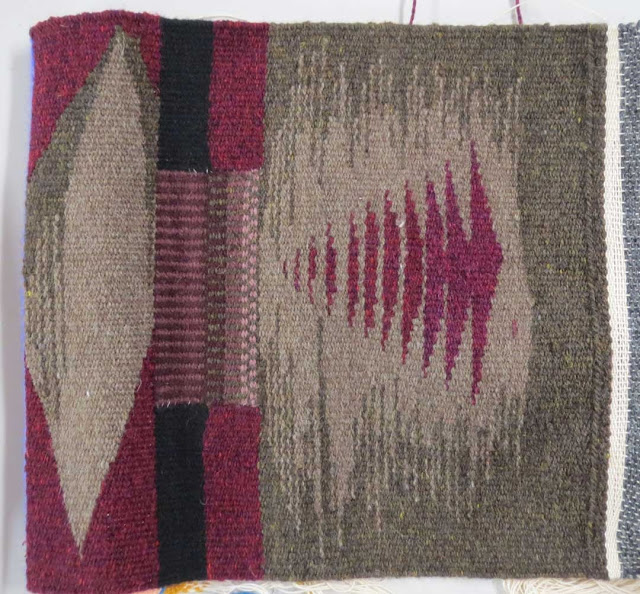
Harrisville yarns come in 64 colors. The color range is not designed for tapestry and doesn't have much in the way of color gradation. But the colors they do have wove up beautifully. No they are not bright jewel-tone colors, but they are lovely. For example, this student sample was woven completely with Harrisville yarns straight from the cone.
Here are photographs of the Harrisville color card. You can order a card from them. They weave all the yarn samples by hand so they do charge for these cards. But they are beautiful and durable and worth the cost if you are going to be weaving with their yarn.


Happy weaving!
Studio Opening, September 21, 2013

Cornelia Theimer Gardella and I share a studio in the Second Street art district in Santa Fe. We are having a party! We are so pleased to have this studio on Lena Street and we want to invite all of you to our opening from 4-6 pm on September 21st.


We still have some spots in our class, Successful Design for Tapestry the three days after the opening. There is more information about the class on my website HERE.

Santa Fe Indian Market 2013

 This is the first year I've been to Santa Fe's Indian Market. It was kind of nuts. Here is a picture standing at the corner of the plaza looking north up Lincoln street at about 9 am today.


We were fortunate to get tickets to the preview event last night which was also packed, but it we were able to see some of the artwork up close. I especially liked a weaving in the youth division by Amber Laughing. I couldn't find her today or see the piece again (nor did I take a photo), but I loved her use of color gradation and texture techniques like pick and pick in her sky over monument valley piece. I predict she'll be a great weaver!
I recommend a visit to this booth if you get a chance. DY Begay weaves beautiful tapestries inspired by her Navajo heritage and her own designs. Her website has a great sampling of her work at www.navajo-indian.com.
She is sharing the booth with her two weaving sisters, Berdina Charley and Berdine Begay, also both talented weavers.
There were quite a few weavers and here is a few very finely woven and naturally dyed pieces by Mona, Charlene and Milton Laughing (I am not sure which piece was done by which weaver).


I think this was Emily's favorite part of Indian Market. That corn was really good.


Indian Market is one of the biggest, if not THE biggest, Santa Fe event. The town is busting. Saint Francis Drive is impossible. But it was wonderful to see all the artwork. I was most interested in textiles, but there was stunning pottery, lots of contemporary painting some of which I would have taken home with me if I could have afforded it, some fascinating beadwork, and of course a lot of great people watching. I've never seen so many white men with bolo ties since I left Gallup for college. It was great fun. And I'm really glad I don't live downtown this weekend.


DY Begay