Have questions about running a tapestry studio?

Fiber Art Now has a monthly webinar program where they interview artists called FANFare. I'm their artist this Sunday, April 12th at 3pm EST. You'll be able to ask questions during the live broadcast.

I have greatly enjoyed past episodes and am looking forward to participating in my own show. We'll talk about my creative process, tapestry production in general, and the joys and challengings of running a small fiber-based business.
I'm off to clean my studio a bit so you can actually see the work in progress! Please join me Sunday if you can.

You can register here (it is free): http://fiberartnow.net/fiberartfanfare/#.VSfnaWYgrW4
And if you miss the episode, go to that link and you can watch the replay.


Really old tapestries... reproductive mural tapestries and making art today

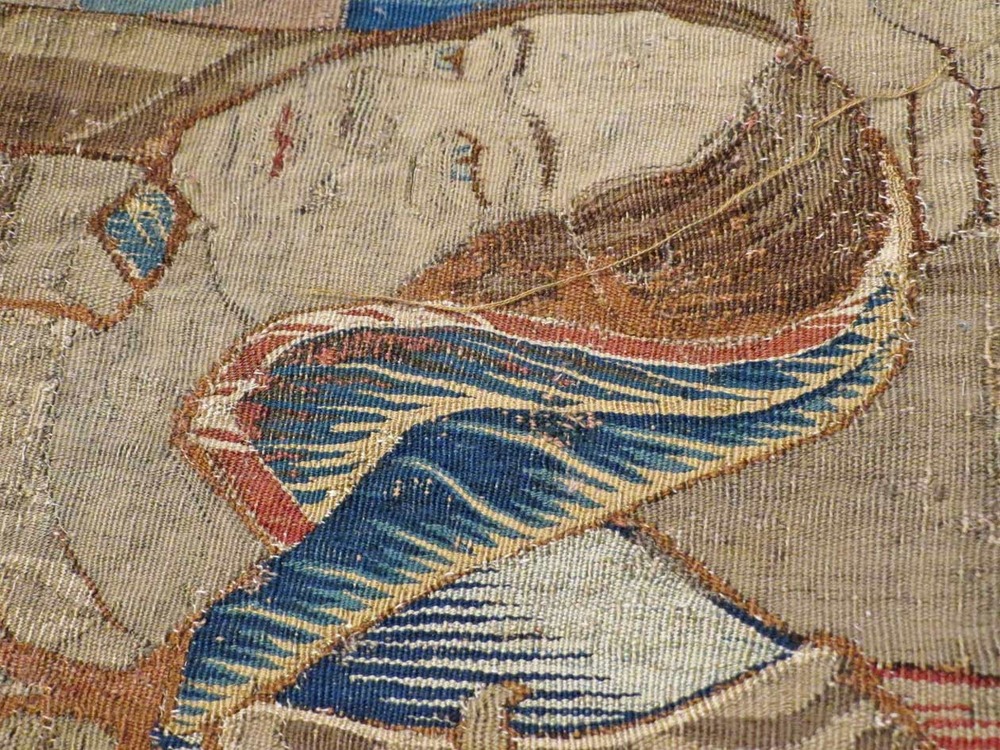
In February I was able to attend a Textile Talk at the Denver Art Museum with conservator Alison McCloskey and her team. They were working on stabilizing two large tapestries for the upcoming tapestry show which opens in June 2015. The smaller of the two pieces was a Flemish tapestry called The Birth of the Prince of Peace which had a wool warp and wool and silk weft. It was from the early 16th century which makes this piece 500 years old.
The Birth of the Prince of Peace, Flemish 16th century tapestry
I really enjoyed hearing about how they stabilize these textiles. The goal for them is to keep the integrity of the textile as much as possible. There are many old repairs which are visible in the photos, most of which they aren't redoing. All of the rough stitching you see was probably repairs made hundreds of years after the initial weaving. There are spots where a repair weft was put in that is a markedly different color than the surrounding tapestry. Probably they matched at one point, but the fiber faded differently.
The conservator who was working on this piece (who's name I did not write down unfortunately!) was using DMC embroidery floss to do some of the twined stabilization.
You can see the twined stitch they are using for stabilization in this close-up of an 18th century Spanish table cover they are also restoring for the exhibit.
And of course I took a few photos for use as illustrations of hachure use in medieval textiles.
The other piece we looked at was a 9 by 20 foot tapestry called The Peasant's Feast, also Flemish. This is a photograph of what the whole tapestry looks like.
And this is what we saw of it.
And a detail from the back which was rolled around the tube.
Alison talked about how they will get this huge and very heavy tapestry up on the wall without damaging it. It involves two lifts and a platform with the tapestry accordian folded on top. It will be raised to the top, attached to the hanging system, and then the two lifts will be lowered simultaneously allowing the tapestry to unfold. I was happy to hear that they use a similar hanging system to mine--twill tape and velcro.

The information about the upcoming tapestry show is not on the Denver Art Museum's website yet, but it will be soon. The show opens in June and will run for most of a year. It will include these historic tapestries as well as many examples of contemporary tapestry from their collection.

All this discussion of medieval tapestries brought me back to the conversation I had recently with Archie Brennan as I was writing my article for the Spring 2015 issue of Fiber Art Now.** Archie talked both to me and in many talks and articles you can find if you dig a little about how tapestry became a reproductive medium in the middle ages. That means that weavers were trained to copy a painting in thread. This brought tapestry weaving away from the lovely improvisational work we see in the Coptic tapestry fragments to something that was stiffer and less creative from the weaver's perspective. Of course those weavers were and are incredibly skilled. But somewhere in that practice of copying paintings, tapestry lost its ability to be an art medium in its own right. It is my opinion that we need to regain the standing of the work of the artist/weaver as an art form before tapestry can even hope to become recognized as more than a "decorative art" or craft.

And of course I also got to see the chief blanket piece of James Koehler which will be in the tapestry show. I wrote more about that on this blog post:
A Chief Blanket-inspired Tapestry of James Koehler at the Denver Art Museum
James Koehler, Chief Blanket with Blocks, in the collection of the Denver Art Museum
** The article in Fiber Art Now is called Susan Martin Maffei & Archie Brennan: Tapestry Partners and Innovators. It is in the Spring 2015 issue which is just coming out now. With another huge thank you to Archie and Susan for their generous donation of time and resources to the article. I learned so much from both of them.

Which online tapestry class is right for me?

The world of tapestry is exciting. There are many great teachers out there and lots of choices.

There aren't so many choices thus far in online learning however. If you are considering one of my beginning online tapestry courses, this decision tree may help answer some of those questions for you. And as always, contact me for more clarification.

The Self-Directed, Part 1, and All-Three-In-One are all versions of my beginning tapestry techniques course, Warp and Weft: Learning the Structure of Tapestry. Intro to Tapestry and The Mobile Tapestry Weaver are currently only offered as in-person classes but they will be online before too long.
If you click the image, it will open in an even bigger window which is easier to read.
This graph only applies to my beginning classes. I will be opening my Color Gradation Techniques for Tapestry class online in August of 2015 and for that you should have some experience with tapestry weaving (for instance, have taken my Warp and Weft class).

I want to put in a little plug here for the Self-Directed version of this course. If you are the kind of person who loves online classes that don't have direct teacher interaction, this version might be just perfect for you. You do miss out on the interaction with fellow students and feedback from me, but that isn't necessary for everyone. And now that my classes are any-time access, you can start the Self-Directed class on the same day you register. No waiting.

The next set of Warp and Weft classes that are timed start May 11th. Registration is open now with videos and PDFs you have access to right away to help with materials and tools. See this page of my website for registration links, reviews, and pricing.
http://www.rebeccamezoff.com/online-learning/

Spinning yarn for tapestry

My second spinning class with Maggie Casey** ended this past week. I have had more fun messing around with my spinning wheel than I thought possible. I love it enough I wouldn't miss a class for two blizzards, a long-scheduled workshop I was teaching, or for car troubles. I made it to all ten classes.

The thing is, it isn't just about the spinning. I have a long way to go to become a good spinner. I realized a few weeks in that I could MAKE YARN! The tools were right in front of me. I can combine fiber in so many ways to make exactly the yarn I want to use in my tapestry. This was a revelation.

For the last class we had to design a project. Mine will be a small piece on a Hokett loom... but with handspun. I figure I can manage to spin enough even yarn to weave a 2 inch square tapestry, right? Even if it takes half a pound of fiber. I'm on a pick and pick kick lately (some of you refer to that perhaps more correctly as half-pass) and have some new ideas related to color blending in spinning. Since I already know how to dye and a friend loaned me a drum carder, I think the options are pretty much endless. I'm just missing a set of those English combs.

Here is a little of what we did this week playing with various fibers. Maggie started us out with silk. It was good thinking on her part. Who doesn't love silk? We started with a cap. It was fascinating to hear the story of the Bombyx Mori and how silk is produced. There is a website called Worm Spit that details the way these silk moths are raised. What I didn't realize is that silk moths are domesticated. They have been so changed by cultivation that they couldn't live on their own.
Maggie separating the silk cap into layers. Each layer is one cocoon.

Silk cap. You can also buy it in "hankies"
Maggie and Kathy pull a layer of the cap off.

The silk in this preparation was not hard to spin. It wasn't even, but the staple is impossibly long, so even though I still have little control sometimes, it wasn't going to break on me.

Then we moved on to some Tussah silk. This had been cut and combed and it was fast! It seemed very hard for my beginning spinning skills. But it was lovely.
Tussah Silk
And here is what the cocoon looks like. The sticky sericin that holds it together is removed in hot water and then the cocoons are unwound onto a reel. There is a mile of silk on one cocoon.
Silk worm cocoon
Then we tried some camel mixed with silk. This went okay. The camel gave the silk a little more bite and I had an easier time spinning it.
50/50 Camel/Silk
All of that silk fiber was lovely. When we were sufficiently lulled by the mysteries of silk and how it is made and processed, Maggie pulled out the next fiber. It couldn't have been more different.
Presenting:
Linen.

The story is still good. Flax preparation involves rotting (rhetting) the fibers and lots of abuse including the use of a medieval torture instrument, the hackle. There is an article about linen in the Twist issue of Ply magazine that talks about this abuse in great detail... in such detail that you really start to feel sorry for the plant. But then she comes back and becomes a better fiber the more abuse you give her.

This fiber did not run away from me. The staple is very long and the fibers very thick. I doubt I'll ever spin linen again, but once I got over the fact that it isn't silk, I enjoyed it.

spinning linen (flax)-- Look at me spinning with a long draw!
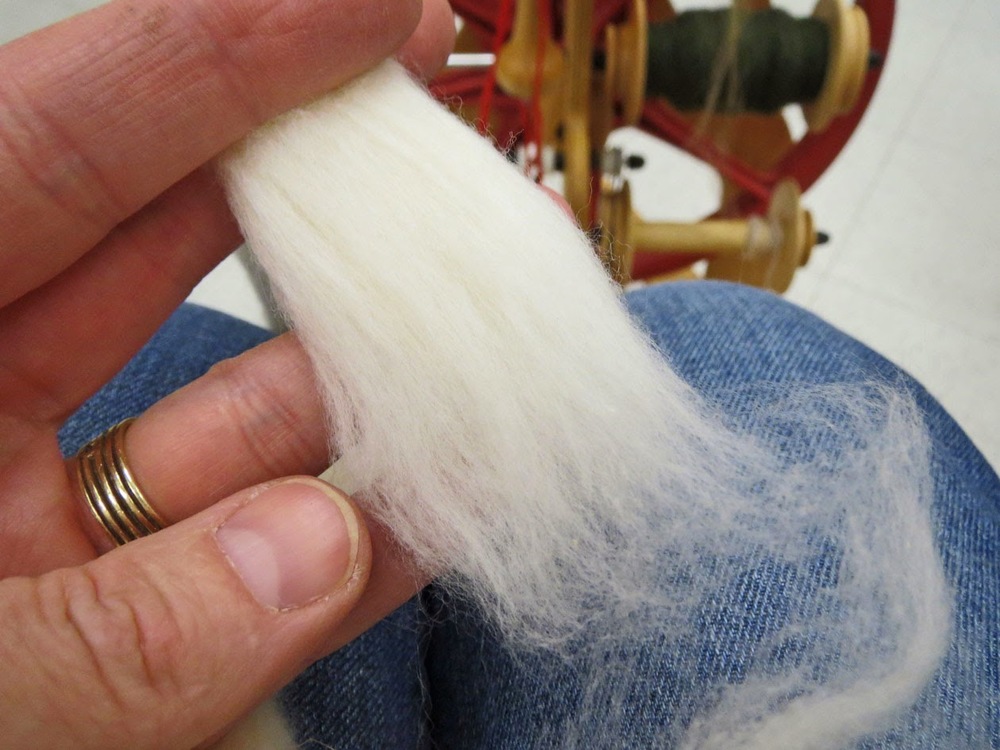
Then there was the cotton. What can I say about cotton except I hope never to spin it again. Maggie started out by telling us we needed to spin it long draw. Now I have had just a tiny bit of success even making the long draw method work for me, so this seemed like a tall order.

The staple is exceedingly short and I couldn't manage it. We started with some lovely processed cotton which I was mildly successful with. At least it held together long enough to wind onto the wheel.
Carded cotton
And then with a little chuckle, she handed us this.
cotton bolls
Spinning from the boll. I did it for about 2.7 seconds and then it all fell apart and I couldn't pull myself it back together. Eventually I started futzing with my wheel and hoping we'd move onto something else fast.

To make up for that misery, she ended on a Merino/Silk blend. It was absolutely lovely and I will be buying more of this fiber when my skills improve a little bit. I was able to manage the fiber nicely and my resulting bit of yarn looks pretty good!
Merino/silk blend
These spinning classes have really opened my eyes to the world of different fibers. I have to admit that I started weaving tapestry with the yarn my tapestry teacher used and haven't stopped yet. I have tried many different yarns and found others that I like quite a lot (as well as many I do not). But I didn't start to understand the subtlety of yarn until now. Not only do I now have many more options of how to blend color and make different color effects, but I have a much better understanding of important concepts like staple length, fiber content, and fiber care/cleaning.

When you look at yarn labels, generally you just see the stuff called WOOL. But there are so many different kinds of sheep and they have such different characteristics. It is a fascinating magical black hole that I have fallen down.

I'll be experimenting with the drum carder and some ways of making tapestry yarns next. I don't expect great things from my ability to make an even yarn, but hopefully I can make something consistent enough to test on the loom... at least on a little lap loom.

When does the next class start Maggie?
Production of silk kills the silkworm. In Korea, they make use of those worms too! Snack food.

**Maggie Casey is a celebrated spinning teacher and co-owner of Shuttles, Spindles, and Skeins in Boulder, CO. She teaches workshops all over the country though I recommend coming to Colorado. She is the author of Start Spinning: Everything you need to know to make great yarn.
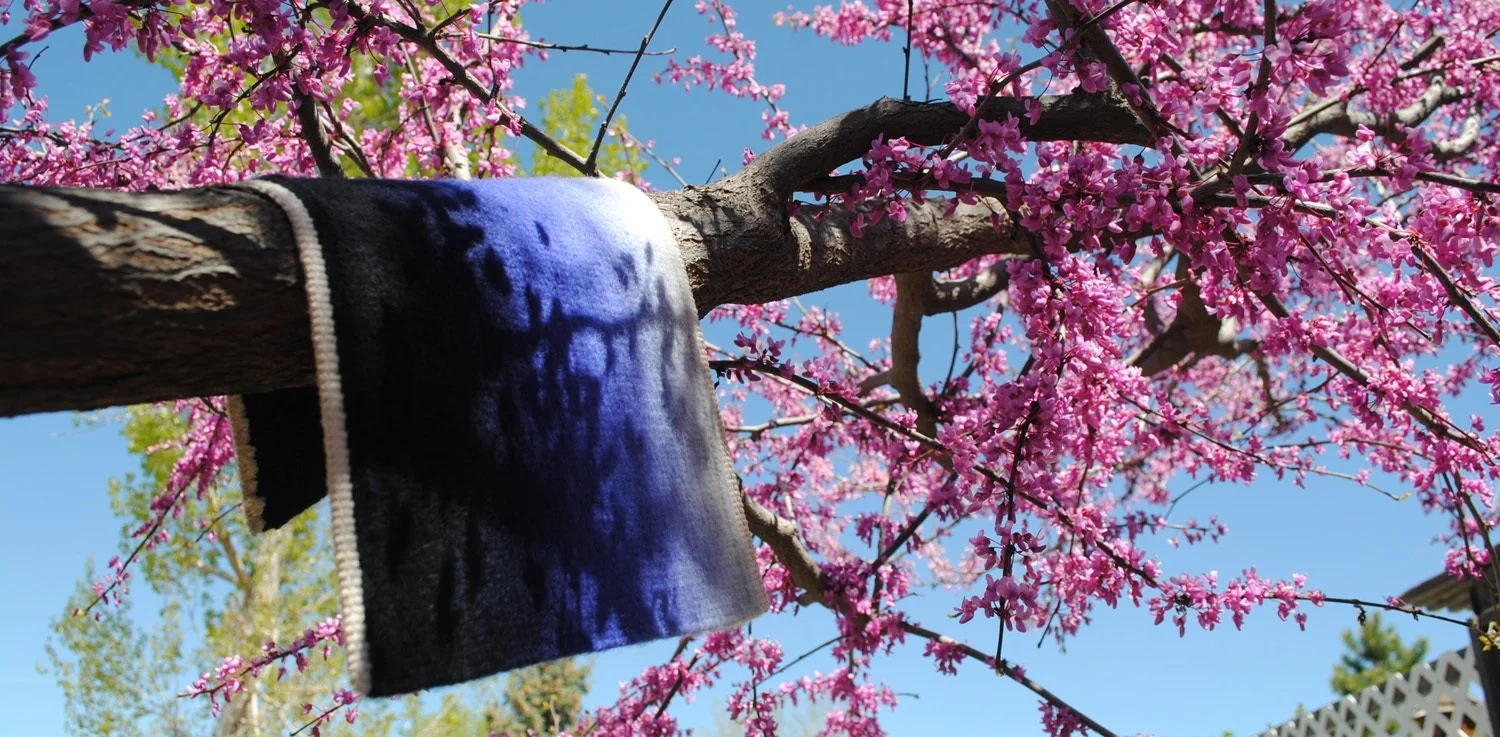
Susan Martin Maffei and Archie Brennan: Tapestry Partners and Innovators

I have been haunting the postal carrier watching for the Spring 2015 issue of Fiber Art Now for weeks now. It hasn't appeared in my mailbox, but I spotted one at Shuttles, Spindles, and Skeins in Boulder last week and of course I couldn't wait for the copy I knew was on the way. I bought it.

The title of my article is Susan Martin Maffei & Archie Brennan: Tapestry Partners and Innovators. I have to admit that the title isn't mine, but I was happy to accept the assignment of writing it. I spent a couple weeks reading everything I could find about the two of them and then had a marvelous conversation over the telephone. Though they are partners in life and are both accomplished tapestry artists, at first I felt odd trying to write about them in the same feature. Their work certainly has similarities which I talk about in the article, but they also have very separate careers.


Susan and Archie are big players in the world of tapestry. Archie grew up in Scotland, trained at the Dovecot and Edinburgh College of Art and eventually was the director of the Dovecot from 1962 to 1975. Susan studied at Manufacture Nationale des Gobelins in Paris and worked for the Scheuer Tapestry Studio in New York. And did you know her first teacher was Mary Lane?!

Their ideas about tapestry converge and diverge, but they both revel in the work. Archie recently completed his 503rd tapestry. I suspect by now he is hard at work on another. Susan's most recent solo show just closed, but she and Archie will be exhibiting and teaching in Oklahoma soon.

One thing I really enjoyed hearing from them was their conception of tapestry weaving as "a journey up the warp." Partly that comes from the fact that neither of them use cartoons very often. But it also refers to the process of weaving tapestry. We have to start at the beginning and move forward until we come to the end. You can't go back and change something that is already woven unless you unweave everything on top of it. In their work and in their words, they they model a method of tapestry weaving which is full of creativity and exploration.
This issue also has a review of a show that tapestry artist Tommye Scanlin is in and photos of work by Pam Silva and Tea Okropiridze.


YEAR 1: being a self-employed artist

An anniversary of sorts came and went this past Sunday. I thought about it a little bit and celebrated by taking a solitary drive around San Juan Island, Washington... watching the ocean and imagining all the adventures one can have in a life.


Then today I decided to tell you that it had passed.

One year ago Sunday was the last day I worked as an occupational therapist. After 17 years, I was out. (You're thinking that I'm WAY too young to have been a therapist for seventeen years, right? Thanks for that.) I'm still hedging my bets, doing my continuing education, and paying for my licenses. But I haven't treated a client in a year. I do sometimes miss working with those little squirts though--pediatrics was full of laughter and sticky fingers.

Since I started this tapestry business, I have learned more things than I ever imagined I would need to know. Sure I know how to weave tapestries, but to actually make a living weaving and teaching tapestry, I have to know a few other things. All those little details I have picked up on the fly. I take classes wherever I can, I ask questions, I use Dr. Google a lot. I look at what other people have done and every day I tell myself that I CAN do it. Even when it seems impossible. Even when it seems scary.

The parts about tapestry aren't scary. I love weaving it and I am a solid teacher. Begin a therapist taught me how to teach but also gave me the skills to interact with a wide variety of people in many situations. It can be challenging to figure out how to meet each individual student where they are. Learning styles vary greatly between individuals and that has to be taken into account when designing curriculum. I thrive on this challenge and I think I'm doing a great job with it.

Nope, the stuff that is the most difficult is all the other stuff. Moving an extensive curriculum online and then running a business...

New software programs with constant updates.
Taxes in so many different jurisdictions.
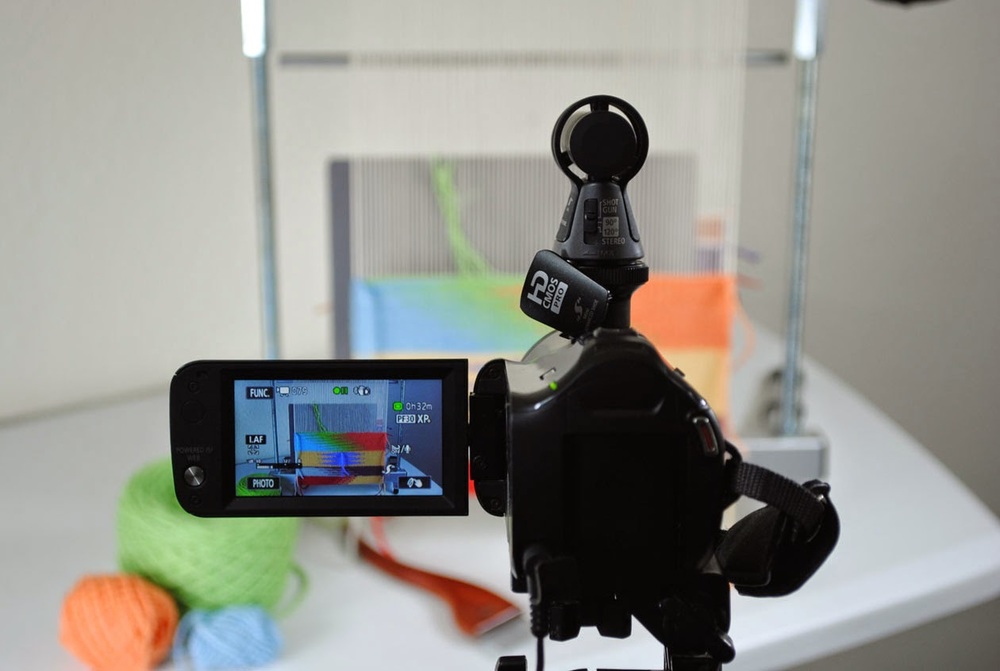
Video! Equipment. Lighting. Shooting. Editing. Sound.
Marketing.
Social media.
Writing. It is important.
Time management (oy vey).
And...
My email inbox. It is the one thing that could bring me down.

Self employment means:
  • dress code is yoga pants*
  • I can tell the little voice in my head that says I can do my own year-end taxes to shove it and bring the whole mess to an accountant.
  • endless cups of tea (sometimes I worry I'll turn my teeth brown. Is that a thing?)
  • remembering to brush my teeth about 11 am (it is a lot about dental hygiene it seems)
  • winding a few balls of yarn when you just can't stand one more minute on the computer
  • a loom available at any moment 
  • the ability to attend events in the middle of a weekday, and the fortitude to mostly say no because I am working
  • the opportunity to work all the time
  • the lessons that opportunity forces about creating balance in life

 *Though I do actually go to yoga classes wearing these pants, Emily reminds me that this just means I get to work in pajamas.


San Juan Island: great place for a weekend of tapestry

I loved my trip to San Juan Island, Washington.

Island time is something to be experienced and I am going to have to go back for a whole summer to get a handle on it. I hear that people who do that end up staying. Starting with the hour+ wait for the ferry, time slows down. I noticed as soon as I got in line for the ferry that everyone heading to Friday Harbor was having a grand time in the parking lot despite fierce wind and cold temperatures. It seems that waiting for the ferry is the place to catch up with friends and family and grab a sandwich and coffee and the coffee shop there.
I had twelve amazing women in the beginning tapestry techniques workshop. They were all good problem solvers and I suspect that is common among people who live on rural islands. They were a joy to teach.
I loved this piece in progress. Annette used a lot of pick and pick and the color choices reminded me of the muted colors of the islands. We were weaving from the back, so I am looking forward to seeing the front of this when it is finished.

The class was a two-day full-out blast through basic tapestry techniques.

I had a little time to drive around the island Sunday evening.
It is all big sky and a lot of water.
I won't forget the after-dark frog chorus, the horizon of water, islands, and mountains, and the stories of sailing and adventure. Thanks Friday Harbor!
On the way back to Seattle I stopped at the tulip fields around Mount Vernon. They are not quite in full bloom yet, but I had some moment to stand and enjoy the enormity of that many flowers in one place.
And then it started to rain.
Hard.
Making the mud soup.
Laughing at my pathetic New Mexico excuse for a rain jacket.