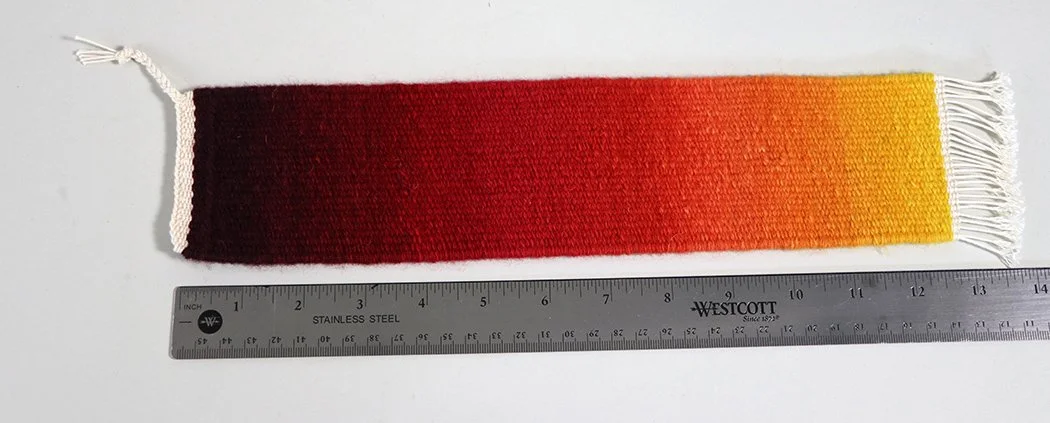
I love weaving gradations in tapestry. There is nothing more thrilling than making colors move from one color to another. Sometimes it is the value of a color that changes (light to dark for example) and sometimes it is a change in hue (green to blue for example). And sometimes it is both a value and a hue change.
Tapestry is well-suited to this sort of color change. I’ve used it a lot in my own work and I teach it in a couple classes online (see the notes at the end of this post if you want to learn).
I’ll show you a few of my older tapestries and then one of the newer ones. In reviewing my work, it is a rare tapestry that doesn’t include some form of gradation.
This first example is a very old tapestry called Awakenings III. I wove it even before I became James Koehler’s apprentice in 2008. It has some design issues especially with the colors, but it was really fun to weave. The gradations from the bottom pink to the top violet change both hue and value. The gradation in the bars also changes both value and hue. Interestingly, the smaller blue boxes don’t change color though they appear to due to simultaneous contrast. Every color affects whatever is next to it!
Rebecca Mezoff, Awakenings III, 40 x 40 inches, hand-dyed wool, cotton, circa 2006
Here is another tapestry that uses gradation in a couple ways. Cherry Lake is a smaller piece that was in one of the Small Tapestry International shows from the American Tapestry Alliance. The blues are all one hue with some black added to make the darkest colors top and bottom. And the colors in the pick and pick are made by shifting red to orange to yellow.
Rebecca Mezoff, Cherry Lake, 13 x 8 inches, hand-dyed wool, cotton
The tapestry below is one of my Rock Mini series. The series still needs a formal name, but for now, they are rock minis. This one uses a gradation that I did dye to be smooth (see the Unconformity piece below which uses the same yarn), but in this piece I chose to weave some of the colors out of order. The gradation in the top teal part generally goes from light to dark, but I wanted more texture than you get with a very smooth gradation to go with the blocky square forms below it.
Rock mini #8 on the copper pipe loom with a Fringeless four-selvedge warp
And many of you have seen this piece from my latest Unconformity series, Clarity. The blue-green to violet background is a dyed gradation.
Rebecca Mezoff, Unconformity series: Clarity, 24 x 48 inches, hand-dyed wool, cotton
Here is an example of how crazy my dyeing can get. If you love this sort of challenge, I do have a whole dye class about how to do this. Otherwise, there are some great commercial yarns you can use instead.
This is a gradation from violet to green that I dyed myself.
Commercially dyed yarns for gradation
These tapestries all utilize hand-dyed yarns that I have specifically dyed for these projects. But you can use commercially dyed yarns to create similar effects. Yarns that are made for tapestry weaving tend to come in value gradations. Two of my favorites are Gist Yarn’s Array and weaversbazaar’s wool. The Australian Tapestry Workshop yarn also comes in a huge array of colors dyed in gradation.*
Gradations do not have to go from light to dark in one hue as you can see from the work above. But learning how to make colors move from one hue to another means taking value into account.
Gradation online courses
I have two classes about weaving gradations in tapestry weaving. The shortest and most easily accessible class is one I just released this week, Gradations: TDB2. This is part of the Tapestry Discovery Box series of courses that I’m re-releasing without the subscription model or yarn kit. This course is a great way to dive into making gradations while being part of a community online and getting help from me! We’ll practice some methods and then weave a tapestry using what we’ve learned. There is more information about this class HERE.
The larger course I have about gradation is called Color Gradation Techniques. This class is more in depth and focuses on learning the techniques in a sampler-fashion. More information about that class is HERE. Please note that both of these classes explore color theory a bit, but they are both techniques classes, not color-use classes specifically.
Join me for the re-release of the Gradations: Tapestry Discovery Box course!**
**If you like a thicker singles yarn often used in southwestern USA by Diné and Hispanic weavers, take a look at Taos Wools and Tierra Wools. They both hand-dye their yarn in a wide range of colors and often in gradation.
*The re-release of these courses is NOT a subscription and it does NOT include yarn. I give information about either purchasing the yarn I used in the courses (Gist Array) or substituting one of the other fantastic tapestry yarns out there. For this Gradations course, you’ll want to pay attention to the suggestions I make about purchasing yarns that can be woven into a pleasing gradation. I cover that in the course and give you some starting tips on the website.