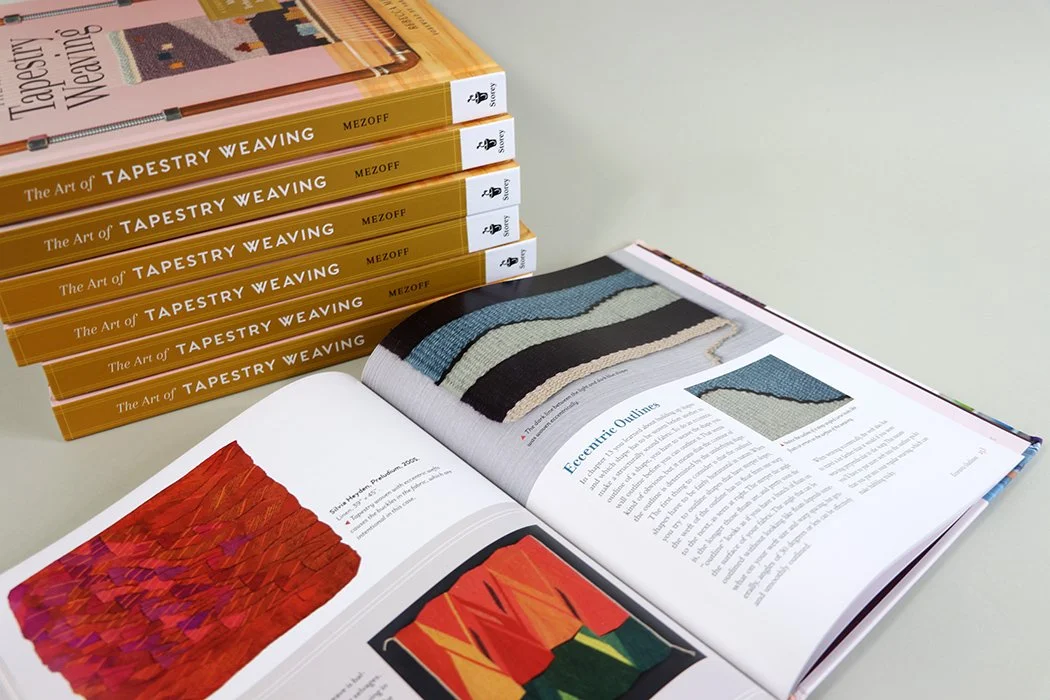
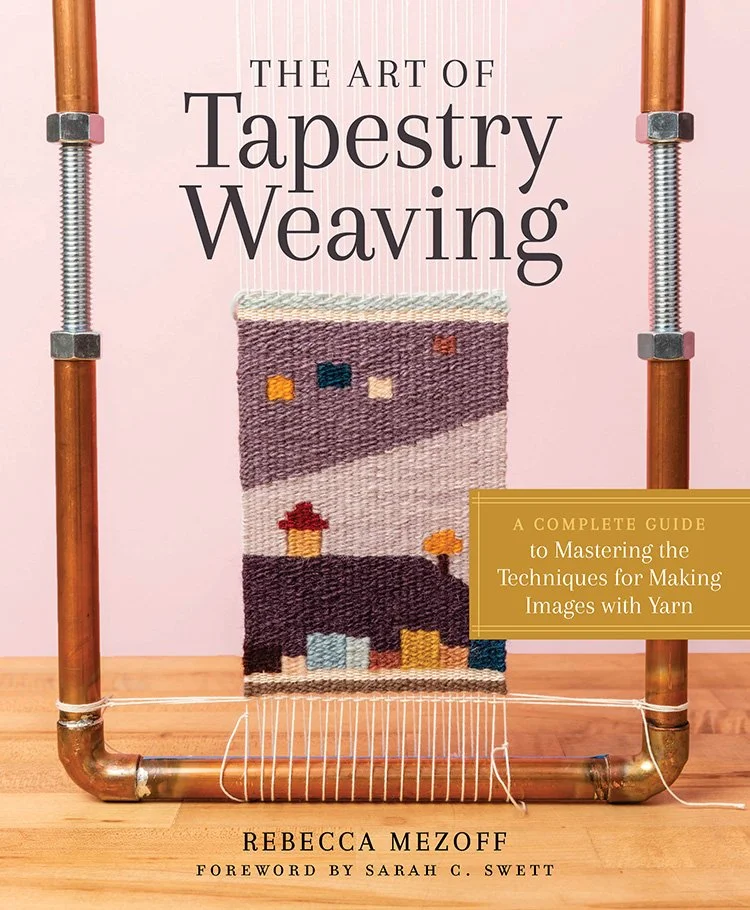
It has been six years since my book, The Art of Tapestry Weaving was published in November of 2020. The journey of making this book was one of surprises. I had no idea what a huge project writing a book like this one would be. It is probably a good thing I didn’t know or I never would have taken it on.
I wrote this book with Storey Publishing and I will be forever grateful for the amazing team I had there. I leaned on them continually. My first editor was Gwen Steege and I think I can honestly say that I would have given up the project if not for her. She helped me put my initial ideas in order and made me realize that writing a book was not the same thing as making an online class!
My course, Warp and Weft had been in the world for several years when I proposed writing the book and I really did think that I could just take my course handouts and the ideas in the videos and tweek them a little and I’d have a book. I was so very mistaken.
Gwen eventually handed me over to the editor who would shepherd me through the rest of the process, Mia Lumsden. I was also assigned a creative director, Michaela Jebb. It is Michaela who is responsible for the colors and layout of the book. I chose the colors of yarn I wanted to use in the samples and the book’s colors were drawn from there. I fought Michaela a bit on the cover color but I have to admit now that I’ve seen it on so many bookstore and library shelves that it stands out. The light red-violet is quite attractive. And finally my photographer Mars Vilaubi was unshakable during a 2+ week photoshoot.
The video below is one I made for the bookstore who was hosting a book signing of my book at Rhinebeck. But it was 2020. Guess what didn’t happen? NY Sheep and Wool (otherwise known as Rhinebeck). So I made a video and pretended I didn’t mind that I’d never been to Rhinebeck and still haven’t been.
Since the book came out, I’ve done a series of videos and teaching on the blog focusing on questions I’ve received from readers of the book. You can find those posts on my blog under the category The Art of Tapestry Weaving.
When reviewing that category I realized that I didn’t say a lot about the actual writing of the book. I have a couple friends working on writing first books who have asked me for advice and I realize I don’t have a lot to say except, hold on, put your ideas down in whatever order they come, write a whole draft before trying to edit it, and then expect that a lot of it is going to either get cut or need to be expanded.
I did some of the work of writing and editing the book at a couple artist residencies. The uninterrupted time needed to focus on a big project provided by an artist residency is really important.*
The first residency/retreat where I worked on the book was in October of 2018. I had written a proposal and that involved an outline and some very sketchy content, but I hadn’t really sat down and pulled everything I wanted to say into a structure I could work with. I wrote a blog post that week from Lake Grandby in Colorado, but I just mentioned that I was working on a new project and didn’t say what it was.
Any place can be a place to write! Especially when it is a free condo in the mountains of Colorado gifted by a student. Thanks Kristen!
So much paper. Notebooks and sticky notes and lined paper all organized and re-organized.
I remember this fairly small room covered with books, sticky notes, and scraps of paper. I organize best with actual pieces of paper that I can move around versus a computer document that is linear. I still do this when organizing a large project either using sticky notes or piles of paper for each section I can move around. I also brought a lot of yarn and my spinning wheel as that was a Spinzilla week and when my brain got tired I would spin.
I like to see the organization of something laid out in a physical way. I used two large cork boards and sticky notes to organize the book and it worked quite well. I’ve also used this method for large online class organization.
Using two cork boards and sticky notes to see the book layout in one place.
Weaving samples
The book is full of woven samples, all of which had to be in yarns that fit the color scheme of the book and clearly demonstrated the techniques I was teaching. I wove a lot of them on my Harrisville rug loom as shown in the photo below. Yes, there is a lot of unused warp there, but this was a way I could think through what I needed in each sample and have more than one going at the same time. It also saved a lot of time warping. One of the yarns I used was dyed by my teacher, James Koehler. I thought he might appreciate having a little hand in the book since he never got to write the tapestry techniques book he wanted to make.
Some of the samples or examples were done on small looms as I wanted people to feel like the teaching was accessible. The weaving below was done on a Hokett loom. This photo was taken on the day I climbed Mt. Graylock during the photoshoot. It must have been on the weekend between the two weeks of shooting.
And I know I wove these samples during my artist residency at the Lillian Smith Center which was after the photoshoot. It was one of those examples I didn’t have the energy to do during the weeks of the in-person photoshoot. The example is about sett and detail.
First pages… and second pages
I had to learn a lot of book publishing lingo and still am not sure I know a lot of it. At some point, I was mailed First Pages. It was a big deal to see the book laid out and printed in color. I made edits right on the pages.
First pages of The Art of Tapestry Weaving
And then when those changes were made, I found out there was such a thing as Second Pages. These came to me in a computer file and I printed them out so I could see them in front of me. The mirror next to my computer showed me the bird feeder through the window behind me.
Working on second pages for The Art of Tapestry Weaving
I had a residency at Lillian Smith Center in Georgia in November of 2019. Though I planned on using this two-week residency for other things, I distinctly remember spending an entire week of it doing book edits. I wrote a post about the residency HERE that has more photos, but the one below is what I was editing that week. That is the edge of a huge spreadsheet with every photograph in the book noted. Edits continued into January that year and then finally the book went to the printer and I could relax.
My experience of writing The Art of Tapestry Weaving
Thinking back to the publication six years ago and the years before that when I was writing it, I remember the great things about the experience. I enjoyed the process of organizing the content, deciding what was important and what was not since I only had 300 pages and there were a lot of photos, and talking to my editors about how to present the content in a modern, easily-accessible format. I’m still pleased with the way the book was laid out with lots of photos and text numbered and correlating to the images. I think this is an easier way to learn a new technique than having to read a lot of text describing what is happening.
Photoshoot for The Art of Tapestry Weaving by Rebecca Mezoff
Everything took so much longer than I thought it would. I did not anticipate how many times I’d have to go through everything and edit it. The first edits were big and sweeping and then over and over again it was refined. At the very end there was a print proof with the pages where the text I had written wouldn’t fit on the page and I had to cut words.
And there was the photoshoot. I did write about that because it was a little bit traumatic. I say in that post that I would do it again… in about five years. Since it has been six and I’m not there yet, we’ll have to push it out further.
Things they don’t tell you about writing a book
We took a trip to Harrisville Designs on one day of the photoshoot. Here Mars is getting some background shots for the book.
You don’t have a lot of control over the title or the cover art. I didn’t name this book. I did agree to the name with one change to the subtitle, but it wasn’t my idea. Publishers are all about marketing and they want a title that is going to sell.
Photoshoots are a big deal and also exhausting. Plan accordingly.
Check the photographs in the book VERY carefully. If they are artwork, you are probably the only person who will know if they are upside down. Don’t assume the file the invited artist sent the publisher was right side up or that the editor will check each and every photo. (With apologies to Elizabeth Buckley. The image was fixed in the second printing.)
It will take astronomically longer than you think. Start as soon as you get the contract. You still won’t have enough time.
You won’t understand the statements you get which tell you how many books have sold and hopefully contain a check. I’ve accepted that and keep cashing the (rather small) checks.
Books go out of print. This is scary to an author.
The publishing industry is a bit of a mess. Find a publisher you trust.
Your publisher could get bought out by a bigger publisher who doesn’t care as much about craft books. This could be a problem.
You really have no control over this, but I don’t recommend having your book publication day during a worldwide pandemic AND a presidential USA election. The anxiety was off the charts.
Your publisher likely doesn’t do translations to other languages. The book is sold to someone who does that. Apparently tapestry weaving is not popular enough to have an international publisher buy it. I’d pick Spanish and French if I could get translations.
It is still worth it.
I love that this book is out in the world and I still thank past Rebecca for doing all the work to publish it. There are a few bits of content I might change slightly, but in general, I stick by the book and don’t think it needs an updated edition (not that anyone is offering that!).
Thanks to all of you!
The book has done well. It is well into it’s 3rd printing. My publisher, Storey Publishing used to be owned by Workman but the whole shebang got bought by Hachette a few years ago. There is no guarantee that the book will remain in print since this change, so the more copies are out in the world the better!
You can help by doing one of these things:
Purchase a copy for a weaving friend.
Purchase a copy for your local library.
Request that your library purchase the book.
Check out the copy that your library has even if you own the book. Libraries track circulation and if a book isn’t checked out, they’re not going to keep it on the shelf.
Donate a copy to your local yarn store’s reference shelf.
If your local yarn store carries weaving supplies, ask them to carry the book.
Write a review and post it where people will see it.
Write a review on the site where you purchased it.
I am honored to find that many if not most of my students have the book beside them either in online classes or when they come to learn from me in person. I wrote the book for all of you and I hope it continues to be useful for a long time.
*Can I suggest THIS one?