Michelle Boyd’s new book is called A User’s Guide to Yarn: Everything knitters, crocheters, and weavers need to know about yarn to level up your craft. Michelle is a master spinner and her prior book was called Twist and was all about spinning. This new book includes information that will be of special interest to spinners, but overall the book is absolutely accessible to any knitter, spinner, crocheter, or weaver (or similar yarn users).*
Table of Contents, A User’s Guide to Yarn by Michelle Boyd
The book is 143 pages and soft-cover. The printing and photos are very clear and there are some excellent tables and illustrations.
I love that she started the book with the thought below. It does depend!
“Because the really hard thing about yarn is that it all depends. Nothing applies to all yarns at all times, or even to one yarn at different times. The same yarn will behave one way when we knit it, another when we crochet it, and yet another when we weave with it.... So the more we know about yarn, the more we can prepare ourselves for “it depends.””
How are you going to use the yarn? What structure will work best? What tools are you using, what fiber technique? There are so many variables that it can feel overwhelming. This book is a helpful guide to understanding how yarn works. I think that if you’re going to use yarn as your art material, it really helps to understand how it is made and why you’d want to look for certain characteristics in the yarn you are choosing.
This book is divided into three sections: Making Yarn, Buying Yarn, and Using Yarn. Right at the beginning Michelle reminds us that the language used for yarn (and I’ll add for whatever craft you’re using the yarn for) changes depending on the language, the country, and who the teacher or author is. This can be very confusing and I think this book helps unravel some of the challenges the way we talk about yarn around the world differs.
Making Yarn
In the Making Yarn section, Boyd discusses various kinds of fibers. then she talks some about how various fibers act and why. If you were curious about various fibers and how they might be applicable to the fiber craft you want to use them for, this section is important.
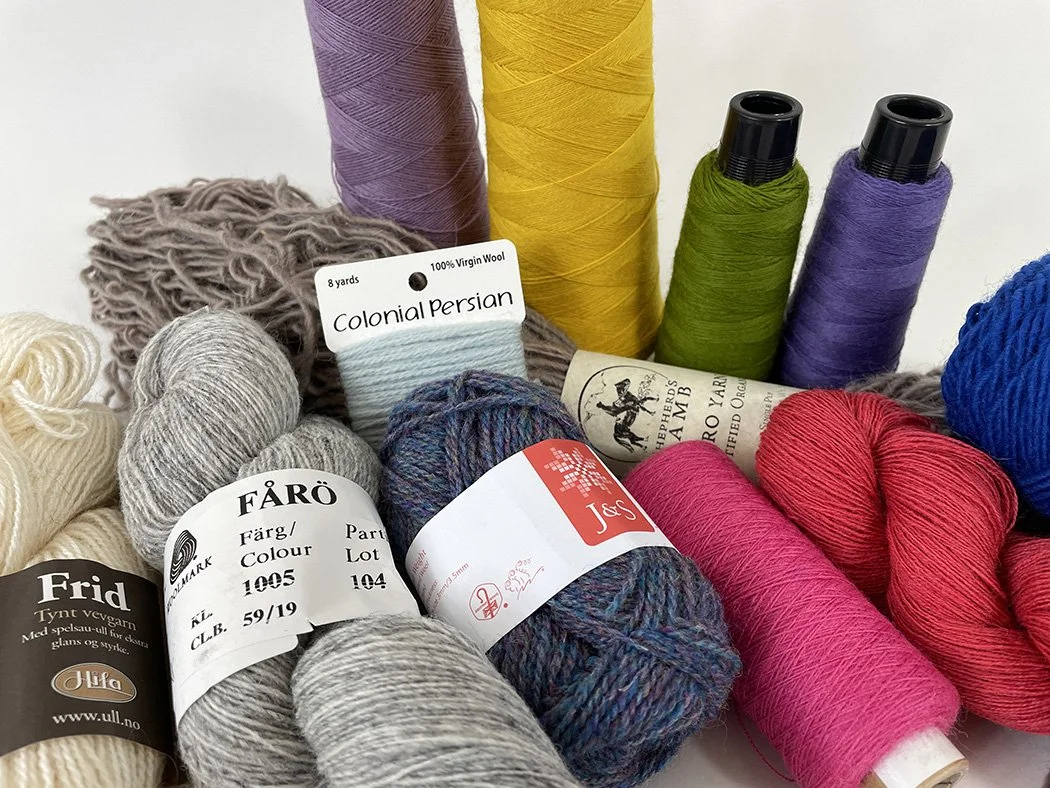
She also talks about yarn structure. This can be important for tapestry weaving. She defines single and plied yarns. Some tapestry yarns are singles. The one I use the most is Harrisville Koehler single (similar to Faro made by Klippen/used to be Borgs). A thin single like this means I can mix 3-4 colors in a bundle at 8 epi for tapestry weaving. I like to ply these singles yarns on my spinning wheel so the yarn is balanced, but it is not necessary.
Most tapestry yarns are 2-ply yarns. Two singles are plied together which makes a nicely balanced yarn. Gist Array, weaversbazaar, Jamieson, Harrisville Highland, and Frid are all 2-ply yarns.
If you try to ply these 2-ply yarns again on your spinning wheel, you’ll make what is called a cabled yarn. You’ll find that the structure of the yarn can change significantly. It is my preference when weaving tapestry to twist the weft bundle consisting of 2-ply yarns as I lay it in the shed instead of trying to add twist to an already twisted yarn a third time using a wheel.
And then Boyd talks about woolen versus worsted yarns. This is about how the yarns are made and the description is great. For the most part, more worsted spun yarns are better for tapestry because they are firmer. But I have spun plenty of woolen yarns myself that I’ve used for tapestry successfully and the Harrisville Highland I often teach with is a woolen spun yarn.
She finishes the section by talking about S and Z twist (important if you’re going to twist your yarns in your weft bundle for tapestry) and some about finishing. Even if you’re not a spinner, finishing can be an important consideration because a lot of mill-spun yarns are not fully finished and before using them in a tapestry, you need to make sure they are (see this blog post about scouring). Fortunately for tapestry weavers, most yarns made specifically for tapestry are fully finished when you get them (Gist Array, weaversbazaar, and Australian Tapestry Workshop yarns for example).
Buying Yarn
In the Buying Yarn section, Michelle helps us choose yarns for projects. Fortunately for tapestry weavers this is not as complicated a question as it might be for a knitter. In tapestry weaving we know we are going to compact the yarn into a weft-faced fabric and probably we are going to have a collection of yarns based more on color that are all fairly similar in how they’re made. But if you use yarn for other sorts of crafts, this section is really important.
For example, she discusses the yarn sizing system that most manufacturers use which you might recognize from the little yarn skein with a number in it. This marking usually appears on commercially spun knitting/crochet yarns you’d get in a yarn store. 0 is lace weight yarn (very thin) and 7 is jumbo yarn (very thick). For tapestry weaving we are usually using yarns at the lower end of this scale, 0-3 because we can bundle them for color variation. 4 is worsted weight and that is the thickest yarn you can use for tapestry at 8 epi. After that you can use thicker yarns at wider setts perhaps to make rugs.
Detail from a larger table in Michelle Boyd’s A User’s Guide to Yarn, page 61
Michelle tells us that weaving yarns are usually labeled with the Bradford count number plus the number of plies. Boyd says about the Bradford count number, “which is based on the number of skeins of yarn that can be spun, at that diameter, from one pound of fibre.”
Many thanks to Michelle for clarifying this. For years I’ve been telling people that weaving yarn does indeed usually indicate the number of plies and that the other number is about how thick the individual strands are. This tracks with her description, but hers is clearer! For example, a 12/6 cotton seine twine warp has 12 strands of yarn of a particular diameter and 6 plies. And this bit I didn’t know…
“Generally, when the number of plies is first, as in 2/8, the yarn has been ring-spun and is more worsted in character. When the count number is first as in 8/2, that yarn has been spun using the open-end process (Fry 2018).”
There are regional variations and it is my experience (which Boyd backs up in this book) that different manufacturers are going to use something different or maybe go out on their own if you’re unlucky.
This section also contains information about burn testing, Bradford counts, wraps per inch, twist angle (more important if you’re spinning your own yarn), and storing yarn. Wraps per inch (WPI) is an interesting subject. Some people swear by it. I’ve always said it is too hard to get an accurate measurement. Spinners tend to like it and it may be time for me to try using it with a variety of tapestry yarns and see if I can get a more consistent feeling of the size of the yarn and therefore what sett it can be used at.
Boyd does talk about gauge and sett but these concepts are more for knitting, crochet, and fabric weaving than for tapestry.
Using Yarn
Yarn put-up. Photo by Rebecca Mezoff.
In this section of the book Boyd spends some time discussion tools (knitting needles, ball winders, weaving tools. She has a general discussion of looms that gives you a nice overview of various kinds of looms people weave on if you’re not familiar with them. She gives tips like how to choose a put-up (how the yarn is packaged and/or used like a ball or a skein) and how to avoid problems like tangles when you wind a skein.
There is an excellent section about how the way a yarn is constructed shows up in knitted structures. There are similar sections about crochet and weaving (aimed mostly at fabric weaving but with some applications to tapestry). These sections are important to understanding why some yarns make a great garment and others don’t (depending on what that garment is!).
There is a section about finishing cloth which is helpful for garments and functional textiles.
At the end of the book there is a glossary of terms, some resources, and an index.
Conclusion
This is a marvelous book that anyone who loves and uses yarn will find useful. Especially if you don’t have experience spinning your own yarn or haven’t experienced a wide range of different yarns before, this book is a great guide for how fibers will act and which ones to choose for your project. Obviously in relation to tapestry weaving, this isn’t a comprehensive resource. No book of this length could address every single yarn use out there. But the concepts that the author covers are useful for tapestry weavers even if some of the particulars don’t apply to our craft.
I will use this book myself and for teaching with great regularity. It is full of thoughtfully presented concepts that answer questions about structure and function of yarn. It belongs on any yarn-user’s shelf!
One example of two much-loved and very different tapestry yarns. On the left is weaversbazaar fine and on the right is Frid, a Norwegian yarn.
I have a short course that addresses tapestry yarns specifically. It talks about how to evaluate a yarn for yourself and reviews 20 different yarns you might use for tapestry. The important thing about the class is learning to evaluate a yarn for yourself. I think this class is a great complement to Michelle Boyd’s book. The class was originally taught live but you can purchase it as a stand-alone online class at any time. It is called What Makes a Good Tapestry Yarn.
*I have no affiliation with this publisher, though I have great respect for Kim Werker who runs Nine Ten Publications. I purchased this book at full price because I suspected that it was going to be an excellent book (and I was right). I also don’t personally know Michelle Boyd the author though I met her in an elevator when we were both teaching at a conference once. I found her book Twist useful and suspected that this book would also be (I was right again). I suggest getting your copy of this book from your local yarn store, an independent bookstore, or if you don’t have either of those, Bookshop.org.