Not just any yarn will work for tapestry weaving and if you’ve tried to use a knitting yarn like Cascade 220 or Knit Picks Wool of the Andes,* you know that these squishy yarns are difficult to use for tapestry and don’t get the best results.
A good tapestry yarn isn’t lofty, doesn’t have much end-to-end stretch, and comes in a lot of colors. Most tapestry weavers bundle thinner weft strands in a bundle to not only achieve the weft bundle size they need for the sett they’re working at, but to increase their color options by blending hues in the weft bundle.
In most of my online classes I suggest a wide range of tapestry yarns you can choose from. I also teach you how to evaluate a yarn for tapestry yourself.
If you’ve purchased the Tapestry Discovery Box courses, Introduction to Tapestry Weaving, or Introduction to Rug Weaving through Gist Yarn, your kit came with the class and Gist Array or Dwella yarn. I suggest other possible yarns in the classes if you take them directly from me (no yarn kit), but how can you learn to evaluate this for yourself?
Consider weft size and sett
It is important that the weft size be appropriate for the sett you’re using.** A lot of tapestry weavers these days use a sett of 8 epi, especially when first starting out. But any sett is possible, you just have to adjust the weft size for the sett you’re using. More space between the warps means you need a thicker weft. Less space between the warps mean you need a thinner weft (or weft bundle).
Primary considerations when matching weft size to sett are:
If your weft is too thin for your sett, your weaving may be very sleazy.
If your weft is too thick for the sett, you will not be able to cover the warp and you’ll see warp lice peeking through.
A general place to start is to hold your weft (or weft bundle) parallel to your warped loom and if the weft visually fills up the space between the warps, you’re in the ballpark of the correct weft bundle. See the photo below.
There is a fairly wide range between too thin and too thick that will work. Please ask in an online class if you’re unsure about your weft bundle size.
What do I mean by “sleazy?” The sample pictured below is one I take to workshops I teach to demonstrate this quality. The weft is Harrisville Highland which is a light worsted weight yarn. The sett is 6 epi. (Normally I would use Highland at 8 or 10 epi.) The weft moves fairly freely on the warp and the holes created by the slits are very large because the thin weft can’t fill the space between the two warps. The fabric is very floppy and does not feel like a typical sturdy tapestry fabric.
What are warp lice? The term sounds kind of gross, but it is what weavers tend to use to describe the warp showing through the sequences of weft. In traditional tapestry, the warp is completely covered by the weft. In the example below, the teal colored yarn is too thick for this warp sett and the warp shows between the sequences.
A sizing starting place is to hold the weft parallel to your warp and see if it visually fills the space between the warps. This is a VERY rough place to start, but if you have some options lying around, it can be helpful.
What about using yards per pound to compare yarns?
This is the first thing I do when I want to try out a new yarn. Yards per pound (ypp) is a very rough estimate and for thicker yarns often doesn’t work. When you’re using a weft bundle with thinner yarns however, it can be quite helpful. If you’re shopping online and you can’t see or feel the yarn, sometimes it is very difficult to tell the size of a yarn from a photo. Ypp can tell you whether it is very thin or very thick. A thin yarn will have a higher yards (or meters) per pound (or kg) number. A thicker yarn will have a lower yards per pound number. Often you have to do some math to compare since different manufacturers have different sized put-ups or use different measurement systems (imperial or metric).
I’ll use Gist Array as an example because that is the yarn I demonstrated with in the thirteen Tapestry Discovery Box courses.^
Array is a thin yarn that is 3,360 yards per pound. Another favorite tapestry yarn is Australian Tapestry Workshop yarn which is 3,200 yards per pound. Both of those yarns are fairly thin and have similar number of yards per pound so I know they might be a good bet for substitution. I generally use 3 or 4 strands of Array at 8 epi and I know that I might use 3 or 4 strands of ATW yarn but I’ll have to sample to know for sure. Because ATW is a little thicker using ypp for comparison, I’m going to guess that I’ll use 3 strands at 8 epi. (Update 9/7: Thanks to Julie, an ATW user, for letting me know that in practice, ATW actually acts thinner than Array! Another example of why sampling is important. Julie says 6-8 strands in a bundle is what she uses and what the weavers at the ATW use. It could be that the ypp numbers I was using for this yarn are also outdated as it seems they have changed the size of it more than once…)
Characteristics of a yarn can have a big influence on this ypp number. A yarn that is loftier will pack in more to cover the warp. A more tightly spun yarn will be stiffer and won’t be as malleable. (However, those tightly spun yarns are very beautiful and great for tapestry!). So after you find a yarn that might be in the same ballpark, you’ll need to do some sampling.
I won’t know exactly how to substitute ATW yarn for Array in the example above until I do a woven sample using the warp and sett I want to use. It might be that I actually need more strands of ATW even though the yarn is a little thicker because it is a little bit softer of a yarn. I won’t know until I sample and I certainly won’t know from looking at these yarns on a website.
Gist Array woven in one of the samples for the Introduction to Tapestry Weaving online course
And of course if you’re making weft bundles you can mix yarns within the bundle (I recommend you keep them all the same fiber type like wool if you’re a beginner). You might mix a strand of Faro with four strands of weaversbazaar fine or two strands of Array with two strands of weaversbazaar fine.
Yarn is a fantastic material and the more you work with it the more you’ll understand how it works. So pull out your stash and let’s get weaving!
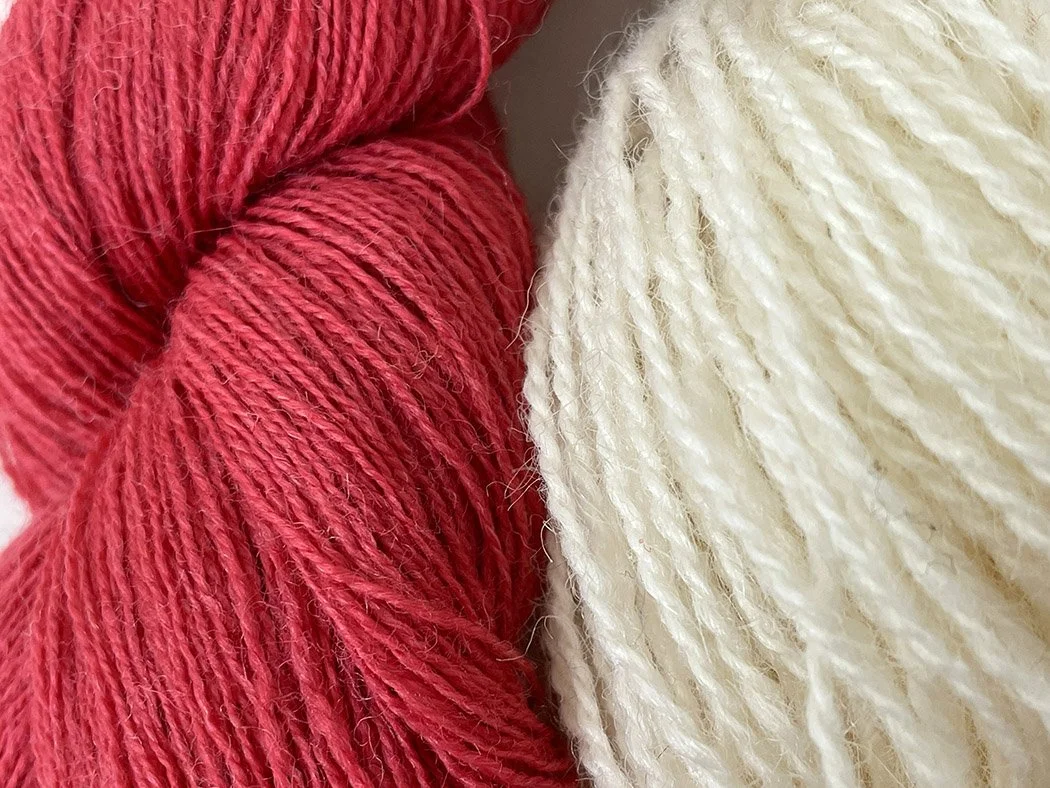
The image that is the header for this post is a skein of weaversbazaar fine on the left and a skein of Frid Vevgarn on the right. The photo above is those two yarns woven. I used 6 strands of WB fine on the left and 2 strands of Frid on the right. You can see the very different character of the fabric with the two yarns. They’re both beautiful tapestry yarns, but what they express is quite different!^^
*Both Cascade 220 and Wool of the Andes are tempting because they come in lots of colors and are relatively inexpensive. You can find them easily, but they are difficult tapestry yarns and they don’t look great when their knitting loftiness is squished down into a tapestry fabric. They’re simply too soft.
Warp sett. This warp has 8 warps in one inch, so we say it is 8 epi (ends per inch).
**Sett is the number of warp ends per inch (epi). 8 epi has 8 warps in one inch of width. 12 epi would have 12 warps in one inch which would be a finer weave and require a thinner weft or weft bundle.
^The Tapestry Discovery Box classes are coming back this month! Watch my newsletter for an announcement next week. I go into more depth about yarn substitution in the class if you’re not going to use Array. There are many other options.
^^If you are fascinated with yarn characteristics and how to use different yarns in tapestry, I have a class called What Makes a Good Tapestry Yarn? you might want to check out.