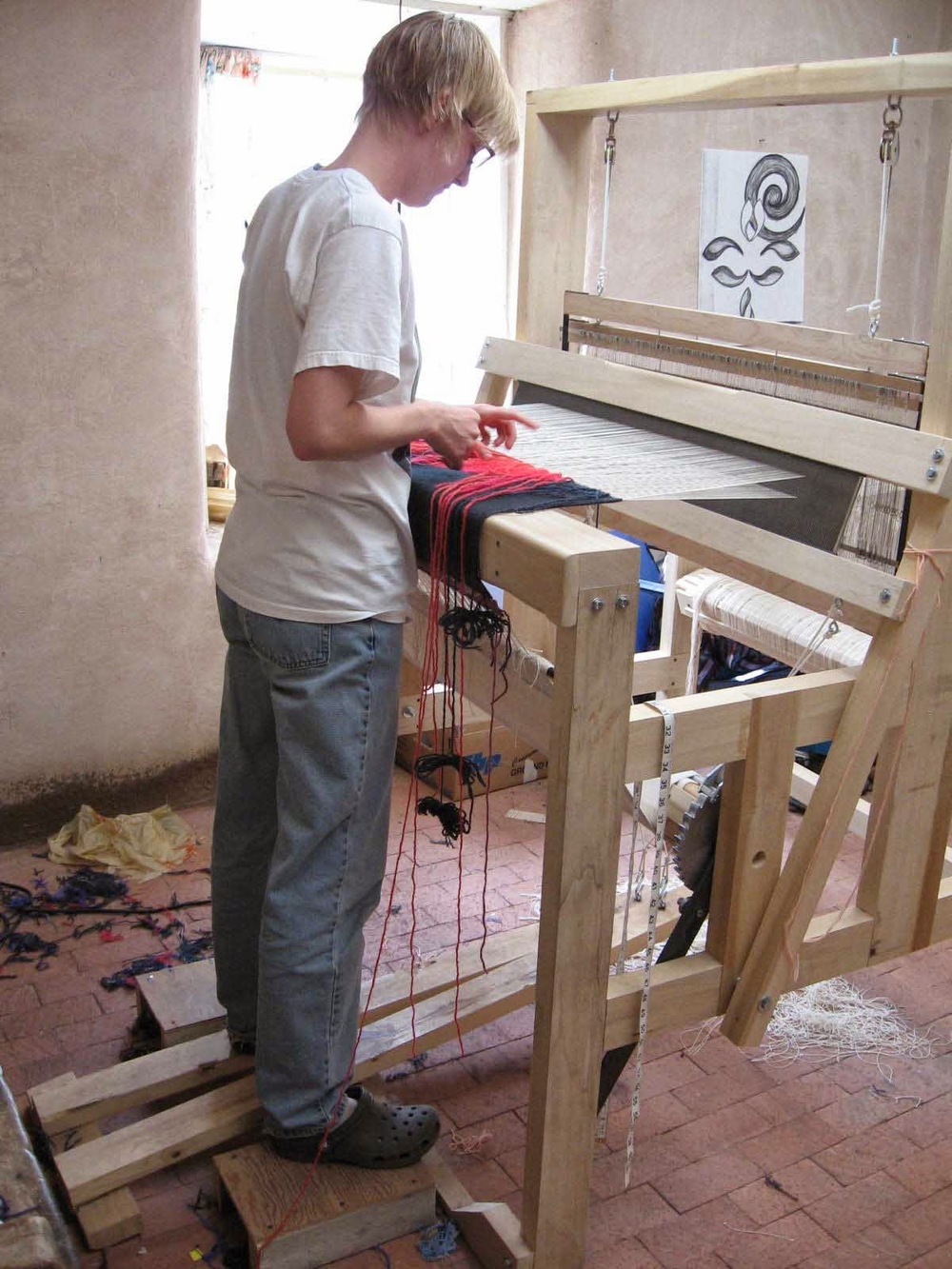
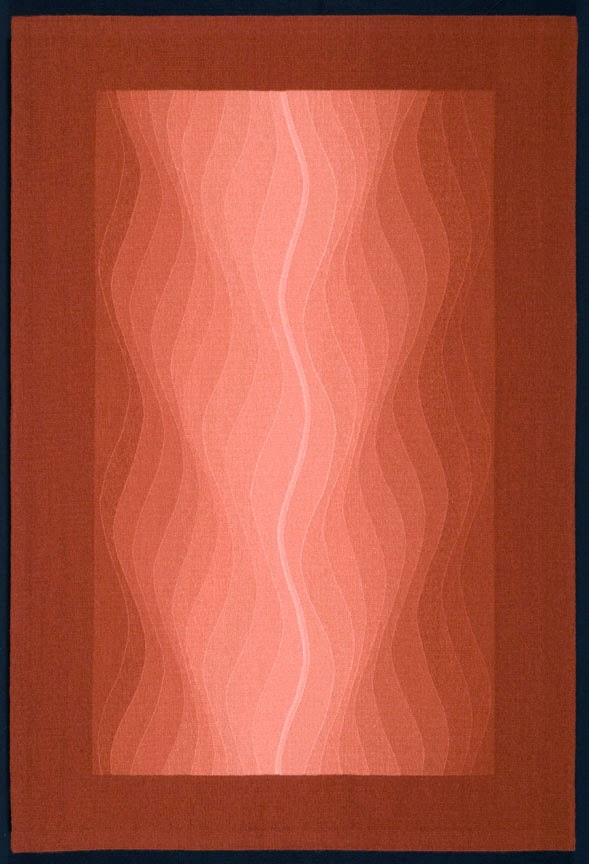
Nacktschnecke... plus the best yarn photos of the week

It has been raining here in northern Colorado. I grew up in the land of sunshine. I expect Colorado offer up 300+ days a year of the stuff. It has been raining for weeks. Now don't get me wrong. The water is wonderful and my worries about all the forests burning down this summer have decreased drastically, though the worry about flooding has increased proportionally. Clearly I have a long-standing habit of worrying about things I can't do anything about. We are currently simultaneously under a Flood Warning, Winter Storm Watch, and Flash Flood Warning. It is supposed to snow later, so it seems reasonable to just stay home today. The family in the SUV stuffed with camping gear towing a pop-up trailer that just drove by by is going to wish they were sitting on the couch knitting and reading books about color as well.

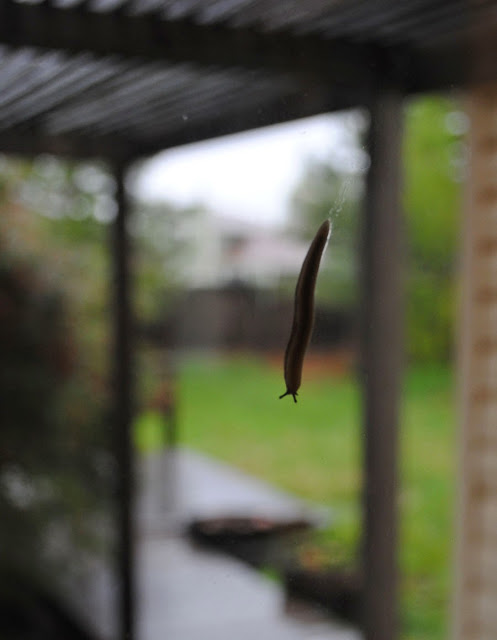
It is so wet that as I was drinking my tea yesterday morning staring out the slider at the rain, I noticed a little visitor on the other side of the glass.
Nacktschnecke is one of the only words I remember from the brief German tutorials we enjoyed while visiting Erfurt from my friend and colleague Conni Theimer Gardella. I remember because schnecken means something like cinnamon roll which looks like a snail which is schnecke and nacktschnecke is naked snail which is a slug. I think my learning of the German language is pretty hopeless in general, but if I applied myself in just this way, perhaps I could learn some of it. Really I just need to know all the words for my favorite foods, some pleasantries for idle conversation, and all the words for yarn and weaving.

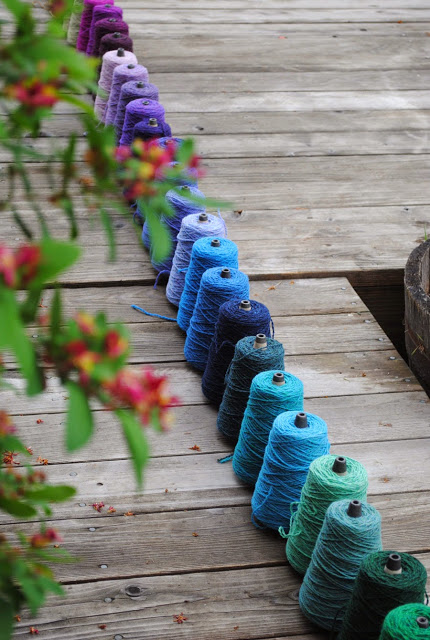
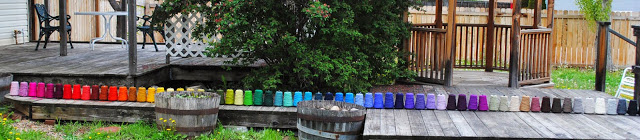
Yarn, weaving, and textiles being the most important things in my current sphere, here are some yarn photos I shot during a brief break in the rain Wednesday.
Yarn is Harrisville Highland by Harrisville Designs
I had the blessing of a friend coming to help me skein yarn yesterday. I was unreasonably, undeniably excited about this. She saved me three hours at the skein winder and seemed to have a great time. I hope she comes back. She is also originally from Germany so maybe if I bribe her with some schnecken?

The value of it all.

Value. I suppose we most often think of that word as referring to what something is worth. But in my world of yarn and dye pots, it mostly means how light or dark a color is. 

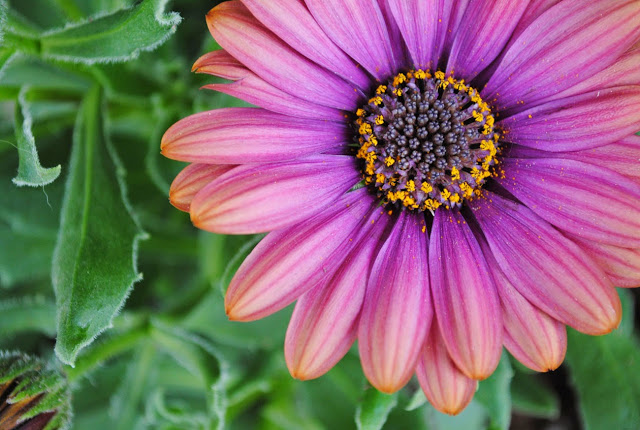
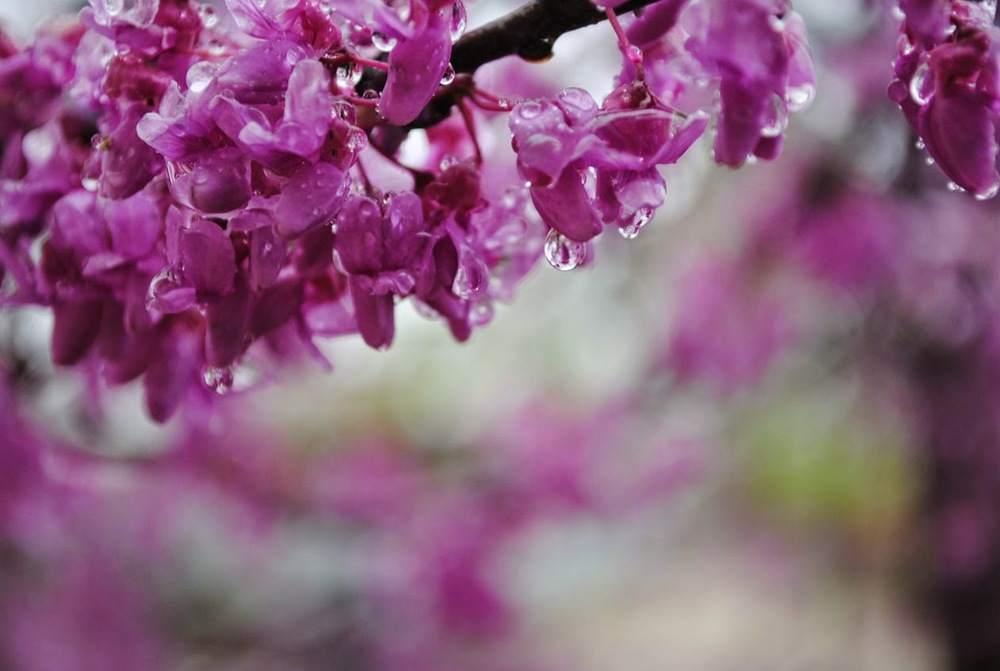
We talked a lot about value in the Color Gradation Techniques class I taught last week in Golden, Colorado. This flower was on the porch of the shop and one of the students pointed out what a lovely color gradation it represented. I am pretty sure I couldn't create this with the colors on my shelf, but I think dyeing them might be an upcoming challenge.

I enjoy teaching classes more and more. Either that or this group of people was just extra special. Or maybe every group is extra special. I'm not sure. We had a small class and they were really interested in exploring color gradation ideas and creating effects with the techniques. (Ha! That is probably  why I enjoyed it so much--they were listening!)

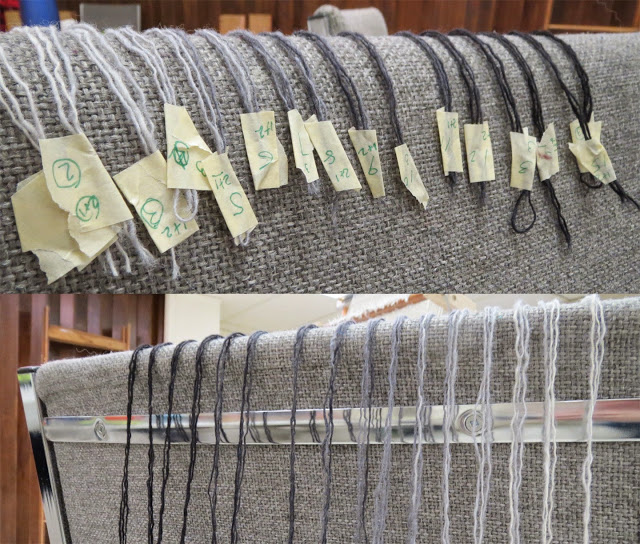
When I start seeing things like the photos below, I know we're in for a good time (or that Judy is as crazy organized as I am when it comes to color. It is all about the masking tape.)
Here are a few more photos from the workshop.
And here is a photo of a transparency that Judy did. Her idea came from Josef Albers' book, Interaction of Color. She added a purple to blue gradation on the edges. The bars in the center get lighter, but the red and the edges of the gray bars don't change even though they appear to. Also note the double color gradation in the Greek Key design: greyscale while the background is moving blue to purple.
It is mostly about the value, though being able to tell orange from green is also helpful.


From some of the lovely yarn shelves at the Recycled Lamb...

Tapestry weft yarn debates and that wheeze in the freezer...

The freezer is doing that weird little barely audible rasp which sounds alternately like the ghost of a bird caught in the ice machine and your grandpa's nose whistle. The sound has become familiar over the last couple days and I have embraced it as white noise.

I'm camped out at a mid-level hotel in Golden, Colorado this week while I teach a class at The Recycled Lamb.

SIX things thrilled me today.
1. The sirachi-flavored turkey on my sandwich was not an abomination as I feared, but tasted quite zingy.
2. My students are absolutely churning out some fantastic color gradation studies. They are innovative, learn quickly, and are having fun.
3. Sweet potato pecan gluten free pancakes are fantastic and I may have to return to Blue Sky Cafe for breakfast again tomorrow.
4. The corner liquor store does carry corkscrews and a trip to a big box store was not required.
5. When you start playing with color in weaving, you learn not only about what weft yarns work in certain situations but how to mix colors to achieve various effects including transparency. By "you" I mean the students in the class. (More on this weft yarn debate thing in an upcoming post.)

And the BEST thing was reading this review of my online tapestry techniques class by the one and only Bhakti Ziek. It literally thrilled me to tears.

If you don't know, Bhakti is a celebrated fiber artist who works in many techniques but is well known for her digital jacquard weaving. Getting this kind of marvelous feedback from someone of her experience and skill is a lovely moment indeed. Just for one example, take a look at THIS commission she did for Princeton University called Stardust.

I like staying at this hotel on the edge of Golden. I love watching people learn how to move color around a surface they are creating in wool. And I love, as we all do, when I hear appreciation for something that has taken a huge amount of dedication and effort. It is a good day.


Bhakti's blog post is HERE.

New skills falling like rain today...

It is only Sunday morning but I've already learned a lot this weekend. Yesterday I learned to mow the "lawn". That was a first. I made it into my 40s without ever having mowed grass. That is because I've largely lived places where I think it is criminal to have lawns. Nevada. New Mexico. Colorado. Not that there is anything wrong with grass. I just don't understand pouring drinking water on a plant that is meant for climates with rain.

This house/studio is a rental and the instructions from the landlords were literally, "just don't let the grass die completely--the city will cite us." So keeping grass healthy apparently involves cutting it from time to time. We hired the neighbor boy to cut it last year, but finally realized that the $17.50 we were paying him every week would quickly pay for a mower (and was more than we made in an hour which just seemed wrong as he is eleven). This pathetic little patch is under some big pine trees so it hardly grows as it gets no sun. A push mower seemed the thing, and one was found at the big orange box store.

We spent Friday evening cruising the lawn mower aisle with a lot of youngish men debating the benefits of this or that power mower. We brushed past a little clot of them surrounding a riding mower and slunk down to the end of the aisle where there were a couple forlorn push mowers. Yep. The ones without power. After about 20 minutes of asking ourselves whether we really needed the ones that make a lot of noise, we bought the best push mower, because if Fiskars makes great sewing scissors, certainly they could make blades that cut grass.

I put it together yesterday morning and 20 minutes later had a nicely shorn "lawn" and stronger biceps.

Learning is good. I learn a great deal from my students. Honestly one of the biggest reasons to teach is that you learn so much. I bet I learn more than they do most days.

I learned a new computer program for presentations after the lawn thing yesterday. Watch out! My videos and classroom presentations are about to become EPIC much better. Last week I learned how to put drop shadows on my tapestry photos. Also very thrilling.

Note to self: One step at a time is how it is done. one. step. at. a. time.

Today is a day for paperwork. The Color Gradation for Tapestry presentation needs some tweaking for the class I teach starting Thursday in Golden, CO. I've wanted to fix it up for years. It was never bad, mind you... just didn't quite give them that whole picture view I want at the beginning of the class. This week is the week... hopefully the guinea pigs students will love it.

(Still spots! There are still many spots open. Come join us! The Recycled Lamb. Yep. That is desperation speaking.)

Oh, and it is actually raining! It is suppose to rain all day. You have no idea how glorious it is to get rain in the desert. My apologies to California.
Weaving color gradations with tapestry... or fun with a copy machine

I'm working on some new sample tapestries for a class I'm teaching in June in Michigan. The class is called Predicting the Unpredictable: Color in Tapestry and it is a color theory for tapestry class. I think I called it that so I would have to learn to spell unpredictible. See there, I still got it wrong. One I, one A. Unpredictable. (As in my spelling is...)

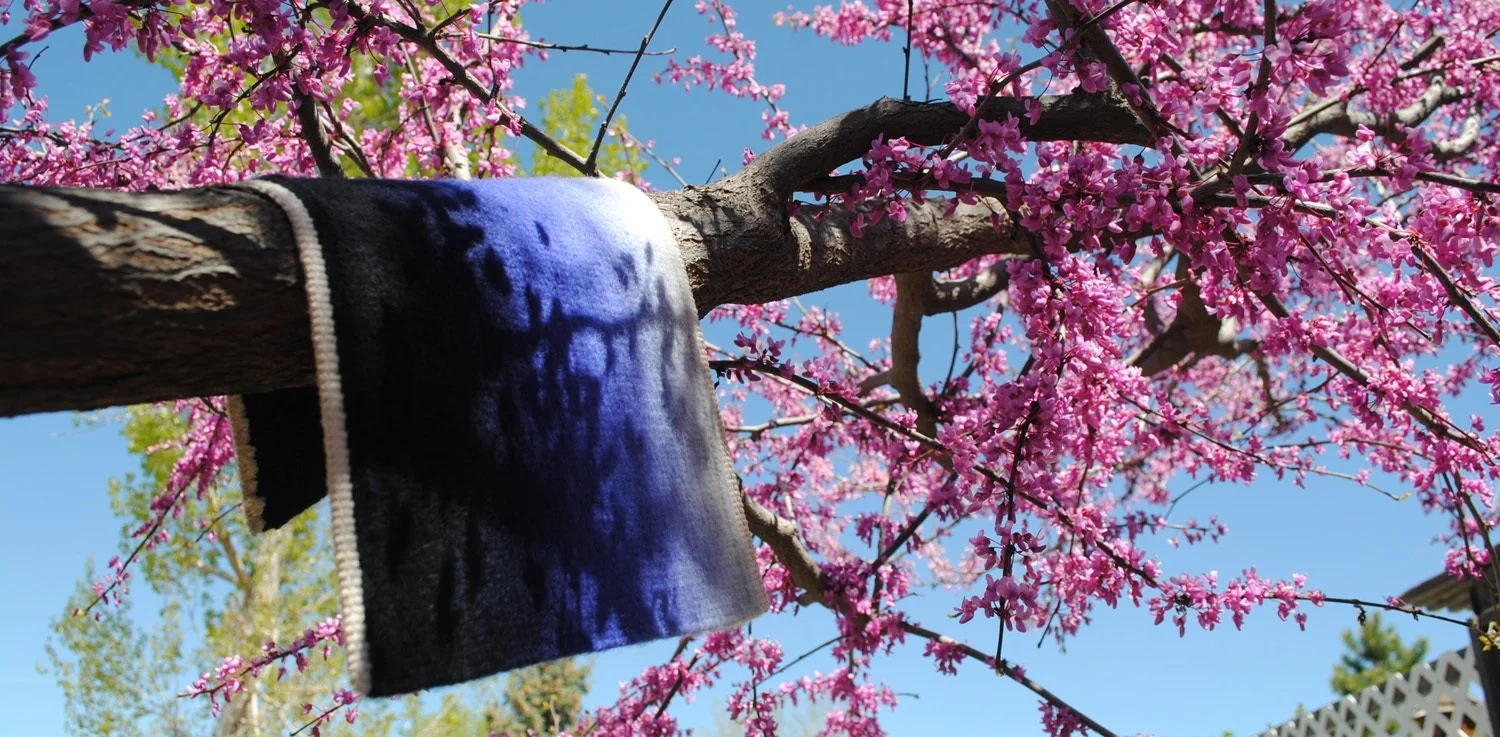
Yesterday I pulled this one off the loom.
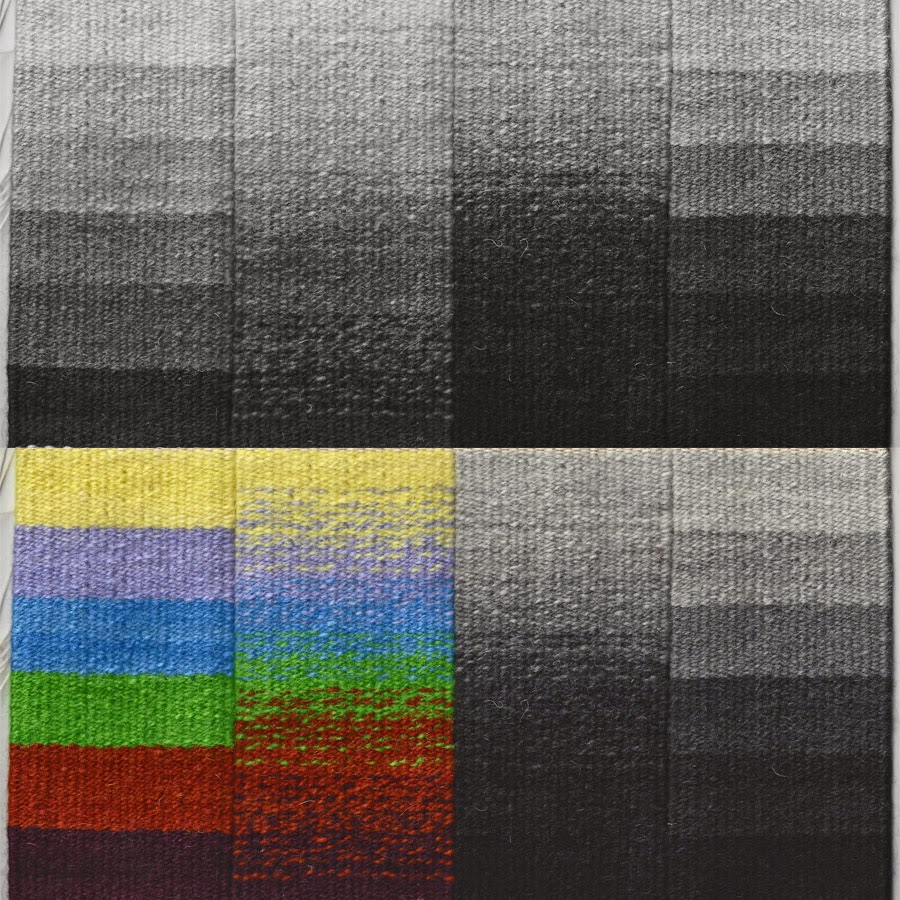
The top half is a photocopy of the weaving on the bottom. I was attempting to match the values in the grayscale with the colors and I'd say it came out pretty close. I didn't pay any attention to the hues of the colors on the bottom, only to the values (though I'm sure I don't have a yellow that would match the darkest three hues).

I am going to do this again. I am also going to dye a different gradation of blacks. This one has a large jump between depth of shades 0.26 and 1.0. See it right in the middle? I am using a dye scale by Ginny Phillips but I think for this one I might just go back to the scale James Koehler taught me which is based on a different geometric progression. I'll certainly show you how it turns out. I think the value gradation in the photocopy (top left) is better than the woven grayscale (top right)!

This is woven with Harrisville Highland which is a two-ply yarn. I will also do it with the singles yarn I use for my tapestries to illustrate the difference between just two and three plys.
I'm also getting ready for another round of Color Gradation Techniques for Tapestry, April 30 - May 3 in Golden, Colorado. I'm really excited about this class. Not only do I have some new ideas to try in the area of color theory and using gradation in real weaving applications, but the class is super small and full of great people I have met various places over the last few years. We really do need a couple more people in the class, so if you have any inclination to spend four days with me in sunny Golden, let me know! Information on The Recycled Lamb where the class is being held is here: http://www.recycledlamb.com/events.php
And a little more information on my website here: http://www.rebeccamezoff.com/workshops

Here are some of the yarns for the class, all packed up now and ready to go!

My favorite tapestry technique

If you've been paying attention, you may have noticed that I teach a lot of things about tapestry. There are times when I want to weave something insanely complicated. If I actually let this wish get the better of me, I might end up feeling like this.
Molly McNeece, Cousin Trapped, watercolor
When this happens, I go back to some old tried and true tricks. My favorite is regular hatching. If you've had a class from me, you've probably tried this technique. I used it in the spirals in many of my Emergence pieces and sometimes I just weave it on a sampler to calm down a little bit, dork dedicated practitioner that I am.
Rebecca Mezoff, Emergence VII, 45 x 45 inches, hand-dyed wool tapestry. All of the spiral form not in the teal bar is done with regular hatching.
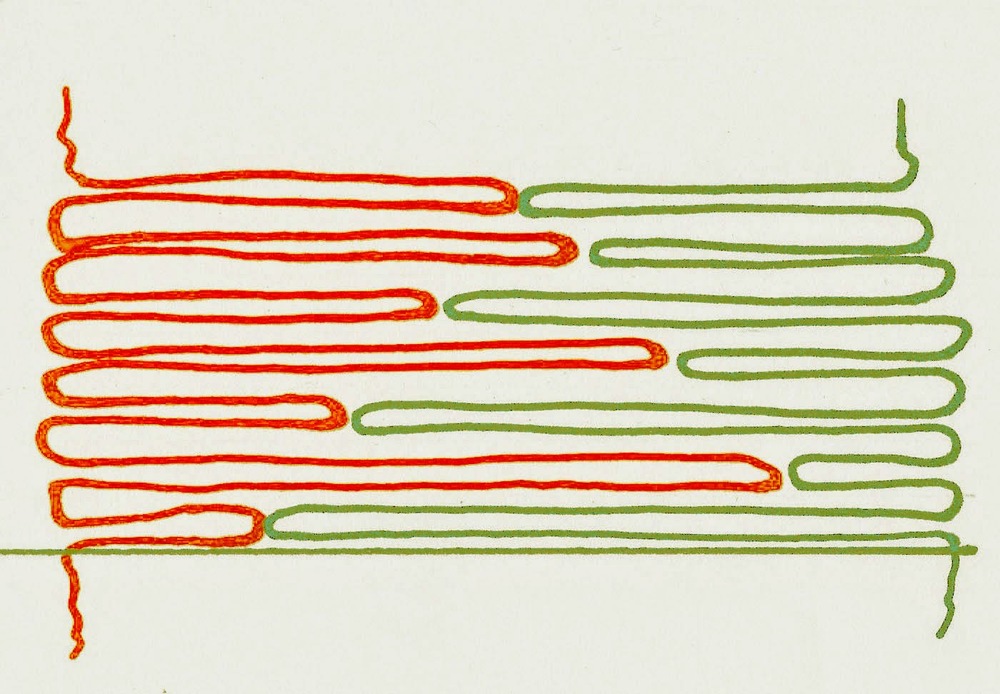
There are a couple ways you can do this technique. The simplest is just to overlap two colors in full sequences in a regular manner.

Use two colors and change the points where they relay according to your cartoon or any regular pattern. The example below creates a triangle.

Depending on the two colors used and their values, you may create the illusion of a third color between the two as in this arrow pattern which seems to suggest a green tree.
An excellent example of this technique is in Ulrikka Mokdad's tapestry, Floating in Blissful Ignorance.
Ulrikka Mokdad, Floating in Blissful Ignorance, 50 x 33 inches, wool weft, linen warp, photo: Frantz Henriksen
This detail shows the regular hatching between the peach and the black in the finger.
Ulrikka Mokdad, Floating in Blissful Ignorance, Detail
This technique can also be done with a separate color used for the striped lines independent of the background color.

Rebecca Mezoff is a tapestry artist and educator who loves to scratch puppies behind their ears, eat pepperoni pizza, hike long trails, and teach people about tapestry weaving. You can find out more about her and her online classes here: http://www.rebeccamezoff.com/online-learning/

Note: This blog post first appeared on the Mirrix blog as a guest post. If you feel like you've read it before, you're not crazy (well, not that I can tell anyway), you did. 

A conversation about Rebecca Mezoff's tapestry with Fiber Art Now. See the webinar replay.

What a fun thing it is to participate in a conversation in webinar format. If you missed my webinar with Fiber Art Now's FANFare yesterday, you can watch it below.

I have always been a very introverted person, but my 17 years of practice as an occupational therapist forced me to learn to interact with other people quickly and to think on my feet. This is the kind of challenge that made this webinar fun to do. The live format is great and of course we always wish for more time for questions! I certainly can't think of my questions that quickly, so if you have them, put them in the comments below or contact me and maybe I'll do a blog post about it.

As you watch it, here are more images and some further explanation about things I was talking about.

The most important part of the webinar for me was the last third where I was talking about the importance of learning and my philosophy about teaching tapestry. Teaching tapestry in a way that is accessible to people in many different life situations is important to me. Expanding the reach of tapestry in the world both as an art medium and as something that is just fun to make is what it is all about for me.

Here are some more details from the webinar:

I talked some about the Reno Fiber Guild (and I am eternally grateful to these wonderful people) and how I started trying to make images in doubleweave which led me to tapestry. This was the kind of thing I was making just before I returned to New Mexico to study Rio Grande weaving at Northern New Mexico Community College in El Rito, NM.

This was my studio in El Rito, the outside and the inside.

My studio in El Rito, NM. 2004-2007

The walls of that studio were five foot thick adobe. It was heated with a woodstove and since I didn't keep the stove lit all the time, it was freezing in there all winter. Still, the light was great from some huge skylights and I wove many things there at the same time I was taking some classes with James Koehler. I would eventually drop out of the Rio Grande program and became James Koehler's apprentice in Santa Fe.

Here are some images of Northern New Mexico Community College in El Rito. They no longer have the Fiber Arts degree program there, but you can take a continuing education class from Karen Martinez who was my instructor if you are interested. She is an amazing artist.

The first "tapestry" I ever wove on one of the walking looms at NNMCC, 2004. It is now a runner in front of my loom and you might spot it in the webinar replay.

This is an example of some of the first tapestry weavings I did.

I talked about the spiral motif in the Emergence series of tapestries. I lived on Mesa Prieta. It is completely covered with black basalt boulders and a great percentage of those rocks are covered with petroglyphs covering a couple thousand year span of time. The spiral images in my work came from the experience of living on that mesa and hunting the glyphs every day on my walks.

My niece Megan with one of the most spectacular petroglyphs on the mesa. This one was about 50 yards from my house.

The strawbale house on Mesa Prieta.

Coming down the mesa after a petroglyph-searching hike. The road turns to rutted dirt just past this point.

One of the spirals on the mesa. Overlooking the Rio Grande River when the cottonwoods were changing.

If you are interested in the petroglyphs, my landlady, Katherine Wells is the person who has spent much of the last couple decades of her life making sure these amazing petroglyphs are preserved. You can find out more about the place and perhaps schedule a visit HERE.

If you are interested in seeing more about my dyeing, this YouTube video shows some of the process.

I mentioned my teacher James Koehler. He does still have an artist page on the American Tapestry Alliance's website. This is an example of his work.

James Koehler, Harmonic Oscillations LXIII

Cornelia Theimer Gardella, James Koehler, and myself at the opening of our show, Interwoven Traditions: New Mexico and Bauhaus show in Erfurt, Germany, September 2010.

Rebecca Mezoff, Barn Burned Down, 5 x 17 inches

I talked about this tapestry and the inspiration from the old barn in the Austrian alps. What I didn't really say in the webinar was how much stories have a part in my design. This one glimpse of light through the slats of a barn created a whole story in my head about light and fire and things disappearing and making way for new things. This piece and another reference the haiku below.

I talked a little bit here about the show I did in Germany with James Koehler and Cornelia Theimer Gardella. The photo above of the three of us was taken at that opening. THIS blog post has more about that experience.

The discussion about representative tapestry versus abstract work both in my work and in tapestry historically is always interesting to me (and perhaps no one else!). I gave the example of this piece being one of the most representative tapestries I've done.

Rebecca Mezoff,

Cherry Lake,

8 x 13 inches

... and clearly if you don't know the story you wouldn't know what this was. I took a hike to a lake called Cherry Lake in southern Colorado and the blue became the lake and sky and the pick and pick pattern the aspen trees that were changing colors. Many of them were red that year which is unusual.

As I was talking about the American Tapestry Alliance, I mentioned Mary Lane (an indispensable part of the organization!) in response to Cami's statement about their Facebook tapestry of the day. And I noticed fleetingly that someone noted who actually does this for ATA. I missed who that was, but please put it in the comments below for me!

Partway through we had a few technical difficulties and Victoria had up the Kasala Gallery page. I didn't think quickly enough to comment on this, but it is my new gallery in Crested Butte, CO.

Cami mentioned my newsletter. You can sign up HERE.

I referenced my YouTube channel which has many videos about tapestry. I was talking about how much better my video-making abilities have gotten. That is true... and more to learn every day.

Leave comments below or

contact me

with what was interesting to you about this webinar. I'd love to have your input and help in growing the community of tapestry artist/weavers all over the world.