We often assume that tapestries are a pictorial fabric we hang on the wall. We also assume that rugs are fabric we put on the floor. But a rug can be a tapestry you use on the floor. It is likely a rug will use thicker weft and a wider sett than a tapestry you’ll hang on the wall.*
Last year I created a class called Introduction to Rug Weaving where I use a rug-weight yarn to create textiles intended for the table. The weight of the finished pieces would make very nice smaller floor rugs or even a larger rug in an area that doesn’t get constant traffic.**
There are many different techniques used to make rugs. My grandfather wove hundreds of rugs on his Harrisvile Rug shaft switching loom. This is the loom I currently weave most of my larger tapestries on. I am not well-versed in weave structures beyond tapestry but if you’re interested in making rugs, Peter Collingwood’s book, The Techniques of Rug Weaving is a great reference. In last week’s blog post I referenced where to get free PDFs of this book, though I recommend trying to find a used copy somewhere as it is quite large and the PDFs are clunky to navigate.
Collingwood discusses all sorts of weave structures that can be used for rugs such as inlay, pile, tapestry, knots, warp-faced weaves, and multi-shaft patterns like twill and shadow weave. Tapestry is one technique that can be used to make images or patterns and is used extensively in floor-rug weaving by the Hispanic and Mexican weavers of north, central, and south America.
I recently stopped by Tierra Wools in Chama, New Mexico which is a place specializing in tapestry rugs. (Do not miss stopping here if you’re ever in northern NM!)
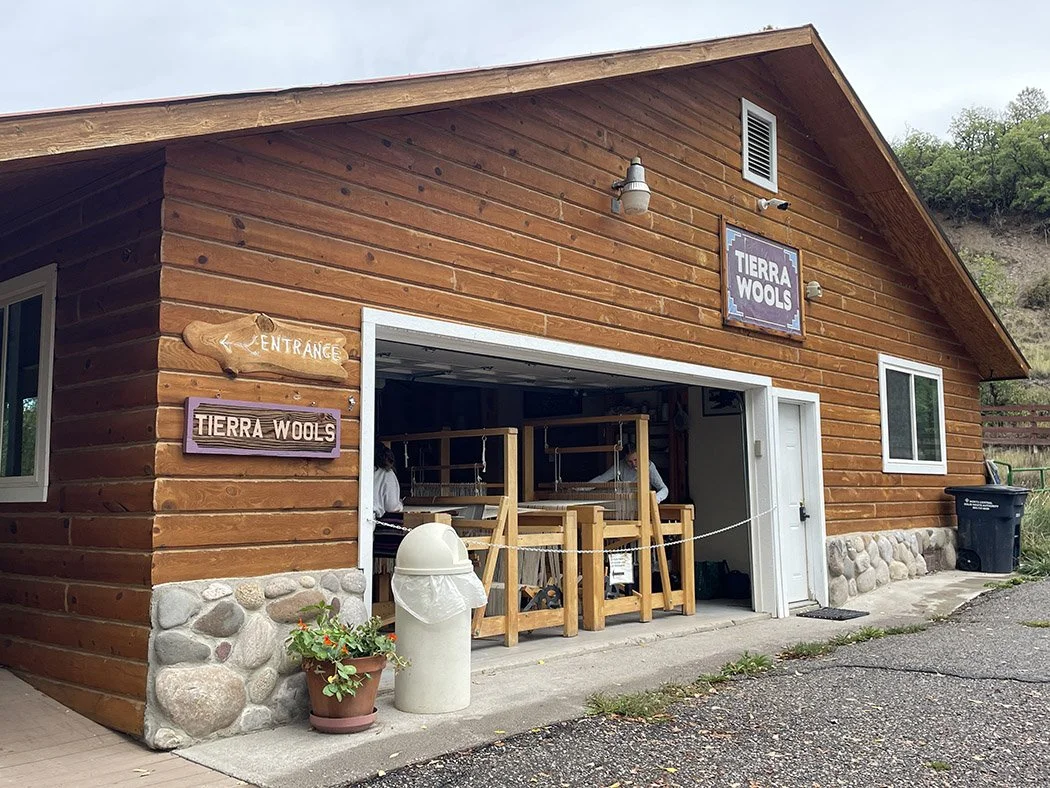
Tierra Wools is a shop, gallery, and teaching space. Here the garage door was open to the large teaching space with a handful of students taking a workshop
The rug detail below is of a piece by Molly Manzanares, one of the owners of Tierra Wools. This is not a textile I would ever consider putting on the floor because it is so beautiful, but it is an example of some of the geometric forms often used in this tradition of tapestry textiles.
Detail of tapestry by Molly Manzanares of Tierra Wools
Advantages to weaving at a wider sett with thicker weft
The weaving is so much faster! Even weaving at 6 epi is markedly faster than weaving at 8 epi. The weft is so much thicker that the image builds a lot faster and before you know it, your textile is finished.
You can make small but very functional textiles quickly with tapestry techniques and rug-weight yarn. These sorts of textiles can be marvelous on top of furniture for runners and drink coasters. They can also be used to protect a surface. I use rug runners on the wide plastered window sills of my straw bale house to protect the plaster from abrasion from plants and dogs.
Learning how to use rug-weight yarns for table textiles
I have an online class that addresses how to make rug-weight textiles. The advantage of having table mats and mug rugs made from thicker yarn is that they stay put and they absorb moisture. Wool sucks up water so having a decorative mat to enhance your home and protect your furniture is functional and you’ll be happy to have a unique and functional piece you made yourself.
The Introduction to Rug Weaving course is a class where I teach a handful of tapestry techniques and then we use them in two projects. And then I’ll encourage you to use what you’ve learned to create your own designs.
The two projects in the Introduction to Rug Weaving course
This class uses Gist Yarn’s Dwella. If you can get this yarn, I highly recommend it, but if you can’t get it or have another yarn in your stash that works at 6 epi, there is information in the class about yarn substitution.
If you want to order the yarn that I demonstrate with in the class (Dwella), you can get the course plus the yarn in a kit directly from Gist Yarn.
Yarn substitution
The Introduction to Rug Weaving course uses Gist Yarn’s Dwella. If you can’t use this yarn, there is information in the class about yarn substitution. I did a lot of searching for appropriate substitutions for Dwella and I didn’t find any I liked as much as Dwella, but I did find some that are beautiful and will work well.
The best two yarns to substitute that I found were:
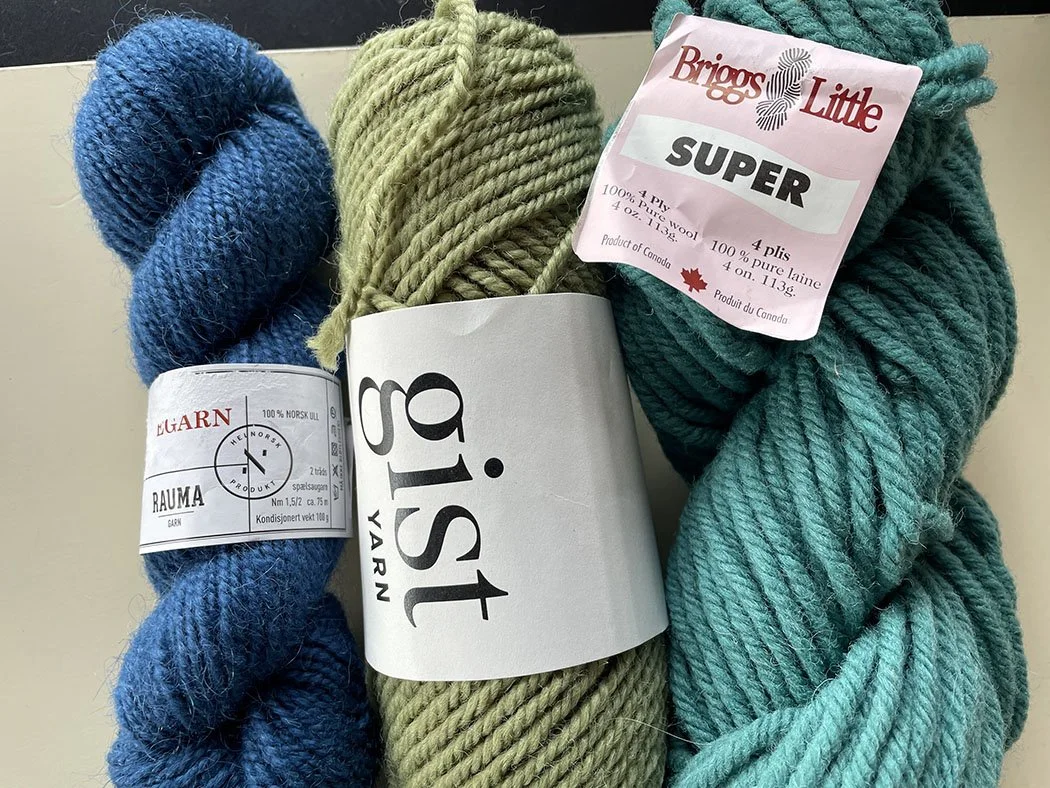
Rauma Ryegarn is a Norwegian yarn that I really liked. It is very firmly spun and thin enough to work at 6 epi. I’d like to test this yarn further for a rug that gets a lot of traffic because I think it would stand up to that abuse.
Brown Sheep Lamb’s Pride Bulky. Many Diné weavers use a thinner version of the Brown Sheep yarn for their gorgeous textiles. Those pieces are mostly hung on the wall, but this yarn does hold up to floor use I think in part because it is 15% mohair (85% wool). In fact, my grandfather’s rugs were all woven with Brown Sheep Top of the Lamb.***
I tested some others and you can find the results of those in the class. One was Taos Wools rug yarn. I love this yarn and it is fantastic for rugs. It doesn’t work at 6 epi unless you have a rug loom (a walking loom for example) and can beat really hard at a high warp tension. But it is lovely at 4 or maybe 5 epi and because it is hand-dyed you won’t get the effect of this yarn from any other source.
Rauma Ryegarn in skeins. I purchased this yarn from The Woolery in the USA but it is available from many stockists.
Lamb’s Pride Bulky and Dwella
My grandfather’s loom
My grandpa was a metallurgical engineer and he picked up weaving on the tails of my grandmother. He soon had some large looms and was weaving yards of fabric. But when he completely retired and moved to my hometown of Gallup, NM, he bought a Harrisville Rug Loom and started weaving shaft switching rugs on it. He wove hundreds over the next couple decades.
My grandfather weaving rugs on the Harrisville rug loom sometime in the 1980s
The same loom in my Santa Fe studio in 2013
You do not need a loom like this to weave rugs, but if you want to weave very large ones, I’d recommend it! Most looms made for household use (jack looms) are light and won’t hold the sort of tension you need for rugs. It is also advantageous to have either a countermarche or counterbalance mechanism for rugs or tapestries. The looms pictured in the Tierra Wools photo above are counterbalance walking looms. This is a simple mechanism that works very well for tapestry. The Harrisville rug loom is a 4-shaft countermarche loom. It can manage other weave structures or as my grandfather did, have a shaft switching device attached to create images which are mostly weft-faced but not tapestry.
Do you have other rug weight yarn suggestions that might work at 6 epi? Let us know in the comments!
*Of course a rug can be hung on the wall and you can also weave something never intended for the floor out of thicker weft. These generalities are not necessarily important, but it is important to get past our assumptions and realize we can use tapestry techniques to weave rugs that are functional.
**There is a functional question here. I used to be an occupational therapist so I’m very sensitive to having things on the floor that are going to cause people to trip. A lightweight piece of fabric on the floor is just a tripping hazard and will at the very least need some sort of grippy mat to stay put. A thicker and therefore heavier textile is much more suited to being walked on.
***I do not believe Top of the Lamb is generally available to the public, but you can get it at trading posts on the Navajo Nation. I believe it is slightly thinner than Lamb’s Pride worsted.